Compilation of audio and visual recordings documents Siberian Latvian culture

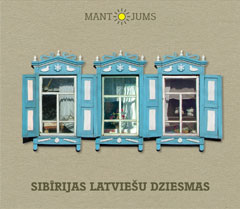
Sibīrijas Latviešu dziesmas

Latvians are scattered throughout the world for various reasons. One of the most remote parts is Siberia. The first Latvians ended up in Siberia in the middle of the 19th century as deportees, later many emigrated to the region hoping to start a new life with the promise of cheap or even free land. In the 1940s and 1950s the biggest influx was those who were deported to the far east by the Soviets. Consequently, Latvians can be found in villages and towns all over Siberia.

Assimilation into the local Russian and other national communities was inevitable. A large proportion of descendants of the original Latvians and Latgalians do not speak their native language or remember traditions, although there have been a few very resilient villages where the culture has survived well into the second and third generations. It is their story that is presented in the audiovisual collection Sibīrijas Latviešu dziesmas.

Since 1975 individual enthusiasts from Latvia have been keen to document for future generations the culture and language of these stalwarts who, defying all odds, still not only speak the language of their forefathers, but also have a mental repertoire of their cultural heritage.

Sibīrijas Latviešu dziesmas is the result of many decades of meticulous work, criss-crossing the Siberian landscape during expeditions to these far-away villages. The beauty of this double-disc edition is the audio and visual elements. Not only can you listen to the compact disc and follow the words of the songs in the liner notes, you can also read the translation in either English or Russian. But the best way of capturing the mood of the Siberian villages is the DVD, as the audio format alone can’t conjure up the image of the singers in their home setting.

The audio tracks—52 in total—show the diversity of songs in Siberia. Some are exact replicas of the folksongs or popular songs (ziņģes) still heard in Latvia today, others have variations on the text and melody. Some, it seems, have “frozen in time” and are songs that were sung in Latvia more than 100 years ago and have since changed their form. Other songs are a merging of traditional Latvian and local Russian songs. Others still have been “brought over” to Siberia during the past decades, as teachers from Latvia who have come to these villages have passed on their cultural knowledge.

The liner notes are particularly informative as they give a descriptive overview of the villages, the different ways each was settled and their fate. It’s also interesting to learn from the liner notes about the different people who have been involved in the expeditions to Siberia through the years and the films and books that have been made about the region. An outline of contact with Latvians from Latvia (or lack of it because of Joseph Stalin’s and later repressions during the Soviet era, where virtually all contact was cut off) over the years is also valuable, sketching in the timeline as well as the ebb and flow of Siberian Latvian village life.

Many of the women singing on the DVD and CD have since passed away, so we are lucky to be able to hear the legacy of this generation before it fades and becomes a distant memory. For various reasons, the DVD leaves one with an uncanny feeling. Here we have modern technology that has captured, almost intruded upon, and documented these elderly farming folk, almost in the manner of a Discovery Channel film, but the object of this documentary is Latvians. The oddest feeling comes over you when you see these women, looking pretty much like any scarfwearing, toothless peasant women from a poor farming community somewhere in Russia. But when you listen closely to the text, you realise that you actually recognise the song! The melody may be different and the singers’ deep, monotonous voices may make it slightly more difficult to recognise, but once you get it, a feeling of sisterhood overwhelms you. Our folksongs are one of our main unifying links—whether we sing them in the heat of the Australian sun, or in the Midwest of the United States, in busy smog-filled Shanghai, in the fields of Zemgale or in these remote Siberian villages.

These are all our people, scattered the world over. This realisation overwhelms because with it comes the duty to not let these songs fade. These songs, and the traditions that go with them, accompany a world-view. If this world-view is forgotten, we will merely become one of the many cultures in the world that have been and gone over the centuries.

So wherever we may be, let’s immortalize these songs by documenting them. But not only that: Let’s teach them to the next generation, and let’s not forget to sing them ourselves and learn new ones every year, so that by the end of our lives we have a mental repertoire like these old folk, the Latvians in Siberia.

Details

Sibīrijas Latviešu dziesmas

Various artists

Upe tuviem un tāliem,  2009
Daina Gross is editor of Latvians Online. An Australian-Latvian she is also a migration researcher at the University of Latvia, PhD from the University of Sussex, formerly a member of the board of the World Federation of Free Latvians, author and translator/ editor/ proofreader from Latvian into English of an eclectic mix of publications of different genres.

Activist, businessman Brunis Rubess dies at 83

Brunis Rubess, a Latvian-Canadian businessman and community activist who became an advisor to the Bank of Latvia, died Dec. 23 in Rīga. He was 83. 

Rubess was born Dec. 21, 1926, in Rīga, according to the online encyclopedia Latvijas ļaudis uz 21. gadsimta sliekšna. His parents were Nikolajs and Milda Rubess.

He attended elementary school (Rīgas pilsētas Kr. Barona 2. pamatskola) and high school (Rīgas pilsētas 1. ģimnāzija) before World War II broke out. While serving in the Januma Regiment of the Latvian Legion, Rubess was captured by the British and ended up in the prisoner-of-war camp in Zedelgheim, Belgium. In the camp Rubess was the editor of the newspaper Laika Griežos and the humor magazine Atskabarga. He completed his secondary education in Latvian high schools in German refugee camps in Oldenburg, Augustdorf and Muenster. From 1948-1953 Rubess was active in the refugee camp in Augustdorf, lending a hand with education, editorial work, in the scouting movement, and as a member of the Latvian National Council (Latviešu Nacionālā padome).

After immigrating to Canada in 1953, Rubess worked in the insurance industry before he started his business career at Mercedes-Benz of Canada. From 1962-1964, he worked at Volkswagen Canada in sales and marketing. Rubess then took a position with the Boston-based management consulting firm Harbridge House, which took him to the United States, Germany and back to Canada.

In 1972, Rubess returned to Volkswagen Canada as president. From 1988-1991, Rubess was senior director for Volkswagen in Munich, Germany.

After Latvia regained independence, Rubess from 1992-1998 served as a member of the Board of Governors for the Bank of Latvia, the country’s central bank. From 1999 on, he continued as a consultant to the bank.

Rubess married Biruta Broks in 1953 and the couple had three children, Baiba, Baņuta and Balvis. Biruta died in 2002. In recent years, Rubess’ partner has been Aija Ebdene.

Rubess was an active member of the Latvian community in Toronto. In 1959 he helped organize the first Youth Festival, followed by the 2×2 Latvian cultural immersion seminars, which were initiated by a group of active Toronto Latvians under Rubess’ leadership. Rubess also was involved with the Latvian Foundation and with the Latvian Canadian Cultural Centre in Toronto.

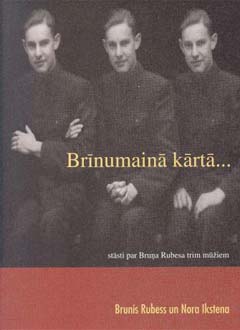
Rubess’ autobiography, Brīnumainā kārtā…, co-authored with writer Nora Ikstena, was published in 1999.

Rubess was also a philanthropist. Through the Vitols Foundation, he has supported Latvian students with the Biruta Rubess scholarship.

Rubess received the Order of Three Stars (Triju zvaigžņu ordenis), Latvia’s highest civilian honor, in 1997.

The funeral is scheduled at noon Jan. 16 in Rīgas Meža kapi, Aizsaules ielā 2, Rīga. In place of flowers or wreaths, memorials may be directed to the “Brunis Rubess piemiņas stipendija” administered by the Vītols Fund in Latvia.

(Updated Jan. 2, 2010, with funeral and memorial information.)

Brīnumainā kārtā

Brunis Rubess’ autobiography Brīnumainā kārtā… was published in Latvia in 1999.

Daina Gross is editor of Latvians Online. An Australian-Latvian she is also a migration researcher at the University of Latvia, PhD from the University of Sussex, formerly a member of the board of the World Federation of Free Latvians, author and translator/ editor/ proofreader from Latvian into English of an eclectic mix of publications of different genres.

Exhibit of émigré music recordings goes on display in National Library

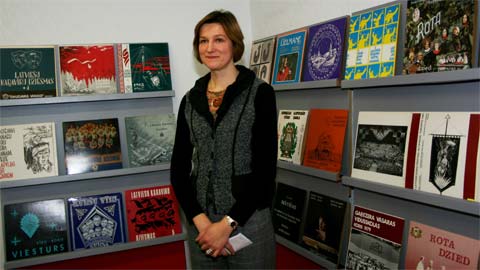
A sizable collection of vinyl records donated by the Latvian Canadian Cultural Centre in Toronto—a total of around 200 LPs—went on display Dec. 16 in the Latvian National Library in Rīga.

The exhibit, “Trimdas ritmā,” is a Christmas present from the library to its readers, according to Zane Grosa, head of the audiovisual section of the library’s Music and Audiovisual Department.

“We only had a few records in the library from the émigré collections to date, so we are very thankful to have received this donation as it shows the diverse cultural life of the émigré Latvians,” Grosa said.

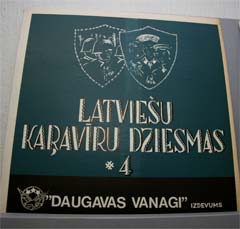
The collection contains music of different genres from the 1960s and 1970s. All the LPs were produced outside Latvia during the exile years. Among them are recordings by Ilmārs Dzenis, Trīs no Pārdaugavas and Čikāgas piecīši, as well as LPs with Latvian soldiers’ songs, theatrical productions, and choir and song festival performances.

The collection can be viewed in the exhibition hall of the Latvian National Library, Barona iela 14, Rīga, daily from 11 a.m. to 5 p.m. until Jan. 30.

Zane

Zane Grosa of the National Library of Latvia poses with the exhibit of vinyl recordings issued in the exile. (Photo by Ligita Ieviņa)

Karavīru dziesmas

A recording of soldiers’ songs, released by the Daugavas Vanagi, is among albums in the exhibit. (Photo by Ligita Ieviņa)

Daina Gross is editor of Latvians Online. An Australian-Latvian she is also a migration researcher at the University of Latvia, PhD from the University of Sussex, formerly a member of the board of the World Federation of Free Latvians, author and translator/ editor/ proofreader from Latvian into English of an eclectic mix of publications of different genres.