If you ever want to feel like a total rock star, host a dziesmu svētki (Latvian song festival). Yes, the majority of your time leading up to the event will consist of unglamorous sweat and tears, sleepless nights poring over non-profit status applications, budget woes, marketing plans, and music selections, but for one brief moment, at the very beginning, you’ll go through one of the most ego-stroking experiences I have ever known: the hotel tour.
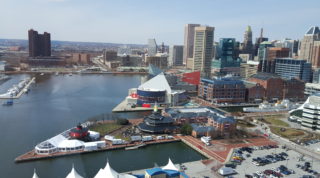
In March I, along with a small group of my fellow organizing-committee members, toured a few high-end hotels in Baltimore in search of a host venue. At one, the tour led us to a luxurious penthouse suite larger than my house. The view was phenomenal; we stared down at the ant-sized tourists a few dozen stories below as they made their way along the tall, historic ships in the beautiful Inner Harbor. We could make out Fort McHenry in the distance, and I wondered if Francis Scott Key’s work would have improved or suffered had he been privy to this penthouse view during the fort’s bombardment. “And the rockets’ red glare (Is that champagne? Wait, where was I?) / The bombs bursting in air (We have a jacuzzi in the third bathroom? Never mind, focus, Francis!) / Gave proof through the– (Did room service just bring us fresh crab cakes? Splendid! I’ll get back to this poem thing later…).”
Our tour continued to the club lounge, where my attention was captured by a roped-off display of tote bags full of Maryland-themed goodies and a beautiful array of puff pastries. “Oh yeah, that’s for you,” our guide said with a sly grin. “Our pastry chef heard you were coming and he whipped these up specially for you.” The tour concluded with complimentary lunch in the hotel restaurant. I could get used to such VIP treatment.
But everyone knows that things are not always what they seem. As our guide showed us the ballroom, he bragged about the number of large events the hotel could host simultaneously. We might have been impressed, had the guide himself not confessed that it meant our group would not get the full attention it deserved, as the hotel would try to cram other groups into every unclaimed space and would not allow us to decorate or congregate in central areas. The illusion of majesty further shattered over lunch when he asked what our main concerns were, but then shrugged them off as if to say, “Deal with it.”
Ultimately, we wound up choosing a different hotel – one that didn’t resort to pastry offerings and bags of swag to woo us, but instead spoke for itself. The Renaissance Harborplace Hotel fit perfectly with the Latvian song festival spirit, winning us over with genuine hospitality, practical solutions, and honest enthusiasm for our event (even the hotel’s chef excitedly offered to work with us on serving up Latvian dishes). Add to this winning recipe a prime central location and idyllic gathering areas, and we didn’t even have to think about it.
Sometimes a place just feels right, and all the personalized pastries in the world cannot counter that. On a larger scale, I feel the same way about about Baltimore assuming the role of host city for next summer’s XIV Latvian-American Song and Dance Festival. Baltimore is genuine. Those of us who have experienced what it has to offer love it. And we have full confidence that everyone else will love it too. We just need people to get there.
The festival’s organizing committee has no illusions that the public’s perception of Baltimore is every bit as glowing as our own. Last fall we conducted a small opinion poll among board members of two Latvian-American organizations. The poll offered up such questions as “In which of these cities would you most like to attend a dziesmu svētki?” Of the three cities listed, Baltimore came in dead last. On every question. Often by a landslide. Even after the organizing committee had officially decided to hold the festival in Baltimore, we received an urgent email from a concerned (non-local) citizen demanding that we switch the city. “Surely there’s a better location somewhere on the East Coast!”
Actually, no, there isn’t. We checked.
As mentioned in the previous entry of this series, finding an ideal location for a song festival is difficult, due in part to the scarcity of appropriate, available venues, particularly for the folk-dancing show. We began by considering major East Coast cities with sizable Latvian populations. New York was expensive. Philadelphia’s venues were in undesirable areas. Boston’s hoped-for venues were already booked. Even Charleston, South Carolina, was briefly considered due to intel from a Latvian familiar with the venues there, but it was just too far from any other organizers (maybe next time?).
From the very beginning, Washington, D.C., the home of most of the organizing committee, was in the lead, but hanging on by a thread: it had a million factors working against it, including possible hotel overcrowding due to the Independence Day holiday (the busiest weekend for the nation’s capital), tiny hotel ballrooms that would require evening events to be held in astronomically expensive outside venues, and a folk-dancing arena with virtually no backstage area and relatively limited seating. In essence, a D.C. festival would have no room for error, and would only work if barely anyone showed up – an utter dream for a committee of first-timers hell-bent on ensuring the future of the Latvian American song festival tradition.
It’s not clear exactly how Baltimore took root as a serious candidate, but I do remember the first time I heard the idea. It was shared in passing years ago by my friend Inga Bebris when we were kids. “If D.C. ever hosts, we should do it in Baltimore,” she said. “Just think about it – everything we would need is right there in the Inner Harbor. And at a fraction of the price of D.C.” it turns out Inga might be psychic, because roughly a decade later she was serving as the ticket coordinator for a song-festival organizing committee that was rapidly reaching the same conclusion she had reached years ago.
As we moved into the new year and our city selection process gained steam, the reasons to pick Baltimore piled up. Local institutions were welcoming, from the chamber of commerce to hotels and venues (which, most importantly, were available on the dates we were eyeing). Most potential festival locations were within walking distance, and non-walkers could easily catch the Charm City Circulator tourist bus for a convenient free ride to the show. The area was full of family-friendly things to do between performances, from the astonishing National Aquarium to the historic home of the Star Spangled Banner, Fort McHenry. Food options were virtually limitless, from quality quick bites like Noodles & Company and Chick-fil-A for dancers on the go, to Maryland’s signature Chesapeake Bay crab cakes, available at legendary Phillips Seafood. The icing on the cake was BWI airport: ranked one of the world’s best airports and connected to the Inner Harbor by a quick and easy Light Rail ride, it was also the second-least-expensive major airport in America, a sure-to-be welcome bit of news for folks looking to fly in from the Midwest and West Coast.
Some people were still pulling for a D.C. plan to work out, but to many of us locals, the choice was obvious. This point was made abundantly clear one day in late January, when a couple of us sat down with a handful of leaders from the D.C. Latvian community. We carefully laid out the pros and cons of both D.C. and Baltimore. When we asked the group which city they thought we should go with, some looked back at us like we had two heads. “Baltimore, obviously. Why are we even discussing this?” they responded. But what of the opinion poll suggesting non-locals would prefer to come to D.C.? These concerns were quickly waved off with eye rolls, an affirmation that Baltimore is no difference than any other major U.S. city, and a baseball movie reference: if you build it, they will come.
A couple weeks later, on the very same day that we gazed down from the swanky VIP penthouse suite while munching on gourmet treats, one of the festival’s out-of-town organizers described the reaction of some Latvians in her own community when she enthusiastically told them about the upcoming festival. Her interaction had fared very differently than our meeting with the D.C. elders.
“Where?” they had all immediately asked with excitement. But at the mention of Baltimore, their faces had instantly frozen, then dropped. “I guess that’s where we’ll go, then.” While it was a good sign that they still planned to attend, the lack of enthusiasm was less than ideal.
I asked the storyteller and first-time Baltimore visitor how we could best convince skeptics to make the journey and to thus experience what she was experiencing. “Pictures! Lots of pictures,” she answered immediately. She gushed at how pleasantly surprised she was by the city’s beauty and vibrance. If people could see everything that Baltimore had to offer, they would get excited and be driven to visit as well. With this in mind, we created an entire section of the festival website devoted to Baltimore’s transportation, neighborhoods, and attractions, complete with photos. We included a rotating collection of Baltimore fun facts on the home page (for example, did you know that the popular Food Network show Ace of Cakes was filmed in Baltimore, and that its starring bakery is still in operation and open to visitors?). And last month organizing committee member Aija Moeller made us of our inaugural Facebook LiveVideo post to give folks a brief walking tour of the Inner Harbor area surrounding the festival hotel. We committed so wholeheartedly to Baltimore promoting that one organizing committee member asked whether we were organizing a song festival or a Baltimore festival.
Still, during several months of an active website, very few people had ventured to the “Location” section of the festival website, leaving us to wonder whether Field of Dreams may have been wrong: if you build it, but they haven’t seen the promotional photos, will they really come?
We got our answer this past week, when reservations became available for the festival hotel. It was our first opportunity to get a sense of potential attendance and enthusiasm. It turned out that reservations poured in faster than any of us could have imagined, and we found ourselves badgering the hotel to continually add more and more rooms to our block. I guess our worries about Baltimore’s rep had been unwarranted, if for no other reason than that Latvians’ energetic love of song and dance outweighs all other concerns.
We’re glad that you all are excited about the song festival, but I also strongly believe that, once you’ve been here, you will be excited about the Baltimore festival as well. Seeya in Baltimore!
“The Making of a Dziesmu Svētki” is an ongoing series documenting the behind-the-scenes process of organizing a Latvian song and dance festival.
The XIV Latvian-American Song and Dance Festival will take place in Baltimore, Maryland, from June 29 to July 3, 2017. For more information, please visit www.latviansongfest2017.com or write to info@latviansongfest2017.com.