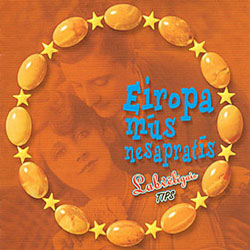
Latest by Labvelīgais Tips lacks classic song

Eiropa mūs nesapratīs

One of the few things left to depend on in this world is the yearly arrival of a Labvelīgais Tips album every April 1. For the last seven years, each April Fool’s Day brings another release from this ensemble, making them probably the most prolific band in Latvia. This past April 1 came Eiropa mūs nesapratīs, a collection of 14 songs.

Labvelīgais Tips is a band that is hard to categorize. Humor is a major part of their arsenal, and many of their songs are in the schlager style (though a more "modern" interpretation of that form). Their songs are about simple topics, finding the humor in everyday occurences. The band itself is larger than your everyday rock band: besides the usual guitar, bass and drums, they add trumpet, flute and accordion, not to mention a string quartet.

I only became a fan of Tips upon the release of their "best of" collection in 1999. I had heard a few of their songs prior to that, but I suppose I wasn’t yet able to get the joke at that point, as Labvelīgais Tips have a very unique sense of humor that takes a certain mentality to appreciate. But after listening to the collection, and hearing tales of omnibuses in people’s backyards and brothers in Chicago, I was hooked. And though I didn’t get all the jokes (it seems most are geared towards people who have spent their lives in Latvia), I began to listen to them much more frequently. I also picked up their 2000 release Atkārtot!, which was another great collection of songs.

Surprisingly, I found Eiropa mūs nesapratīs a bit disappointing. Though the classic Tips "sound" was there, after listening to the album a number of times it seemed to me that something was missing: a truly classic Tips song. The "best of" collection was full of these classic songs, and Atkārtot! added a few more, but there aren’t really any songs on Eiropa that can stand alongside their earlier material. Not that the songs are bad: All the songs are solid, but there aren’t any songs that I would look forward to hearing if I were to see these guys in concert.

The songs continue to have an even more eclectic sound, with influences ranging from reggae to Latin. "Koka klucis Konstantīns" sounds like a combination of Latin and lounge music. The song "Pazudis ir miegs" also has a Latin sound, but also strikes me as that "Russian-Latin" sound that many Raimonds Pauls songs in the 1970s seemed to have.

The old Latvian standard, "Augstu laimi un prieku" (the "Lai dzīvo sveiks!" song), is redone a la Tips, this time in a Mexican mariachi style.

Many of the songs here defy description, which is part of the charm of Labvelīgais Tips, though some may be turned off by the constant changing of styles. There is always some new sound, some new surprise on each of their records. Even the lyrics defy description, as some of the songs left me scratching my head and thinking, "What was THAT about?" Songs such as "Smilšu krasas portfelīts", "Dubļi mani dubļi" and "Tu, mana ģeometriskā" either show off the creativity of the band or leave some thinking, "These guys will write a song about anything."

"Eiropa mūs nesapratīs" is a song in waltz style that tells the story of a Latvian guy and his great-great-great-great-great (and a few more greats) grandfather, both of whom have been to neither Germany nor Denmark and don’t have any Hungarian or Irish friends. This probably alludes to the fact that to truly appreciate and understand Labvelīgais Tips you have to be a Latvian living in Latvia.

The packaging of this album, though it looks nice, also is lacking in a few ways. Particularly annoying is the absence of lyrics. Having those would make a lot of their jokes easier to understand. Also, though the members of the band are listed, nowhere is it written what they do or what instruments they play.

Maybe the need to release an album every year has started to take its toll and isn’t giving them enough time to properly craft an album. Many of the songs wind up sounding a bit repetitive, often repeating verses and choruses a few more times than necessary. Perhaps the reason that Atkārtot! was such a good album was that it was two years after the last recording of new material.

Die-hard Tips fans will like this record. I don’t dislike it, but don’t think it will be making it into my CD player with any great frequency. If you don’t have any Tips recordings, this is probably not the one to start with. I’d recommend starting with the "best of" release. If you really like what you hear there, you might just like Eiropa mūs nesapratīs.

Details

Eiropa mūs nesapratīs

Labvēlīgais Tips

MICREC,  2001
Egils Kaljo is an American-born Latvian from the New York area . Kaljo began listening to Latvian music as soon as he was able to put a record on a record player, and still has old Bellacord 78 rpm records lying around somewhere.

3×3 in Rucava: A personal perspective

Our family just attended our first 3×3 camp in Latvia. We had already had a great introduction to the way 3×3 works back in January 2000 when we braved the Australian summer heat and headed off to the camp in Falls Creek, Victoria, for what proved to be an exhilarating experience that we wanted to repeat in the near future.

At the time we were rather exhausted as we had ventured to the camp with an active four-year-old and a (barely) one-year-old toddler. Our children are now slightly older and as we have already started to forget our “trials” in 2000, we felt ready for something on a grander scale.

The 3×3 camp in Rucava was to take place July 15-22 in the southwestern Latvian town close to the Lithuanian border. We had been informed that we would be transported to the camp from Rīga by bus on the morning of the 15th. So we headed off to Dailes teātris at 10 a.m. The first bus drove off without a hitch. But tragedy had struck the second bus—the one we were waiting for—on its way from Rucava to Rīga. We were deeply shocked to learn the driver and his young son died when the bus collided with a train at the Kalvene railway crossing and rolled over. Even more astounding was the news that the Rucava 3×3 camp leader, Dace Jurka, had originally planned to be on the bus but had changed her mind at the last minute.

Such an eerie introduction to the camp left many wondering about fate, God and the powers that be.

This was the 22nd Latvian 3×3 camp held in Latvia. Many of the people in charge looked like they already knew each other well and greeted each other with warm hugs and smiling faces. Seeing as we were true newcomers (as were most of the other camp participants), we entered the Rucava school grounds with a touch of apprehension but a strong feeling that we would very soon feel at home here.

We had chosen to board with one of the locals. We were immediately whisked away to the other side of Rucava (a two-minute drive away!) and introduced to our “landlady” for the week: a homely, smiling rucavniece who showed us to our quarters. We had stayed with friends and relatives in the countryside before so we were not surprised at all by our accommodations. Our main criteria for a pleasant stay is hospitality and a smiling face from the host. We immediately felt this warmth from our host, so we were certain we had been put together with the right person.

The walk back to the camp at a brisk pace would take 20 minutes. But with our two dawdlers in tow—who had to inspect every cow, dog, chicken and cat on the way—the walk took a bit longer. Our motto: the more fresh country air we breathe, the better!

We knew a few people—all “Westerners”—but in no time at all we had chatted to strangers with smiling faces and warm hearts, keen to meet this Latvian family from “down under.” It did not take too long to feel like part of a big family. A great way to meet people was at mealtimes. I don’t think we ever ended up sitting next to the same camp participant twice. I hope the reason for this was not our active children who scared mealtime “neighbors” away! Every mealtime proved to be an introduction to another soul, some keen to chat, others more reserved. The 3×3 organizers actively promoted this by encouraging everyone to greet each other using the personal pronoun “tu” instead of “Jus” in conversation, to wear our name tags at all times and to deliberately find a new person to sit next to each mealtime.

Some statistics may be worth mentioning at this point. There were 426 people in the Rucava 3×3 camp, including all the participants, organizers, cooks, cleaners and local rucavnieki who attended. Of these, 102 participants were locals while the remainder came from all four corners of the earth, some from the United States, Canada, Magadan (in far eastern Russia) and Australia, but most from within Latvian borders.

The first evening was spent in the Rucava open-air amphitheater, enjoying the talents of the locals, both young and old. Particularly impressive were the elderly Rucava ladies (our host was among them) singing ancient local songs in their national costumes. The festivities came to a premature halt when nature took over. A freak storm—a sudden wind followed by a full thunder and lightning extravaganza—put on a grand show that was later described by camp organizers as consistent with the theme of the camp, which was “fire.” We all later marvelled at the pine trees that had been struck by lightning only a couple of metres from the camp buildings.

The next six days of this camp raced by like a whirlwind. All I remember is that at a constantly hurried pace I was forever either handing my children over to the camp kindergarten (for three- to six-year-olds), racing to an ievirze (as the camp activities are called), being transported somewhere by one of the camp’s buses, eating yet another delicious meal or falling exhausted into bed after a full day’s activities (after killing an army of vicious mosquitoes that had taken us hostage in our bedroom).

The ievirzes at this 3×3 camp, about 30 in all, were many and varied: floristry, jewelry making, felt toy making, the art of ancient Latvian weaponmaking, theatre, discussions about Latvian politics, the Latvian oral history project (mutvārdu vēsture), a seminar focusing on family issues led by Māra Tupese and Līga Ruperte, Latvian cooking, literature, various folklore topics and many, many more activities. It would have been a hard task not to find at least one activity that sounded interesting!

In addition to all these ievirzes, on offer were excursions to a list of interesting sights in the Rucava region: the Latvian brumbies (savvaļas zirgi), the local “holy spring” (svētavots), Pape beach for regular swims, and a half-day excursion to Lithuania, including the dolphin show near Klaipeda and the amber museum in Palanga. However, the most interesting of these excursions was the trip to Nida beach where the organizers had planned such a varied program that it was impossible for anyone to complain about boredom: a sports carnival, a folkloric performance by Liepaja theatre actors, the opportunity to join local fishermen when they hauled in their day’s catch, and a feast of fish soup and rye bread. The most moving of this afternoon’s activities was a theatrical yet deeply symbolic “uguns daudzinājums”—fire worship—as a climax to the theme of this year’s 3×3 camp.

Most of all I enjoyed the chance to exchange ideas about any topic under the sun with other participants young and old. Our children had a great time as well, playing with Latvian kids in Latvian, not English, as they are used to doing in their home country of Australia. It was also interesting to chat to Latvian teenagers (there were about 50 of them at the camp) and catch a glimpse of their world view.

Overall the whole family found this week to be a hectic yet extremely positive experience, one we would certainly want to repeat sometime in the near future!

Daina Gross is editor of Latvians Online. An Australian-Latvian she is also a migration researcher at the University of Latvia, PhD from the University of Sussex, formerly a member of the board of the World Federation of Free Latvians, author and translator/ editor/ proofreader from Latvian into English of an eclectic mix of publications of different genres.

Placenames may reveal Latvian ancestry

Thousands of tourists are streaming to the real Rīga this year as Latvia’s capital city celebrates its 800th anniversary. Those who can’t make the trip to Latvia might try searching for the Rīgas, or Rigas (without the diacritical mark), in their backyards.

Several places with the name of Rīga can be found in the United States, not to mention other Latvian-sounding sites such as Livonia or Baltic. And the United States isn’t alone: Similar sites can be found in Canada and Australia.

The Web offers online placename databases for several countries that can be used to find the spots.

Perhaps the best digital resource in the United States is the Geographic Names Information System, run by the U.S. Geological Survey. A search of the database for “Riga” turned up places or geographic objects in Connecticut, Kansas, Michigan, Missouri, New York, North Dakota and Virginia. The database is linked to Microsoft’s TerraServer database, allowing users to see USGS topographic maps and, in many cases, aerial images of places.

The places with Rīga in their name include:

  • A lake, a dam and a mountain in Litchfield County is western Connecticut. The mountain, Mount Riga, also is claimed by New York’s Dutchess County, which also has a Riga Lake.
  • A populated place in Trego County in Kansas.
  • A township, cemetery and a canal in Lenawee County in Michigan.
  • A populated place in Ripley County in Missouri.
  • A township and a school in North Dakota’s McHenry County.
  • A town in Monroe County in New York.
  • And a stream in Virginia’s Orange County.

But the database doesn’t reveal much if anything about the history of these places. While most of the places in North America that have names suggesting some tie to Latvia probably have little connection, a few do.

For example, Riga is a small town in the western New York’s Monroe County, southwest of Rochester. Established in 1808 in the breakup of the larger Town of Northhampton, the community historical committee on its Web site reveals nothing about why Riga was chosen as the name. Even documents such as J.H. French’s 1860 Historical and Statistical Gazetteer of New York State shed little light.

Another Riga, in southeastern Michigan’s Lenawee County, is a lightly populated spot where “For Sale” signs appear frequently. A visit to the community’s cemetery reveals that the town has been home for people of German ethnicity. The town also in 1990 was briefly considered for a low-level radioactive waste disposal facility, but was removed from a list of potential sites after it successfully sued the state of Michigan.

"Riga" placenames also are found in Canada and Australia.

Libau, a community in Canada’s province of Manitoba, does have links to Latvian history. The community, on the south end of Lake Winnipeg, is where a group of Latvian immigrants settled in the early 20th century to take up farming. Libau is the German name for the port city of Liepāja.

To the east of Manitoba’s Libau, on Lac du Bonnet, is Lettonia Bay. The community of Lac du Bonnet, southwest of the lake, was home to Latvian immigrants in the early 20th century.

According to Geomatics Canada, the province of Quebec is home to a Lac Riga and to a Lac de Riga. And in Ontario, near Sudbury, there’s a Riga Lake.

The South Australian State Gazetteer’s online version reports a homestead called Riga Downs.

Livonia is the name of the province that became part of modern Latvia. Quite a few Livonias can be found in the United States in Indiana, Louisiana, Michigan, Minnesota, Missouri, New York and Pennsylvania. But again, the story of why a place was named Livonia isn’t always clear. And when it is, the trail may not point back to Latvian ancestry.

For example, Livonia Township in Minnesota’s Sherburne County, northwest of the Twin Cities metropolitan area, apparently has little to do with the province. It was named instead for the wife of a judge who settled in the area in 1864, according to the Minnesota Historical Society.

The same is true for Baltic. In many cases, the naming of a place as Baltic-something probably has more to do with seafaring or with other lands that touch on the Baltic Sea.

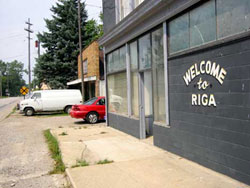
Riga, Michigan

An abandoned building in Riga, a small community in southeastern Michigan, bears a welcoming sign. The town is among the places in the United States with a name that suggests a Latvian connection. (Photo by Andris Straumanis)

Andris Straumanis is a special correspondent for and a co-founder of Latvians Online. From 2000–2012 he was editor of the website.