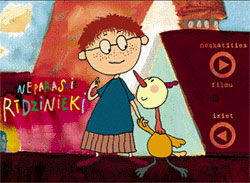
A cute adventure for Latvian kids with computers

Description of image

The CD-ROM includes an animation film and music.

Having never made much use of CD-ROMs before, much less never having watched a movie on CD-ROM, being asked to review the children’s animation film Neparastie rīdzinieki in this medium was a novelty for me. And not being particular technologically savvy, I did need help to install QuickTime on my computer to be able to watch the movie. Once that was done, however, I was able to sit back and enjoy the 26-minute long animation that was produced in honor of Rīga’s 800th anniversary and was first shown at celebrations this summer.

The film begins with a song and not much action. My first instinct was to think that many American-born children, having been brought up on action-packed and fast-paced movies and games, might find this particular film too slow. I, however, was enchanted.

The main character of the film, the young rooster Justiņš, is absolutely adorable. The little child he befriends is also cute. Together they have an assortment of adventures in "modern-day" Rīga. (One knows that it is the present because Riga’s 800th anniversary is mentioned.)

The film is like many other children’s films, featuring songs interspersed with dialogue. The five songs’ texts are by Pēteris Brūveris and music is by Valts Pūce. The songs are what I would consider very typical for a children’s film. My favorite was the last one, "Lai ir," which includes the lines “Lai ir, lai ir, lai putniem ligzdas ir, lai zvēriem alas ir, lai ļaudīm mājas ir. Lai ir, lai ir, lai visiem mājas ir un visiem savās mājās labi klājas!" (May the birds have nests, may the animals have caves, may the people have homes, may everyone have homes, and may everyone fare well in their homes).

And my favorite part of the film was when Justiņš and the child found themselves under Rīga, where they met the "root elves" of Rīga. These are the little (and very cute) elves who live under Rīga, taking care of the roots on which Rīga is built.

In addition to the film, the CD-ROM can be played as a compact disc on which one hears not only the five songs, but also another six songs written by many Latvian cultural luminaries. "Brīvības iela," for example, is written by Raimonds Pauls and Guntars Račs. "Jūras kalni man arami" is a folk song with musical adaptation by Imants Kalniņš. "Rīgas tilti" is by Zigfrīds Muktupāvels and Račs. The last song, "Dziesma Rīgai" (Song for Riga), is by Jānis Lūsēns and Māra Zalīte. These songs are performed mostly by the children’s chorus Knīpas un knauķi with some help from Muktupāvels and Juris Kulakovs. The film’s songs are peformed by Dace and Valts Pūce and Niks Matejevs.

I know of at least one adult who purchased this as a CD in Latvia this summer and loves the music. I, however, find it much better suited for the taste of children. Not being a big fan of synthesizer music, I was a bit turned off by its heavy use on this recording, particularly in the song "Jūras kalni man arami." Also, many of the songs’ lyrics are very repetitive—great for a young child who wants to sing along, but a bit dull for an adult. For example, in the song "Brīvības iela" it seems the chorus repeats an unending number of times. But, again, I’m sure that many young children would enjoy singing along to these songs.

As with many Latvian CDs today, the packaging is very attractive and the liner notes include all of the lyrics. However, no English translation or explanation is provided.

Overall, I think that both the movie and the music of this CD-ROM would be enjoyed by children in preschool and kindergarten, and maybe a bit older. Neparastie rīdzinieki would make a lovely gift to a Latvian family with young children.

Details

Neparastie rīdzinieki

Roze Stiebra, director

Dauka,  2001

Notes: Note: Requires minimum of any Macintosh or Windows 95/98/NT/2000/ME/XP computer with Apple QuickTime software installed.
A lively, danceable album from Maskačka

I was quite excited by the prospect of hearing the first album by Maskačkas spēlmaņi, Zirnīšiem skaisti ziedi. Having heard some of their tunes previously on the Internet, I was ready to really enjoy this one in full length.

Maskačkas spēlmaņi, led by Ansis Ataols Bērziņš, hails from from the Maskavas district of Rīga, south of the Old City and east of the Central Market along the Daugava River.

The album begins with some very good songs that got me tapping my feet and humming along. “Meitas mani melli sauca,” the first song, had that really good beat and style that makes you want to bounce along. So did “Nadūd, Dīvs, nadūd, Dīvs.”

Other tracks that I really enjoyed were “Moza beju, gonūs goju,” “Trīs putan dižan dzied,” and “Teci rikšiem, kumeliņi.” Being a Latvian folk dancer, my feet are always looking for a good tune. Maskačkas spēlmaņi do deliver in that category, giving the listener many songs that could easily be made into folk dances or just enjoyed at a party.

I also really enjoyed listening to one track, “Pats precieju, pats atvežu,” that consisted of only kokle and voices. It was close to musical styling of Andris Kapusts of the folk group Grodi. The kokle playing is clean and precise, as are the voices.

One song that got my attention was “Tālu gāju sievas ņemt.” The refrain is in Russian and my wife, who is from Latvia, says it is part of a Russian soldier’s song. Historically, this song has value in that it clearly reflects the musical and linguistic influences of that era. But details on that in the liner notes might be helpful.

The musical and technical ability of Maskačkas spēlmaņi is very good and the recording is also of good quality. The majority of the tracks is very folksy and upbeat and makes me want to dance and sing along to the tunes.  The instrument mix makes for a very diverse sound and creates a good balance of high notes and low notes. The accordions (bayan and ieviņa) have a good driving sound and the drum really keeps the beat going. Being an accordion player myself, I really enjoyed the songs that utilized the Latvian-made ieviņa button accordion. The honking bass really adds to the folksy sound the band is attempting to achieve. The cītara rounds out the sound and the violin is able to create a good counter-position to the accordion. The trejdeksnis and other percussion also help to bring the sounds all together.

The liner notes are quite nice in that they provide the words to the songs, just in case you like to sing along—like I do. And given that Maskačkas spēlmaņi sing many tunes in the Latgalian dialect, non-speakers of that will find the words to be of great help. For non-Latvians, some brief liner notes in English would also have been good.

I would have liked to have more information about the group itself in the liner notes, but Maskačkas spēlmaņi provide a Web site with information so that listeners may “get the scoop.” I would encourage people to visit the site and see their pictures. I always like to see who is playing the music I’m listening to.

Members of the band, besides Bērziņš, are Jānis Barons, Zane Kriumane, Sandra Kuzmina, Ieva Medene and Paulis Paulins.

Overall, this first album by Maskačkas spēlmaņi is very nice. Listeners will like the catchy tunes, and dancers will enjoy the driving beat.

Details

Zirnīšiem skaisti ziedi

Maskačkas spēlmaņi

Maskačkas spēlmaņi,  2001

Unpredictable Kalniņš pens music for son’s group

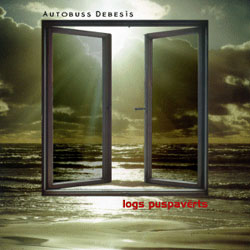
Logs puspavērts

Imants Kalniņš is one of the most adept composers in Latvia. Not confining himself to any one style, he can move between symphonic work (a great example being his “4th Symphony”) to film work (the music to “Pūt, vējiņi!”) as well as to popular music. He brings his style to every form of music that he composes, making it at once unique, but also recognizable. One never knows what to expect next from him.

One of his most recent projects is writing the music for the group Autobuss Debesīs, whose first album, Logs puspavērts, came out earlier this year.

Autobuss Debesīs is a new group, but one that I liked after hearing just one song. I had heard the song “Sitiet bungas, mani mīļie” on the MICREC release Superizlase and was anxiously waiting to hear more from the group. Though that song isn’t on this release, there are many other great songs that make this record a good listen.

Of course, it is not just Imants Kalniņš that made this record possible. The band is made up of Kalniņs’ son, Marts Kristiāns Kalniņš, on vocals; Kārlis Auzāns on lead guitar; Andrejs Grimms on acoustic guitar; Ervings Znotiņš on keyboards; Armands Treilihs on bass, and Emīls Zilberts on percussion. The lyrics are provided by Ieva Roze, Māra Čakla and Aigars Jirgens. Latvian actress Rēzija Kalniņa (now appearing in the new film Labas rokas) shows up to add vocals to two songs as well.

As with most music by Imants Kalniņš, it can be very hard to describe at times. Being an accomplished composer, most of the music is rather intricate and involved, taking a few listens to appreciate. The first few times I listened to the album, I didn’t think too much of it. The album seemed to be a bit too “artsy” for my tastes. But after repeated listenings, I began to enjoy it much more. The music is complex, so this record might not be for everyone, but I think even those people whose musical tastes are more toward the simpler style will find many things to enjoy.

The album opens up with “Alejas,” which is one of the more intricate songs (and, at more than six minutes, one of the longer ones). The singer describes himself as “apmulsis gaiss” (confused air) and wants to add green to the air in your alleys, or something like that.

Two of my favorite songs on the album are the second and third, “Es to tev teikšu” and “Kur slēpies tu,” which are more traditional in the sense that they are very catchy and have great melodies. “Kur slēpies tu” contains some great lead guitar work by Auzāns. These songs show that Autobuss debesīs are quite capable of playing great three-minute pop songs as well.

“Kad migla” recalls other Imants Kalniņš songs; it’s a subdued, keyboard heavy piece. It reminds me of the songs Kalniņš did with Ainars Mielavs, very relaxed and understated.

“Pie mežrozīša krūma” is another lengthy pice, clocking at the eight-minute mark. It starts off slowly, leading you to believe that this will be another relaxed song. Then suddenly, the song really kicks in and the tempo increases, allowing the musicians to shine in lengthy instrumental passages. But the song doesn’t seem to drag at all.

The song “Logs puspavērts” is a very pretty tune that features the vocals of Rēzija Kalniņa, as well as some beautiful cello work by Auzāns. It is another subdued piece, but also evokes a great sadness. Marts Kalniņš sings as well, but his vocals are mixed much lower than usual, so Kalniņa gets the chance to really shine in this song.

The lyrics on Logs puspavērts (which are included in the liner notes) also are on the artsy side, more poetic than the standard rock release. My knowledge of the Latvian language is fairly decent, but these lyrics had me reaching for the Latvian-to-English dictionary more often than usual.

Imants Kalniņš fans will like this record, as it features his trademark unpredictable style. The album can be enjoyed by all, from casual music fans to more serious listeners. It does take a few listens to get into, but it is worth it. Even if you’ve never heard of Imants Kalniņš before, this would be a good way to introduce yourself to his music, as there is plenty more good stuff where this came from.

Details

Logs puspavērts

Autobuss Debesīs

UPE Recording Co.,  2001

UPE CD 024

Egils Kaljo is an American-born Latvian from the New York area . Kaljo began listening to Latvian music as soon as he was able to put a record on a record player, and still has old Bellacord 78 rpm records lying around somewhere.