Stories in spoken form have been told in societies in generations past, but the organized effort to collect personal commentaries in Latvian has a much shorter history.
During the years of occupation, people were silenced. No one dared to talk about the occupation or their feelings, hopes and dreams. The only truth was Soviet propaganda.
With the advent of glasnost in the 1980s, a few historians in Latvia began to recognize the need and urgency for the collecting and preserving of stories from those Latvians whose voices for the last 50 years had not been heard , but who had witnessed the horrible events in their own lifetime. Even to this day, some of the latest history books do not reveal the true and accurate information of those years. However, the testimonies collected do collectively represent life as it was lived, perceived and experienced by common people of all walks of life. These stories will aid the historians in their work of historical reconstruction.
About the same time Latvians abroad also recognized that our experiences will be lost for the future generations. Even the children and grandchildren of those who left our homeland as youngsters are not familiar with the past experiences of their ancestors. The war years and life in the Displaced Persons camps in Germany is part of our history, but this period has been very poorly documented. The circumstances of immigration—to America, Australia, Canada, Sweden, England, Venezuela, and elsewhere—in the late 1940s and early 1950s is understood by only a few. The first few months in a strange country with a different culture were difficult and overwhelming. Life stories of these strange times can be very revealing and very important.
In the United States all subcultures—ethnic or otherwise—are increasingly being assimilated. Recording the voices of those who balanced their lives, became citizens of another country while remaining deeply rooted in their own unique ethnicity, is a most important task. Because Latvia is once again a free country, all Latvians need to be reacquainted. Exchange of a truthful information once again is possible; we can begin the healing process of understanding and acceptance. Our life stories will help us to build the bridges across oceans and time.
In mid-1980s a project in Latvia was developed by Māra Zirnīte to collect life narratives in an oral history archive, later known as Nacionālā mutvārdu vēstures projekts (Latvian National Oral History) collection. The work slowly proceeded and by 1995 it had moved to the Latvian Academy of Sciences and consisted of some 350 narratives.
Oral history collects spoken memories and personal commentaries of historical significance through recorded interviews. Oral history is a collaboration between the narrator and the interviewer. These recorded stories are then transcribed, summarized, indexed and placed in archives.
It was soon recognized that more work needs to be done and it has to be done with limited financial and human resources. Under the tutelage of Maija Hinkle and Inta Carpenter from Indiana University and Augusts Milts and Māra Zirnīte from the University of Latvia, plus the financial support mostly from the Latvian Foundation Inc., a program was developed that involved volunteers both from Latvia and abroad participating in oral history expeditions.
Every summer since 1996 a total of 146 trained volunteers (about a third from abroad) and staff members, after receiving training in several day-long seminars, have participated in week-long field work expeditions of gathering life stories in different regions of Latvia. The Latvian National Oral History collection now has more than 1,500 audio life narratives, including those collected in United States and other countries. Data collection continues. Many narratives have been already transcribed and have been authorized by the authors for use in further research. Short summaries of 30 narratives can be found on the project’s Web site.
For those of us who have had the patience and genuine interest in people, the opportunity to participate and work in Latvia has been a humbling experience. Not only did we help to document people’s life stories, but it enriched our own lives. We heard stories of unthinkable suffering, of inner strength, of physical endurance. We also learned from the eyewitness accounts about life under the Soviet regime.
In 1996, the American Latvian Association began to support the work of documenting the exile experience. The gathering of oral histories became a funded project. The goals were to record life stories from as many American Latvians as possible, to make these stories available to students and scholars in Latvia and elsewhere, and to add their experiences to the Immigration History Research Center at the University of Minnesota.
Volunteers in the United States are trained in 3×3 culture camps, lectures and special seminars, mostly conducted by Hinkle, who is the project coordinator for American Latvian Association. Those of us who have been participating in fieldwork in Latvia have gained ample experience and are continuing to volunteer our time in recording Latvian stories in the states. Several Latvian oral historians are members of the American Oral History Association, which organizes national conventions with opportunities to learn from the most distinguished names in the field.
Thus far in United States 115 potential volunteers have been trained. Of those, 32 have participated in interviewing and have recorded about 115 life stories. Interviewers in their communities choose the narrators. We select people who are older, are good story tellers and who have had unique experiences. Generally we allow the narrators to tell their story as they would like, but there are several topics that we try to cover. We are specially interested in their experiences during World War II and their life in Displaced Persons camps. Very little information about the immediate post-war period is available in historical records.
We also ask about their relationship with present-day Latvia, their feelings of belonging, their ideas of "home," their dreams and disappointments.
Most interviews are about two to four hours long, but many are much longer.
We also have developed special projects. For example, people who live in the Latvian village "Ciems Latvija" in Michigan were given the opportunity to talk about their life experiences and their desire to spend retirement years in an ethnically homogeneous community. These stories can convey personalities and explain motivations for choices in life.
Many Latvian emigres in the United States have been almost totally integrated into the American society. However, some—mostly those now aged 65 or older—have lived their social lives exclusively among Latvians. They read Latvian books, they support each other, and educate their children in special Latvian schools. "There is no need, or room, for strangers," explained one interviewee.
But most of those interviewed also recognize that the life of their children will be different.
Typical is a story from an older gentleman who chose not to pursue his previous profession in Latvia. He began his career in America as a church custodian. There he was extremely well respected, set an example for the whole church community, and was employed in the same church for 37 years. As a deeply religious person, he thanks God for the life he has been able to live. The main reason for his choice of work was his free time, which he could devote to the Latvian community service.
But another interviewee, a woman who also was a devoted Latvian activist, was critical of the Latvian community. She said she felt the Latvians have not given the younger generation a feeling of belonging. Too many from the old school have been critical, she said, and young people have not been able to find a meaningful role amongst their own people.
Such and similar stories will be preserved. We consider these stories a gift and we are grateful to receive them. Scholars and researchers in years to come, hopefully, will be able to study, compare and identify the values, the strengths and weaknesses of the Latvians in the different parts of the world in 20th Century.
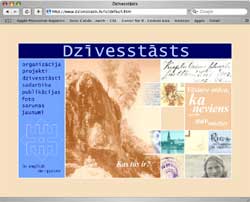
The Latvian National Oral History project has a Web site with background on collection efforts and samples of some life stories.