A mellow album that’s not for the birds

Putni maina virzienu

The musical output of Latvia has become more and more varied through recent years. Beyond the standard styles of rock and folk, other styles like dance, techno, rap, and rhythm and blues have been heard being played by Latvian groups. Some styles are particularly hard to define. One example is the group Kopējā izteiksme and their release Putni maina virzienu. One would be quick to label it as "New Age," but it does not fit neatly into that category.

It is an entirely instrumental album, full of textured sounds and many different kinds of instruments. It is very heavy on synthesizers (maybe a bit much so), but a varied lineup of musicians keep the album from sounding overly synthesized. It is also very atmospheric, complete with ocean sounds. Much of the music sounds like it belongs in a film sountrack.

The main musicians in Kopējā izteiksme are Jānis Brūveris (on keyboards and programming, as well as composer of eight of the 11 tunes on the album), and Ainārs Paukšēns (also on keyboards and programming, as well as the cello). Joining them are Michael Nagy on acoustic guitar, Juris Kulakovs on accordion and Artis Gāga on saxaphone. Also appearing is a string quartet, made up of Lāsma Muceniece on violin, Signe Šteimane on violin, Jānis Lielbārdis on viola and Paukšēns on cello.

As with many "New Age" groups, Kopējā izteiksme’s music is very influenced by nature. One of the main themes of the album is about birds, their ability to know where to fly when they migrate and how they know where to return to.

Of note is that there is nothing particularly "Latvian" about the music, besides the fact that it was produced by Latvian musicians.

The album opens up with "Tuvums," which starts off with a very pretty introduction on acoustic guitar.

The song "Pirmais gads" reminds me a bit of the music of the Indians of South America (the kind who always seem to be playing in the Times Square subway station), mainly due to the synthesized, flute-like sound.

"Sniegs (akustiskais mix)" with its piano theme, is a particularly haunting song, simple but eerie. It reminds me of the theme to the Halloween horror movies. The strings provide a nice balance to the piano melody.

This theme returns in "Sniegs (paplašinātais mix)," which for the most part is simply an extended version of the original, but diverges near the end, where bass and drum sounds are added.

My favorite track on the recording is probably "No sevis sāc," perhaps because it sounds more like an actual "song" (but without words, of course) and has a melody that can be hummed along with. I particularly like the way the acoustic guitar sounds in it.

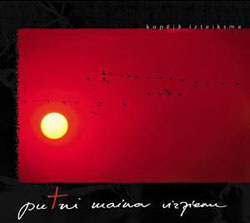
The album packaging is on the simple side, with the obligatory nature pictures in it. Text relating to the theme of the album asks Zen-like cosmic questions such as "Kur putni maina virzienu? Tu zini? Un kāpēc? Tu zini? Pastāsti man!" (Where do birds change direction? Do you know? And why? Do you know? Tell me!)

Putni maina virzienu is a great-sounding album, full of many styles and textures. It is a pleasant listen when one needs more mellow music to relax with. Listening to this music will make people light up their incense and start meditating. But it is not the kind of recording that I would buy. Listening to the album made me sleepy (but perhaps that is one of the intentions of the artists). Enough variety is on the album for fans of this genre, though it does seem at times that a few of the pieces on the album start to sound very similar.

As with many of these kinds of recordings, the human aspect is missing. The music sounds very "mechanical" at times, as though it was entirely performed by a machine (which I’m sure a lot of it was, because both Paukšēns and Brūveris are credited with “programming”). However, if you like your music atmospheric and heavy on the synthesizer sound, then you will most likely like Putni maina virzienu.

Details

Putni maina virzienu

Kopējā izteiksme

Latvijas Radio,  2000
Egils Kaljo is an American-born Latvian from the New York area . Kaljo began listening to Latvian music as soon as he was able to put a record on a record player, and still has old Bellacord 78 rpm records lying around somewhere.

Sixteen songs from a national treasure

Dziesmu izlase

Imants Kalniņš is one of the most beloved composers in Latvia. His music is listened to and appreciated by all types, whether they are casual music fans or devout music theorists. What is it about his music that seems to strike a chord within most every Latvian? Perhaps it is the variety of styles he can compose in, or how his music can convey just about any emotion—from happy rejoicing to being stranded in sadness to exuberant nationalism.

The past few years have seen Kalniņš once again take center stage in the public musical eye. Popular works in recent times include the re-recording of the film score to the movie "Pūt, vējiņi!" and the success of the rock group Autobuss debesīs, whose music was composed entirely by Kalniņš.

This year also saw the release of the retrospective Dziesmu izlase, containing an assortment of his popular music, recorded by the many artists who have worked with Kalniņš’ music throughout the years: Menuets, Turaidas roze, Jauns Mēness, Aigars Grāvers of Jumprava, and Renārs Kaupers of Prāta Vetra.

The disc conntains 16 tracks, compiled by Kalniņš and Ainars Mielavs. Coincidentally enough, seven of the 16 songs are songs that involve either Mielavs or his dormant group, Jauns mēness. But no matter…

The album starts off with two songs by Menuets, "Viņi dejoja vienu vasaru" and "Alvas zaldatiņi," both of which have lyrics by Māris Čaklais. The first song is a very pretty but sad piece about two lovers who had a brief romance. The chorus to the song reminds me a bit of "Memory" by Andrew Lloyd Weber. "Alvas zaldatiņi" (Tin soldiers) is one of Kalniņš’ more popular songs. It is a "military" style song about children who are playing with tin soldiers. It also offers the advice that "a dead Napoleon should be buried so he doesn’t smell, but a cat should be fed with warm milk"!

Another group that played songs by Kalniņš was Turaidas roze, and they have four songs on this release : "Svētku diena," "Nelaid, māte, bērnus mežā," "Apvij rokas" and "Mežā." Of the four, my favorite is "Svētku diena" (for which Kalniņš also wrote the lyrics), a celebratory song about the return of a loved one: "Every time that you are next to me is day of celebration!"

Another favorite on the album is "Es šodien jūku prātā," featuring Jauns mēness and lead vocals by Renārs Kaupers. I especially like the mandolin part, as well as the lyrics by Mielavs: "Nav vērts ja tikai tāpat par velti zvaigznes krīt" (It’s not worth if it if the stars fall for no reason).

Many of Kalniņš’ compositions are richly textured, a good example being the very beautiful song "Es redzēju sapnī," with its very lush keyboard part. It is almost symphonic in its style, and it is complemented well by Mielavs’ vocals. However, the very next song, "I Love You," is a straight ahead rock song that makes the listener want to sing along with its very simple but effective chorus in English, "I love you, do you love me too?"

The new "sensation" in Latvian music these days is Autobuss debesīs, who had the honor of closing out the day of rock music at the Rīga 800 festival on Aug. 18 (they played right before the amazing fireworks display). Part of the reason the are so popular is Kalniņš’ music. The group’s lead singer is Marts Kristiāns Kalniņš, the composer’s son. Dziesmu izlase contains two Autobuss songs, neither of which are on their album Logs puspavērts. They are "Sitiet bungas, mani mīļie" and the song called "Autobuss debesīs," another favorite of mine on this record. The lyrics for both songs were written by Viks (just Viks—no other name given!). The Autobuss songs are also a good example of how Kalniņš is capable of writing music that appeals to a younger generation. Kalniņš truly has cross-generational appeal.

The final song on the album, "Apturi mani," is a beautiful duet between Ainars Mielavs and Rēzija Kalniņa (who, besides being a well-known Latvian actress, is also Imants Kalniņš’ daughter).

Of course, you couldn’t possibly fit all the great Kalniņš songs onto one CD. One song that I particularly missed on this release was "Veltijums LTF" (dedicated to the Latvian Popular Front), probably my favorite Kalnīņš song.

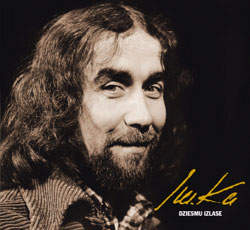
The major disappointment in this release is the packaging: besides the CD cover, there isn’t any! You’d figure that with an artist with the popularity of Kalniņš, UPE Recording Co. could have at least included the lyrics and maybe a bit of history about each band (what albums they released, who were the members of the band, etc.) since it is not just Kalniņš music itself that is important. Besides, Kalniņš being such an interesting person, a bit of biographical information wouldn’t have hurt either. For those interested in more about Kalniņš the composer, I would recommend reading the book Jaunā mūzika pēc divdesmit gadiem by Ingrīda Zemzare and Guntars Pupa.

This CD is essential listening for anyone interested in Latvian music. There is good reason Kalniņš is considered a national treasure, and this CD goes a long way in confirming that standing.

As for the lyrics being absent, I think a Latvian friend of mine had the best explanation for that. "Why would you need the lyrics?," she asked. "These songs are already such a part of the Latvian culture that everyone knows all the lyrics by heart anyway!"

Details

Dziesmu izlase

Imants Kalniņš

UPE Recording Co.,  2001

UPE CD 027

Egils Kaljo is an American-born Latvian from the New York area . Kaljo began listening to Latvian music as soon as he was able to put a record on a record player, and still has old Bellacord 78 rpm records lying around somewhere.

Documentary shows Rīga in the raw

Rīga pēc desmit gadiem

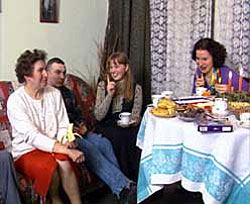
Līga (far right) with her family in Rīga. (Photo by Jānis Eglītis, Kaupo Filma)

Television shows and films about Latvia are rarely seen elsewhere in the world, and those that do make it onto the screen often make the locals cringe. In recent years, the only depictions of this small country seem to have been dubious exposes about prostitution and alleged ethnic troubles.

However, a documentary that recently premiered in Rīga is an interesting change from all that. Made with Western money and local talent, Rīga pēc desmit gadiem (Rīga After Ten Years) is one of the most honest and insightful films this reviewer has seen about the Latvian capital.

The premise is simple: During the winter of 2001, a camera crew followed four young people ages 21 to 28. We are given glimpses into their everyday lives. It may sound like a reality show, but this one achieves a lot more depth than is usually the case with that genre.

Karīna, a lawyer, is grieving over her boyfriend who committed suicide. Līga, a promising opera singer, is pondering whether to leave Latvia to join her lover in Spain. Aivars, a police academy cadet, is already flirting with the temptations of power and corruption. And Romāns, a butcher in Rīga’s central market and the oldest of the four, seems to be making the best of his life despite a childhood spent in various institutions and a grueling workload as an adult.

The film is rescued from mere voyeurism by the obvious trust that the production team has won from the subjects. And while the main focus is on the individuals, as the title suggests a lot is also said about Rīga a decade after independence.

Not all of it is pretty. While these young people seem to be making the best of things, they are beset by money and relationship difficulties, and it is made clear that other members of their generation are falling victim to drugs and alcohol. The troubled atmosphere is reflected in the footage of Rīga itself. A few shots of churches and cobblestones are outweighed by darkened, smoggy streets and tiny apartments. But somehow Rīga still comes across as a place of energy and tough optimism.

The film was financed by French TV channel ARTE. It was screened in October in France, Switzerland and Germany as part of a series about young people in five European cities (the others are Istanbul, Rekyavik, Belgrade and Bilbao.) An important part of the deal was that locals have artistic control over the films, and in Latvia this opportunity was handed to Arta Biseniece of Rīga-based Kaupo Filma.

Biseniece said that all of the action in the films is spontaneous and no one was specially auditioned for the parts. She wanted a policeman, a singer, a worker from the central markets, and Karīna, who is a personal friend of hers. The only other candidates were a young Russian man at the markets, who turned down an offer to take part, and a Russian DJ, who was to have been a fifth subject until the production team decided that he had nothing interesting to say.

In fact, Biseniece said her goal was to focus on ordinary people.

"For some reason Latvians are always making films about artists," she said with a laugh. "They get a musician and film him on a roof playing a saxophone."

The director said she developed a lot of affection for her subjects, even for Aivars the policeman, whom she respects for being honest about his views on the world.

And she firmly defended the images of Rīga shown in the film.

"The film was made in winter, which is always less picturesque than summer, but more importantly, everyday life is not a holiday," she said. "Rīga is not just the Old Town, most of us live in Purvciems or Ziepniekalns (Soviet-era housing estates), we go to work through muddy tunnels and come home exhausted after dark."

Just 31 herself, Biseniece said she can completely relate to her quartet. She suggested that they are an intermediate generation which still has memories of Communism but is young enough to adjust to the new realities.

Oddly, she said that she had not been at all influenced by an earlier documentary about young Latvians made by Juris Podnieks in the late 1980s, whose title posed the question, Is It Easy to be Young?

However, as that film implied about youth under glasnost, so this one suggests that the answer today is still a resounding no.

Rīga pēc desmit gadiem won the award for best documentary in the Lielais Kristaps film festival Nov. 16, the Latvian equivalent of the Oscars. No plans have been announced to distribute the film outside of Europe, and video copies aren’t available yet either. However, when it does come on screen, this film should be seen by anyone who wants to look into the very heart of the city.

Details

Rīga pēc desmit gadiem

Arta Biseniece, director

Kaupo Filma,  2001

Notes: In Latvian. Documentary, color.