Changes in election law benefit Latvians abroad

Latvian citizens living abroad—including World War II exiles and their descendents who reclaimed citizenship after 1991—may find it a bit easier to vote in the upcoming parliamentary elections. Latvia’s parliament, the Saeima, on May 30 approved changes to the election law that were sought by several Latvian emigre organizations.

Under the revised law, voters abroad will be able to mail in absentee ballots at least 15 days before the official election day. Latvia’s national election day this year is set for Saturday, Oct. 5.

Some citizens abroad had complained that in their countries of residence mail service is not offered on Saturdays, while Latvia’s election law said that citizens abroad could vote either in person or post their absentee ballots on the day of the election. Mailed ballots also had to be received and opened in polling offices within three days of the election.

The World Federation of Free Latvians (Pasaules brīvo latviešu apvienība, or PBLA) was among emigre organizations pushing for the changes.

“The PBLA is very satisfied,” Linda Kovaļevska, head of the federation’s Rīga office, said in an e-mail to Latvians Online, “because the adopted amendment that allows voting by mail 15 days before election day was proposed by the PBLA.”

The president of the Latvian National Federation in Canada (Latviešu nacionālā apvienība Kanādā, or LNAK) agreed the changes are good.

“The changes definitely will help Latvians living in Canada to participate in the elections,” said Imants Purvs. The federation already has begun discussions with the Latvian Embassy in Ottawa about how best to publicize the changes and increase voter participation.

Under the revised election law, citizens living abroad may still vote at an official polling place.

The emigre organizations’ concerns were addressed in election law amendments proposed Oct. 31 by the Central Elections Commission, according to a press release. The commission oversees elections in Latvia. Arnis Cimdars, chair of the commission, also had noted that in some large countries even three days may not be enough time for a ballot to reach a local polling place.

Although the changes may satisfy the concerns of many Latvian citizens abroad, one catch might be that in order to receive an absentee ballot, voters will have to mail their Latvian passport to their polling place to prove their eligibility. Because a unified and computerized registry of voters is not yet available in Latvia, the passport is needed to verify eligibility. By the time the next parliamentary elections would be scheduled in 2006, such a registry should be ready, Kovaļevska said.

The PBLA also headed off an amendment proposed by the Latvian Foreign Ministry which would have barred citizens without a passport from voting, Kovaļevska said. Some citizens may not have a passport, but instead have a document from the Department of Citizenship and Migration Affairs that proves their citizenship.

Also struck from the proposed legislation was a provision that would have allowed a citizen voting abroad by mail to change their ballot by showing up in person at the polling place, taking back their absentee ballot and voting again.

Voters on Oct. 5 will elect 100 members of parliament. Citizens who are at least 18 years old are eligible to vote. Candidates for parliament have a 20-day window, beginning 80 days before the election, in which to apply to be on the ballot.

In the meantime, the Central Elections Commission also will need to decide where polling places will be established abroad. In Canada, Purvs said, LNAK is considering opening an election office in Toronto.

For the last parliamentary elections in 1998, the Central Elections Commission set up a total of 31 polling places abroad, most of them in embassies. Three of those were in the United States: the Latvian House in Chicago, the Latvian Social Center in Los Angeles and the Latvian Embassy in Washington, D.C. Two were in Canada: the Latvian Embassy in Ottawa and the Latvian Canadian Cultural Centre in Toronto. Australia also had two, in the honorary consulates in Sydney and Melbourne.

In all, 10,080 votes were recorded from Latvian citizens living abroad, with 2,928 (29 percent) coming from the United States. Australia had the next largest bloc of votes, 1,791 (17.7 percent), while Canada contributed 1,579 (15.6 percent). Together, Latvian voters in the three countries represented more than 62 percent of votes cast abroad.

Voters abroad in general were a conservative group. Of the 10,080 votes cast, 46 percent went to Tēvzemei un brīvībai/LNNK (For Fatherland and Freedom/LNNK), Latvia’s leading conservative party. Overall, the party took third in national elections, earning 17 spots in the 100-seat Saeima. A third of ballots abroad were cast for Tautas partija (People’s Party), the conservative reform party that recorded the best results in the election, earning 24 seats.

More than 32,000 Latvian citizens were living abroad in 2000, according to the Department of Citizenship and Migration Affairs. More than a third—a total of 11,344—were in the United States, followed by 4,447 in Australia and 4,198 in Canada.
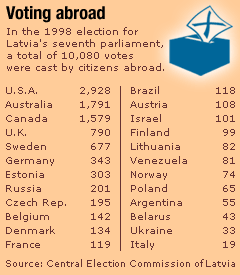
Voting in 7th Saeima election

Andris Straumanis is a special correspondent for and a co-founder of Latvians Online. From 2000–2012 he was editor of the website.

Sorry, Marija, we didn’t think you’d win

Our apologies to Marija Naumova, because we didn’t think she would win. The night before the Eurovision Song Contest was to begin in Tallinn, my daughter and I sat down at her computer and watched all 24 videos of this year’s entries. Our conclusion was that Naumova and her song “I Wanna” certainly was well above average, but not necessarily good enough to win the contest.

If we had any favorites in addition to Latvia, they were Austria, Denmark, Macedonia and perhaps France and the United Kingdom.

Austria’s Manuel Ortega—who, despite what his name suggests, was born in Linz—surprised us with his upbeat “Say a Word.” We also liked Denmark’s Malene Winther Mortensen and her performance of “Tell Me Who You Are.” The video especially brought smiles, as the singer vandalizes the apartment of her lover whom she suspects of having walked out on her (but returns bearing a couple of baguettes).

And Macedonia’s young pop star, Karolina Gocheva, sang wonderfully the tune, “Od nas zavisi” (It Depends On Us). Her participation in Eurovision saw one of several minor scandals this year. Gocheva wanted to perform the song in English in Tallinn, but was convinced by the powers that be back home that Macedonian was the way to go.

France’s Sandrine Francois performed “Il faut du temps” (“It Takes Time”), a fittingly moody French song that was a refreshing change of pace from the all-too-happy pop songs offered by many other artists.

Finally, the United Kingdom’s Jessica Garlick, who many thought was a virtual shoo-in this year thanks in part to heavy pre-contest promotion, seemed like she would do well with the soulful “Come Back.” When I interviewed Naumova in April, she said Garlick’s song was her favorite among all the entries.

But when I booted up the computer mid-afternoon Saturday to check the results, I was surprised to find that voting was still underway. The Webcast from the Saku Suurhall in Tallinn reported that Latvia was in the lead with 118 points, tussling with Malta for control of first place. My jaw must have hit the keyboard as I watched during the next half hour as Latvia’s score continued to mount. And then Lithuanian television reported that Latvia’s neighbors to the south were giving 12 points to Naumova, boosting her to a score of 176 and clear victory.

Malta’s Ira Losco, who performed “7th Wonder,” came in second with 164 points. The U.K.‘s Garlick tied with Estonia at 111 points. (We were a bit disappointed that Estonia employed a ringer: Young Swedish singer Sahlene sang “Runaway,” a tune with lyrics and music created by Estonians.) And France was next with 104. Unfortunately, one of our favorites, Denmark, ended up in last place with only 7 points, right behind Lithuania in 23rd place.

Yes, Eurovision is a silly contest, but it’s one that’s been running for 47 years. Yes, most of the songs are nothing special. But the point, at least this year, is that in Latvia’s third time in the Eurovision contest it has come away with a victory. Coupled with Estonia’s win last year, the results should help convince any doubters that the Baltics are not some backwater region of Europe.

I guess it’s time to start saving for airfare to next year’s Eurovision contest, which is to be held in Latvia as part of the spoils of victory. The next months are sure to see a debate about whether Latvia can even afford to pull off a Eurovision event and, if it can, whether it should be held in Rīga or in Ventspils, which is where the national runup to Eurovision has been staged.

In the meantime, our congratulations to Marija Naumova, even if we didn’t think you’d win.

Andris Straumanis is a special correspondent for and a co-founder of Latvians Online. From 2000–2012 he was editor of the website.

For Paul, who wanted to learn Latvian

Talk Now! Learn Latvian

When I got a hold of the CD-ROM Talk Now! Learn Latvian, my first response was “It’s about time!”, followed by “How come it took so long?”

If you know someone who has ever had even the slightest urge to learn Latvian, you’ll understand why.

My brother-in-law Paul is first on my list. He struggled through a Latvian language course and finally gave up because, well, naming the planets was not exactly what he needed to make dinner conversation.

We all wanted to help him, but you have to admit teaching a language takes more than desire. And even though Toronto has the largest Latvian population outside Latvia (and hence the largest number of non-Latvian speaking community members), Latvian-as-a-second-language courses are few and far between. (The exception is the “Mēs mācamies latviski” stream for children at the Latvian school Valodiņa for three hours a week).

Talk Now! is a straightforward language learning program that teaches “essential words and phrases for absolute beginners.” What a perfect solution for anyone who wants to learn basic Latvian—and not even have to leave the comfort of their own home to do so.

The program is built on the same template that’s used to teach 80 other languages, and which allows speakers of 80 other languages to learn Latvian. This means that all spoken words, with the exception of the introductory remarks, are in Latvian. In fact, a more appropriate title for the program would be Learn Latvian in Latvian, which is not as intimidating as it sounds, because the teaching is all done through images and the spoken word. A colour print picture dictionary is available for off-screen practice.

Because the program is template-based, it also means the words taught are all globally usable, as determined by the program’s U.K.-based creators, EuroTalk Interactive Ltd. Hence you won’t learn anything uniquely Latvian, such as “pīrags” or “tēvzeme,” but you’ll know how to identify a necktie and chopsticks. And for those griping about the lack of uniquely Latvian aspects, be forewarned that because Latvian is one of the later titles to be added to the Talk Now! series, Latvia is even missing from the lineup of national flags.

After logging in, choose one of nine areas to explore. To make it more fun, and not bring back flashbacks of boring class time, Talk Now! is set up like a game, where your goal is to score 1,800 points. Each area includes word and speaking practice, as well as both easy and hard games. The language areas include First Words, Food, Colours, Phrases, Body, Numbers, Time, Shopping and Countries.

One of the most impressive things about this multimedia product is that it seeks to avoid repetition by teaching language in more than one way. In the Body game, for example, two skulls iterate body parts. Click on an identified part and assemble a Frankenstein looking cadaver that comes to life when you’re finished. In the Food game, click on the right food and it pops into a shelf.

Because of this and the various levels within each section, users will find themselves making a mental list of all the people Talk Now! might appeal to. My four-and-a-half year old gets a kick out of the Colour section where clicking on the right colour alters black-and-white images. My two-and-a-half year old, who is working on basic language concepts, loves clicking on the right item in Shopping just to hear the male speaker belt out a resounding “jā!” (although his abrupt “nē!” is just as inspiring).

But most of all, Talk Now! gets me thinking about all the people this program could really benefit: Norm, Judy, Katherine, Joe, Anne, Dainis… Perhaps a Latvian organization could purchase a zillion copies and ship one to every non-speaker who wants or needs it, before they’ve totally given up on Latvian?

One section that can be a bit problematic—even for fluent speakers—is Phrases, because this relies on students matching up spoken sentences with crudely drawn images. Even I had problems figuring out which picture referred to “Es vēlos vietu pie loga, lēdzu!”

Latvian speakers who will want to have some fun and brush up on their Latvian will find the game occasionally has trouble keeping up if they move along too quickly. They’ll also be irritated by occasional errors (for example, in Latvian plums and bananas are only recognized in the plural form), and what’s with the voice confusing times of day in the opening sequence?

Overall, however, Talk Now! Learn Latvian is an excellent way to start learning Latvian. Now, if only Paul still has the desire to give it one more try…

Details

Talk Now! Learn Latvian

EuroTalk Interactive

London:  EuroTalk Interactive Ltd.,  2000

Notes: Minimum requirements are Windows 95/98/NT/2000 or Macintosh OS 7 or above, a color monitor, CD-ROM drive and a microphone (recommended).

Mara Gulens is an editor and writer based in Toronto.