Forward into 1980s with latest Piecīši re-release

Last year saw the release of the latest compact disc of Čikāgas Piecīši re-releases, which takes us into the 1980s. The album Par mani, draudziņ, nebēdā was originally issued in 1982, while Made in Latvia was released in 1988. Both are collected now on CD.

Already in the 1980s the Piecīši were in their third decade of performing and recording, and as they are getting older, their songs have begun to develop a more sentimental (not to mention patriotic) bent to them. The distinctive tounge-in-cheek humor is still there, but it is enhanced with songs that show a group that has become older and wiser through the years.

It is not clear from the liner notes what the lineup is on the Par mani record, though I can be fairly certain that at least Alberts Legzdiņš, Armands Birkens and Janīna Ankipāne are there. “Made in Latvia” lists Legzdiņš, Birkens, Uldis Streips and Lorija Vuda as singers; musicians are Birkens on guitar and R. Daughtry on guitar and bass guitar.

Patriotism is a strong theme in these two recordings. One of the highlights is the song “Par mani, draudziņ, nebēdā,” the Piecīši tribute to the Freedom Monument in Rīga. The song is sung from the monument’s perspective, telling everyone “not to worry about me”—a song of optimism where no matter how bad things go, they will turn out fine in the end. And they did, so it was a prophetic song in a way.

Also in patriotic style is the song “Made in Latvia.” It is about how, even though everything in his house is imported in some way (Japanese shaver, South Korean alarm clock, Danish table), at the very least, his beloved is 100 percent Latvian. She is so Latvian that even when the neighbors ask her to play bridge, she can’t, as she is making pīrāgi.

Though the leader of the Piecīši will always be Legzdiņš, who provides almost all of the words and music, the real star of this release is the achingly sincere tenor voice of Armands Birkens. Just hearing his voice will make the listener weepy. Even if he sang the phone book, most listeners would break into tears! This is best displayed on the song “Lai visa pasaule to redz” (a duet with Lorija Vuda), a song about two lovers, one in Rīga, one in Chicago, who want the whole world to see how great their love is, regardless of the distance between them. This song is one of my favorites on this release.

Sentiment is also heavy on the song “Mūsu mīlestība,” a song about someday meeting again, because their love will never end. This song again features the voice of Birkens.

Now that the Piecīši have grown older, and have had had children, it was inevitable that there would be songs about the trials and tribulations of getting these children to Latvian school on Saturday mornings. The similarly titled “Piektdienas vakars, sestdienas rīts” and “Sestdienas rītā” are about the occasional panic attacks on Friday nights, and the massive process of getting everyone ready Saturday morning. Reminds me of the many occasions in my family when on Friday evening I realized that I had a domraksts to get done by the next morning!

On certain songs, the Piecīši display their growing country music influence, complete with twangy guitars, baying vocals and songs where a pickup truck is a major plot device—see “Šoferdziesma”. This song is actually a bit too country for me, featuring Birkens howling in the background. I usually skip over it.

Though heavy on sentiment, the distinctive Piecīši humor is still present. The opening track is “Kurpniekzeļļi,” a song about shoemaker apprentices who spend more time staring at women’s legs than doing their job. This song’s “sequel” is “Skroderzeļļi,” this time about the great life a tailor’s apprentice enjoys, which is apparently much better than a shoemaker’s apprentice’s life.

Also in the humorous vein is “Trīs vecenītes,” which is about three old ladies sitting around and bragging about what they have managed to keep “real,” even in their old age. Legzdiņš encourages the audience to spit along with the chorus.

My main complaint about this release is the same complaint I have had about the other Piecīši re-releases: the packaging. I think I have already whined about this enough in my previous reviews, so go read those, because I don’t think I have anything different or more insightful to say this time.

Though they may have gotten older, and their songs have gotten (perhaps a bit too) heavy on the sentiment and patriotism, these Piecīši re-releases still occupy a very important space in the Latvian music world. They give voice to the many Latvians in the United States (and elsewhere outside of Latvia) who were also growing older, and at the same time facing similar problems such as raising Latvian kids and trying to keep their Latvian identity. Though they have gotten advanced in age, these records still sound fresh and relevant today. They reinforce once again the importance of the songs of the Čikāgas Piecīši, both in the 1980s as well as today.

Details

Par mani, draudziņ, nebēdā & Made in Latvia

Čikāgas Piecīši

Balss,  2001
Egils Kaljo is an American-born Latvian from the New York area . Kaljo began listening to Latvian music as soon as he was able to put a record on a record player, and still has old Bellacord 78 rpm records lying around somewhere.

Song festival tribute mixes the old with novelties

Latvians are more likely to ask each other “Did you go to the last Song Festival?” rather than “Have you ever been to one?” Almost every year for decades, a song festival has been held somewhere in the world, and Latvians have flocked in droves to this most ubiquitous celebration of their culture and heritage. Non-Latvians may have difficulty understanding the excitement and emotion surrounding these events. Lasting several days to a week or more, the larger festivals feature numerous concerts, dance presentations, crafts exhibitions, nightly balls, and mass demonstrations of Latvian patriotism and nationalism—in short, total immersion in the Latvian ethos.

During the period of Soviet occupation of Latvia, festivals were held periodically in Latvia, but the repertoire and events were carefully manipulated. While the trappings of Latvian culture were present (at least those reasonably acceptable to Soviet authorities), many foreign influences were also felt and much was strictly proscribed. During those years, festivals in Latvian communities abroad helped keep the spirit alive, and when Latvians were finally allowed to hold a truly national festival in their own country in 1990, for the first time in 50 years, the excitement, pageantry, emotion, and sense of occasion were overwhelming.

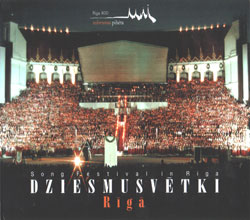
The album Dziesmusvētki Rīgā features some highlights from that milestone event, as well as more recent selections. Issued as part of the national commemoration of the 800th anniversary of the founding of Latvia’s capital, Rīga, this compact disc mixes old favorites with some novelties.

The disc opens with choral arrangements, by Jānis Cimze, Emīlis Melngailis and Pāvuls Jurjāns, of beloved Latvian folksongs. Original compositions by Jāzeps Vītols (“Gaismas pils”) and Raimonds Pauls (“Manai dzimtenei”) follow, works that have come to be as well known to most Latvians as their national anthem.

The Festival Choir has numbered up to 24,000 singers in Rīga, and the ability to cohesively and musically conduct such a huge mass of singers with subtlety and nuance is clearly an art form. Effectively recording such a widely dispersed field of humanity, where balance problems are already inevitable when one end of the choir is hundreds of feet away from the other, is also a highly specialized skill, with happier results in some selections than others.

All the conductors represented here are experienced in directing such large forces, though some are more satisfying than others. Haralds Mednis’ performance of “Gaismas pils” is a model of clarity, unity, and musicality. On the other hand, Jānis Zirnis succumbs to the temptation to stretch phrases to their limits and overemphasize dramatic effects in Melngailis’ “Jāņu vakars.” Subtlety is not really the point of these events, though: for the singer, it’s the joy of lending one’s voice under such momentous circumstances; for the listener, it’s the thrill of hearing a huge, stirring sound.

Two purely instrumental works follow: an old waltz tune, “Brūklenājs,” zips along merrily but the ensemble often verges on chaos. A potpourri of popular Latvian beer-drinking songs, arranged for brass band as “Alutiņš,” chugs along in marching-band style of a century ago. A 1998 choral composition by Juris Vaivods titled “Rīgas dziesmas” concludes the more traditional fare on this disc, and features a number of familiar tunes with connections to Rīga’s past. Effectively done, and enthusiastically sung.

Finally, something completely different—excerpts from Zigmārs Liepiņš’ rock musical “Teika,” presented at a Latvian youth song festival held in 2000. Despite generally not being fond of rock music, I found parts of the work very enjoyable and arresting. This is not a work with a strong, personal profile, though—much of the material is firmly rooted in the sound of groups and composers popular in the 1970s in the West, such as Supertramp and Electric Light Orchestra, and Imants Kalniņš’ influence is also felt. I suspect this work would have been much more interesting on video—the excitement of the audience and photos in the booklet suggest a strong visual element.

The album has attractive packaging, with thorough annotations in Latvian and English. Proofreading by a native English speaker would have been useful, though. In short, if you’d like a souvenir of “Rīga 800” and a melange of different musical genres doesn’t discourage you, then by all means try this unique, generally enjoyable compilation.

Details

Dziesmusvētki Rīgā

Various artists

MICREC and Latvijas Radio,  2001

MRCD 158

Scholars offer dispassionate, rich look at Latvia

It’s a lot like the mood of many Latvians today, facing rapid change in all spheres of life. Artis Pabriks and Aldis Pūrs’ book shows us that the “challenges of change” have been many, and difficult, over the past century. One is left quite aghast at the range of shocks that have faced Latvia over this time, and the difficulties yet to face.

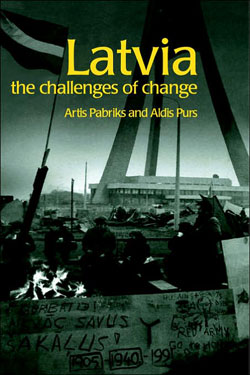
The tone for the text is quite adequately set by the cover. This is a serious work of scholarship, part of a series of academic “snapshots” of postcommunist countries. It is one of the few in the series actually written by citizens of the country under study. What makes this book interesting for Latvian readers is that it is a collaboration between a scholar originating from Latvia and another from the diaspora.

The characterisation of the authors in the preface was curious. Pūrs is offered to the reader as “cynical and irreverent,” scion of the Latvian emigre community, characterised as an environment of “intense conservatism and nationalism.” Postmodern titbits on Latvian identity scattered in the text would have to be pure Pūrs. Pabriks is proferred to the reader as a “liberal republican,” words to me very evocative of American politics.

It was pleasantly refreshing to read a dispassionate perspective, yet written by “insiders” to the Latvian scene. Too much written by Latvians about themselves and Latvia is highly charged with bias and emotion. Although one could never purport to be entirely objective, the authors are well-effaced in the writing, leaving readers to breathe a sigh of relief, weigh up the evidence presented and make their own conclusions. Bravo to the authors for raising discussion of “alternative concepts of Latvianness” and those strained state-citizen relationships in contemporary Latvia.

Historical transformations in Latvia are surveyed since the time of first national awakening in the 1850s, with a focus on the period commencing with the second awakening, beginning in the mid-1980s. The reader is informed of developments up until the close of the 20th century.

The end product is a well-woven mesh of history, politics, economics and foreign policy analysis. Overall, here is a sweeping panorama that importantly places changes in Latvia in a wider context, avoiding the nationalistic provincialism of many an emigre history.

The main problem with panoramas is that some portions of the text can become over-packed with information. The introductory chapter was a heady brew in this respect. The rapid march of social and political movements over a century was conveyed in a measured, clear but rather sterile prose style, which did go some way to alienating a general reader like me, although the narrative came alive for me where it painted a picture of people’s lives and social conditions, such as the section on Latvia between the wars. Generally, however, the book is a mine of facts, not a field of flowery phrases or a sea of emotion.

Intriguing were summaries on contemporary issues, such as foreign policy, giving some indication of the motives behind attitudes of some foreign states toward Latvia, and discussing how Latvians can envision their future (for instance, former Latvian ambassador the United States Ojars Kalniņš’ “Amber Gateway” conception of Latvia’s place in its region). The work remaining to be done by Latvians themselves is highlighted. Criticism of recent governments is tempered by muted concluding calls for further development of civil society; for the public, not the state or international organisations, to be more loudly heard in debates over Latvia’s future.

Latvia: The Challenges of Change is a handy general introduction to contemporary Latvia, though primarily for foreign scholars of the region and its particularities. Nevertheless it is a useful reference work and appraisal of the immediate postcommunist period for other readers. And it is a bridge to much more besides. The book is very positive is its copious list of references and impressive bibliography (including Internet sites), as well as a handy chronology for those who want it short and sweet.

Much as its cover attests, Latvia: The Challenges of Change is not a sparkling, rollicking narrative, not a light read by any means. Latvians might say that “not all is gold that shimmers,” but then not all that doesn’t is to be avoided.

Details

Latvia: The Challenges of Change

Artis Pabriks and Aldis Pūrs

London:  Routledge,  2001

ISBN 0415267307

Where to buy

Purchase Latvia: The Challenges of Change from Amazon.com.

Note: Latvians Online receives a commission on purchases.