Song festival tribute mixes the old with novelties

Latvians are more likely to ask each other “Did you go to the last Song Festival?” rather than “Have you ever been to one?” Almost every year for decades, a song festival has been held somewhere in the world, and Latvians have flocked in droves to this most ubiquitous celebration of their culture and heritage. Non-Latvians may have difficulty understanding the excitement and emotion surrounding these events. Lasting several days to a week or more, the larger festivals feature numerous concerts, dance presentations, crafts exhibitions, nightly balls, and mass demonstrations of Latvian patriotism and nationalism—in short, total immersion in the Latvian ethos.

During the period of Soviet occupation of Latvia, festivals were held periodically in Latvia, but the repertoire and events were carefully manipulated. While the trappings of Latvian culture were present (at least those reasonably acceptable to Soviet authorities), many foreign influences were also felt and much was strictly proscribed. During those years, festivals in Latvian communities abroad helped keep the spirit alive, and when Latvians were finally allowed to hold a truly national festival in their own country in 1990, for the first time in 50 years, the excitement, pageantry, emotion, and sense of occasion were overwhelming.

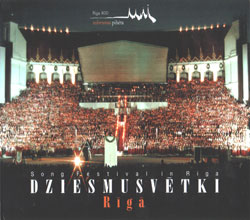
The album Dziesmusvētki Rīgā features some highlights from that milestone event, as well as more recent selections. Issued as part of the national commemoration of the 800th anniversary of the founding of Latvia’s capital, Rīga, this compact disc mixes old favorites with some novelties.

The disc opens with choral arrangements, by Jānis Cimze, Emīlis Melngailis and Pāvuls Jurjāns, of beloved Latvian folksongs. Original compositions by Jāzeps Vītols (“Gaismas pils”) and Raimonds Pauls (“Manai dzimtenei”) follow, works that have come to be as well known to most Latvians as their national anthem.

The Festival Choir has numbered up to 24,000 singers in Rīga, and the ability to cohesively and musically conduct such a huge mass of singers with subtlety and nuance is clearly an art form. Effectively recording such a widely dispersed field of humanity, where balance problems are already inevitable when one end of the choir is hundreds of feet away from the other, is also a highly specialized skill, with happier results in some selections than others.

All the conductors represented here are experienced in directing such large forces, though some are more satisfying than others. Haralds Mednis’ performance of “Gaismas pils” is a model of clarity, unity, and musicality. On the other hand, Jānis Zirnis succumbs to the temptation to stretch phrases to their limits and overemphasize dramatic effects in Melngailis’ “Jāņu vakars.” Subtlety is not really the point of these events, though: for the singer, it’s the joy of lending one’s voice under such momentous circumstances; for the listener, it’s the thrill of hearing a huge, stirring sound.

Two purely instrumental works follow: an old waltz tune, “Brūklenājs,” zips along merrily but the ensemble often verges on chaos. A potpourri of popular Latvian beer-drinking songs, arranged for brass band as “Alutiņš,” chugs along in marching-band style of a century ago. A 1998 choral composition by Juris Vaivods titled “Rīgas dziesmas” concludes the more traditional fare on this disc, and features a number of familiar tunes with connections to Rīga’s past. Effectively done, and enthusiastically sung.

Finally, something completely different—excerpts from Zigmārs Liepiņš’ rock musical “Teika,” presented at a Latvian youth song festival held in 2000. Despite generally not being fond of rock music, I found parts of the work very enjoyable and arresting. This is not a work with a strong, personal profile, though—much of the material is firmly rooted in the sound of groups and composers popular in the 1970s in the West, such as Supertramp and Electric Light Orchestra, and Imants Kalniņš’ influence is also felt. I suspect this work would have been much more interesting on video—the excitement of the audience and photos in the booklet suggest a strong visual element.

The album has attractive packaging, with thorough annotations in Latvian and English. Proofreading by a native English speaker would have been useful, though. In short, if you’d like a souvenir of “Rīga 800” and a melange of different musical genres doesn’t discourage you, then by all means try this unique, generally enjoyable compilation.

Details

Dziesmusvētki Rīgā

Various artists

MICREC and Latvijas Radio,  2001

MRCD 158
Scholars offer dispassionate, rich look at Latvia

It’s a lot like the mood of many Latvians today, facing rapid change in all spheres of life. Artis Pabriks and Aldis Pūrs’ book shows us that the “challenges of change” have been many, and difficult, over the past century. One is left quite aghast at the range of shocks that have faced Latvia over this time, and the difficulties yet to face.

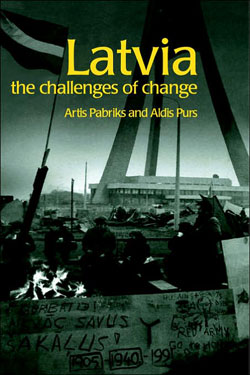
The tone for the text is quite adequately set by the cover. This is a serious work of scholarship, part of a series of academic “snapshots” of postcommunist countries. It is one of the few in the series actually written by citizens of the country under study. What makes this book interesting for Latvian readers is that it is a collaboration between a scholar originating from Latvia and another from the diaspora.

The characterisation of the authors in the preface was curious. Pūrs is offered to the reader as “cynical and irreverent,” scion of the Latvian emigre community, characterised as an environment of “intense conservatism and nationalism.” Postmodern titbits on Latvian identity scattered in the text would have to be pure Pūrs. Pabriks is proferred to the reader as a “liberal republican,” words to me very evocative of American politics.

It was pleasantly refreshing to read a dispassionate perspective, yet written by “insiders” to the Latvian scene. Too much written by Latvians about themselves and Latvia is highly charged with bias and emotion. Although one could never purport to be entirely objective, the authors are well-effaced in the writing, leaving readers to breathe a sigh of relief, weigh up the evidence presented and make their own conclusions. Bravo to the authors for raising discussion of “alternative concepts of Latvianness” and those strained state-citizen relationships in contemporary Latvia.

Historical transformations in Latvia are surveyed since the time of first national awakening in the 1850s, with a focus on the period commencing with the second awakening, beginning in the mid-1980s. The reader is informed of developments up until the close of the 20th century.

The end product is a well-woven mesh of history, politics, economics and foreign policy analysis. Overall, here is a sweeping panorama that importantly places changes in Latvia in a wider context, avoiding the nationalistic provincialism of many an emigre history.

The main problem with panoramas is that some portions of the text can become over-packed with information. The introductory chapter was a heady brew in this respect. The rapid march of social and political movements over a century was conveyed in a measured, clear but rather sterile prose style, which did go some way to alienating a general reader like me, although the narrative came alive for me where it painted a picture of people’s lives and social conditions, such as the section on Latvia between the wars. Generally, however, the book is a mine of facts, not a field of flowery phrases or a sea of emotion.

Intriguing were summaries on contemporary issues, such as foreign policy, giving some indication of the motives behind attitudes of some foreign states toward Latvia, and discussing how Latvians can envision their future (for instance, former Latvian ambassador the United States Ojars Kalniņš’ “Amber Gateway” conception of Latvia’s place in its region). The work remaining to be done by Latvians themselves is highlighted. Criticism of recent governments is tempered by muted concluding calls for further development of civil society; for the public, not the state or international organisations, to be more loudly heard in debates over Latvia’s future.

Latvia: The Challenges of Change is a handy general introduction to contemporary Latvia, though primarily for foreign scholars of the region and its particularities. Nevertheless it is a useful reference work and appraisal of the immediate postcommunist period for other readers. And it is a bridge to much more besides. The book is very positive is its copious list of references and impressive bibliography (including Internet sites), as well as a handy chronology for those who want it short and sweet.

Much as its cover attests, Latvia: The Challenges of Change is not a sparkling, rollicking narrative, not a light read by any means. Latvians might say that “not all is gold that shimmers,” but then not all that doesn’t is to be avoided.

Details

Latvia: The Challenges of Change

Artis Pabriks and Aldis Pūrs

London:  Routledge,  2001

ISBN 0415267307

Where to buy

Purchase Latvia: The Challenges of Change from Amazon.com.

Note: Latvians Online receives a commission on purchases.

Census data on Latvians cause bewilderment

A dozen years ago, about 1,000 people with Latvian ancestry lived in Arizona, according to the U.S. Census Bureau. Perhaps lured by the dry climate, the sunshine or the dramatic vistas of the Grand Canyon, the number of Latvians in Arizona had tripled by the year 2000, new census data suggest.

Or perhaps not.

If that many Latvians were living in Arizona even 12 years ago, said Rasma Ekmanis, former chairperson of the Arizona Latvian Club, they would be renting a ballroom to host dances.

“We don’t have the slightest idea where they are,” she said of the 3,020 Arizonans the census bureau estimates had Latvian ancestry when the latest count was made two years ago.

The current chairperson, Jānis Baltiņš, agreed. The Latvian club only has about 40-60 members from throughout the state, he said.

Arizona is not the only state with doubtful numbers of Latvians. Data about Americans’ ancestry is included in the latest batch of Census 2000 figures released to the public in the past several weeks, but the numbers have Latvian leaders in several communities scratching their heads in bewilderment.

The tally of “long form” questionnaires given to one in six American homes during the 2000 census shows that Americans with Latvian ancestry totaled an estimated 94,905 in 2000, down 5.4 percent from the 100,331 recorded in 1990.

The numbers are derived by adding the “first ancestry” and the “second ancestry” reported on the long form. The numbers also are estimates, interpolated by the census bureau from the national sample. The census bureau also reported lower and upper bounds for the data, which suggest that nationally the number of Americans with Latvian ancestry could be as low as 31,351 or as high as 174,711. The census also found that 10,780 persons in the United States were born in Latvia.

While the national number may appear believable, state-by-state breakdowns reveal some astonishing population shifts. One explanation may be that the Census Bureau’s sampling of ancestry and its interpretation of the numbers just gave bad results for Latvians. Or perhaps the numbers are accurate and ethnic Latvians are in fact escaping some states and flocking to others. Perhaps people who never considered themselves Latvian have seen a reawakening of their ethnic identity. The numbers may also raise questions about what exactly Latvian identity means, whether to be counted it’s enough to be from Latvia rather than be a “real” Latvian.

For example, the Latvian population tripled in Utah, Hawaii and Arizona during the 1990s, according to the census. Utah’s Latvians—some of whom became quite visible during the Winter Olympics in Salt Lake City—grew to an estimated 583, while Hawaii’s rose to 683.

Curiously, even North Dakota has more Latvians now than 10 years ago. A total of 182 persons claimed Latvian ancestry in the most recent census, compared to 64 in 1990.

Oregon saw its Latvian population swell by almost 83 percent from 1990 to 2000, the census estimates. One explanation might be found in the influx of Russian-speaking immigrants, said Juris Orle, the leader of the Portland-based Oregon Latvian Evangelical Lutheran Church. “In America there’s a certain prejudice against Russians,” Orle said, suggesting that the new immigrants who came from Latvia identified themselves as Latvian in the census rather than Russian.

According to census figures, Oregon has 50,162 persons of Russian ancestry. Overall, according to the daily newspaper The Oregonian, the 2000 census shows that the Pacific Northwest is the fastest-growing region for the Russian population in the United States.

But only about 400 ethnic Latvians live in Oregon, Orle told Latvians Online.

Several states that for decades have had strong Latvian populations saw significant decreases during the past decade. New Jersey, for example, experienced a nearly 70 percent plunge in persons claiming Latvian ancestry. In the 2000 census, 1,671 persons said they had some Latvian blood, compared to 5,393 in 1990. Pennsylvania saw a 28 percent drop, to 3,468 Latvians, while Washington experienced a nearly 21 percent slide, to 2,319 Latvians.

The figures for New Jersey may be believable, said I. Gabliks, head of the New Jersey Latvian Society. According to the census, the number of New Jersey residents with Latvian ancestry stood at 1,671 in 2000, down 69 percent from the 5,393 reported in 1990. The Latvian society, Babliks said, has about 300 members.

Latvians also appear to have abandoned a number of Midwestern and Western states. Arkansas, Colorado, Iowa, Kansas, Louisiana, Nebraska, New Mexico, South Dakota, Texas and Wyoming—none of which had large Latvian populations in 1990—reported decreases of 20 to 100 percent. Decreases may in part be credited to assimilation. Throughout the United States, more people than in the 1990 census reported their ancestry as simply “American.”

But even in states that had relatively stable Latvian populations, doubts arise about census figures. Florida in 1990 had 5,725 Latvians, increasing 5.9 percent by 2000 to 6,605.

“Around here we have a hard time understanding that,” Andris Ritums, head of the St. Petersburg Latvian Society, said of the numbers. “In St. Petersburg with all the snowbirds we get 500-600,” he said. The St. Petersburg area is home to the largest number of Latvians in Florida he said, and the number shrinks when temporary residents go back north.

The society, he added, has about 300 members.

If the numbers are right, it’s good news for New York, which reclaims bragging rights as the state with the most Latvians. The 2000 census revealed 12,758 people with Latvian ancestry, compared to California’s second-place total of 12,041. Ten years earlier, the largest state on the West Coast had the most.

Also in the top five states in terms of Latvian population are Michigan with 6,972, Illinois with 6,619 and Florida with 6,065. But that’s if you believe the numbers.

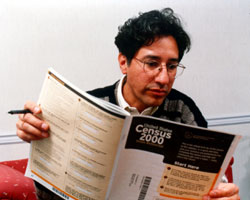
Man answering census questions

Millions of U.S. residents completed census forms in 2000, with one in six getting the “long form.” (Photo courtesy of U.S. Census Bureau)

Andris Straumanis is a special correspondent for and a co-founder of Latvians Online. From 2000–2012 he was editor of the website.