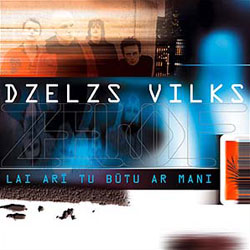
Industrial metal album is a rather dull affair

During the Rīga 800 celebration last year, one of the highlights for me was the all-day music performances on the big stage by the Daugava River. The entire day was devoted to all kinds of Latvian bands, of all different styles and sounds. Two bands caught my interest. The first was Deus sex machina (formerly named Deus ex machina), followed by Dzelzs vilks. It was a very hot day, and perhaps I was suffering from heat exhaustion, but it appeared that the groups were one and the same—no personnel changes happened between their sets. This is not a surprise as the guitarist, Juris Kaukulis, plays in both groups (as well as sings in Dzelzs vilks). I enjoyed their performance, as the group had a heavy, aggressive industrial sound, balanced by intricate keyboard parts.

After the performance, I picked up the Deus sex machina recording of the Fausts rock opera. Unfortunately, it was not to my liking, though the performances on the album were all good. On that recording, Kaukulis was joined by Andris Vilcāns (the composer of the music) on keyboards. Perhaps I would have appreciated the record more if I had actually seen the rock opera, but this compact disc rarely gets into my CD player.

After hearing and liking the song “Ledus” on the Black Friday Vol. IV compilation, I decided to pick up the latest Dzelzs vilks CD. The UPE Recording Co.‘s Web site explained that it is the band’s third album, but only the first to be released on CD. Even though I didn’t like the Fausts recording, my expectations were still high, since this was a different group on the CD, and the songs were the band’s own compositions. However, I found Lai arī Tu būtu ar mani a rather dull affair.

Kaukulis is joined by Armands Butkevičs on bass, Mārcis Judzis on drums and Kaspars Tobis on programming.  Kaukulis also wrote all the music and lyrics for the record.

The music is all in the industrial metal style. That on its own is not why I dislike the album, but it becomes clear from listening to the record that the participants spent a lot of time listening to bands like Nine Inch Nails and other industrial bands. This results the album sounding like a diluted Nine Inch Nails record, on which Dzelzs vilks tries to recreate the sound of a better-known band, but without great success.

It also seems at times that the guitar sound does not change much throughout the album. It remains in the “crunchy” style from beginning to end. This gives the album a repetitive sound and even after multiple listenings I have difficulty distinguishing between many of the songs.

The album starts out well enough with the title track “Lai arī Tu būtu ar mani.” It is a good introduction to the band, with heavy guitars, prominent synthesizers and Kaukulis singing like a soul in torment. The lyrics of this song also present many themes that reoccur throughout the album,  such as the pain of love and how generally miserable existence can be from time to time.

The recording of “Ledus” is slightly different than on the Black Friday compilation, sounding a bit more polished. This remains my favorite song on the album, becaues I think it has a good melody and is not too repetitive.

I also like “Vienas nakts meitene.” The song is quite different than the others on the album, starting off with a very pretty piano and guitar introduction. The track is less aggressive than the others on the album, and it is a good way for the listener to relax (if briefly) before the sonic assault of the rest of the album.

“Saplēstie stikli” has a very eerie piano introduction that is repeated within the song, though the “Whoa-oh” vocals start getting repetitive after a while.

The album ends with a remix of “Ledus” done by Alis P. Though not much different from the original, this remix brings the beat out more with a louder drum track.

Most of the other songs follow the same pattern—starting with a quiet introduction, then the guitars crash in—which is likely why I cant distinguish many of the tracks.

Though many of the songs show promise, this album was not to my taste at all. This is ideally meant for seriously devoted industrial fans (of which I am not one). The production on the album can also be quite muddy, as the crunchy guitars tend to drown everything else out. These guys have talent and have some interesting synthesizer loops,  but there is not too much of interest on this record for me. You could classify the music as hard rock, but its industrial influences make Dzelzs vilks a far different group than, for example, Līvi, so it would not be fair to compare them. Fans of industrial will likely find everything they are looking for here (synthesizer loops, crunchy guitars, angst-filled lyrics), but I must pass on this one.

Details

Lai arī Tu būtu ar mani

Dzelzs vilks

UPE Recording Co.,  2001

Egils Kaljo is an American-born Latvian from the New York area . Kaljo began listening to Latvian music as soon as he was able to put a record on a record player, and still has old Bellacord 78 rpm records lying around somewhere.

Police seek public’s help to solve murder

Quebec police have asked the public for information in the shooting death early last year of a 40-year-old Latvian man suspected of having ties to the Russian mafia, according to the Montreal Gazette.

The body of Voldes Ousinsh (Valdis Osiņš) was found Jan. 4, 2001, in Pointe Fortune, Quebec, near the Ontario border. The Surete du Quebec issued its public appeal July 9 after discovering that a gun involved in the accidental wounding of a teenager in Cote St. Luc also was used to kill Ousinsh.

The teenager was injured May 4, the Gazette reported, when another teenager was showing off the gun to friends. The youth is not a suspect in Ousinsh’s murder.

Investigators have said they believe Ousinsh was killed elsewhere and his body dumped in Pointe Fortune, the newspaper said. Ousinsh had a record of credit card fraud and had used several aliases since 1997 when he arrived in Canada, the Gazette reported.

Andris Straumanis is a special correspondent for and a co-founder of Latvians Online. From 2000–2012 he was editor of the website.

Fantasy gives way to reality of NATO

Three or four years ago, I read a science fiction novel written in 1924 by the Latvian author Gotfrīds Mīlbergs. The novel, set in the year 2107, begins with the new Russian Empire invading Latvia. Through a combination of advanced technology, stealth, the legendary prowess of the Latvian soldier and a certain degree of serendipity, the Latvian military manages to repulse the attackers.

But, continues the author of Sidrabota saule lec…, the Latvians don’t stop there. Their doggedness leads to the collapse of the Russian military and, by story’s end, Latvian soldiers are patrolling the streets of Moscow.

The NATO defense alliance, or something like it, was nowhere to be seen.

But this is science fiction—and fantasy. The reality is that against such a formidable foe Latvia and much of Eastern Europe could well crumble without military assistance from abroad.

The residents of Latvia know this. In the results of a survey released April 10 by the Latvian Foreign Ministry, 81.8 percent of those polled were sure that in the event of such a crisis, Latvia would not be able to defend itself. That’s why nearly 64 percent of those polled were positively oriented to Latvian membership in NATO.

That’s what I told an audience of students and faculty when I moderated a roundtable discussion in April at the University of Wisconsin – Eau Claire. The session, “The Security of East Europe and the Expansion of NATO,” was sponsored in part by the university’s Baltic Student Organization and also featured Professor Paulis Lazda, who teaches history at Eau Claire, and several international students including Sanita Kupča of Latvia.

I remain skeptical about the need for Latvia to join NATO. But during the past several weeks, my skepticism has begun to mellow, particularly now that Russian President Vladimir Putin has gotten cozy with NATO.

This November in Prague, 10 Eastern European nations are hoping they get to join the NATO alliance. Observers are confident the Baltic nations—Estonia, Latvia and Lithuania—will make the cut. And some are even forecasting that countries such a Romania, whose prospects earlier were dim, might get an invitation thanks in part to the “new world” in which we live since Sept. 11.

But can a country such as Latvia afford to bring its military up to a level desired by NATO—and maintain that level? Would NATO membership really guarantee that Russia or any other nation or movement would not attack Latvia? Is it the proper role of the United States, Canada and Western Europe to protect Eastern Europe—and from what?

On the other hand, why should Latvia trust Putin’s Russia? When Putin last November visited the United States, he suggested that Moscow would no longer stand in the way of NATO membership for the Baltics. Why? Because, he suggested, NATO has outlived its purpose. Perhaps it has. So then why did Putin go to Rome in late May to strike a new agreement for NATO-Russian cooperation? And why is Russian Foreign Ministry spokesman Alexander Yakovenko still saying that NATO expansion would “unequivocally qualify as a mistake”?

Until these recent events, I used to believe that NATO membership for Latvia would be rather worthless nose-thumbing toward Russia. The only “enemy” Latvia might potentially have is Russia. Why antagonize it needlessly? Plus, I had to wonder if Russia decided to do something silly like invade Latvia, would NATO really rise to defend a small nation on the Baltic Sea?

I still harbor those doubts. But they have become overwhelmed by questions about Russia’s motives for its renewed interest in NATO. Perhaps my skepticism of Russia’s motives is shaped by growing up Latvian in the United States. I imagine the skepticism would be even stronger if I had lived in Latvia during the decades of occupation. Regardless, it’s troubling that Russia has rushed ahead to form closer ties to an organization it has viewed as an anachronism and an insult, while Latvia and the other candidate nations are forced to wait until November to learn whether they’ll be asked to join the club.

In a fantasy world, Latvia would have no need for the defense alliance. But in the real world, it’s time to expand NATO.

Andris Straumanis is a special correspondent for and a co-founder of Latvians Online. From 2000–2012 he was editor of the website.