If there’s a darling of the popular music business in Latvia these days, it has to be BrainStorm (Prāta Vētra). The group, led by the exuberant Renārs Kaupers, has won the hearts of fans in Latvia, who have watched and cheered as the group has become the country’s best-known band both at home and abroad.
Formed in 1989 by high school classmates from Jelgava, BrainStorm released its first single in 1992. Several singles and albums have followed, each one garnering a larger fan base in Latvia and, gradually, in neighboring countries.
Its third-place showing in the 2000 Eurovision Song Contest raised interest in the band throughout the continent, earning it further exposure and record deals. Being the warm-up act for The Cranberries during part of the Irish band’s recent European tour didn’t hurt, either.
And now the band is set to stir up a storm as it plays to fans during the Latvian Song Festival in Chicago this week. Those who never have seen the band perform in Latvia will get a chance to see lead singer Kaupers, guitarist Jānis Jubalts, bassist Gundars Mauševics, drummer Kaspars Roga and keyboardist Māris Mihelsons play both at the Club Metro on July 19 and at an official song festival dance July 20.
BrainStorm’s latest albums, the English-language Online and the Latvian-language Kaķēns, kurš atteicās no jūrasskolas, share music but not lyrics. Both were released last year and singles from Online continue to earn impressive results in pop music polls around Europe. The album recently went gold in Poland (selling 35,000 units), and the video for “Waterfall” made it to the top spot on Slovakia’s pop chart as well as the MTV Nordic chart.
Between touring and getting ready for Chicago, Kaupers via e-mail answered some questions about the band and the changes it has seen over the years.
Q: How did the group come up with the name BrainStorm (Prāta vētra)? Were there other choices, and why didn’t you pick those?
The idea came from our drummer Kaspars’ aunt, who by the way is from America. She went to one of our first concerts in the Jelgava high school, and afterwards said that was some kind of brainstorm. As you know, “brainstorm” in English means when ideas happen or are generated. We translated BrainStorm to Latvian and got Prāta vētra. Of course, there were other choices, such as Swordfish or, in Latvian, Zobenzivs.
Q: Just a few years ago you were a new and pleasant group from Jelgava, but now you are known in a number of European countries. You no longer have concerts just in the homeland, but everywhere, soon even in the United States. Your music videos are professionally produced, you’ve appeared with The Cranberries, etc. What in your opinion has changed, and what has stayed the same?
The most important thing is that we began playing music as friends—and we still are friends. During these years our friendship has become closer. BrainStorm is like our second family. We’ve changed musically and, we want to believe, have become more professional.
Q: Two years ago BrainStorm earned third place in the Eurovision Song Contest. At the time, some predicted big things for you. Was the Eurovision result meaningful for BrainStorm’s development outside Latvia. And will BrainStorm benefit from Marija Naumova’s victory this year?
Of course, we can’t deny the meaning of Eurovision to BrainStorm’s success. But Eurovision by itself was not our goal. Rather, we saw it as a platform and a way to draw attention to ourselves, because it’s hard for a group from Eastern Europe to show the Western world that we too can record songs that meet Western technical standards. Eurovision has a gigantic audience and even though we don’t play the kind of music usually heard in Eurovision, from our vantage point it doesn’t matter whether you’re playing in the Glastonbury festival in Great Britain or in Eurovision, because everywhere the audience always is and will be people. Marija’s victory of course reminded those who had forgotten that two years ago BrainStorm got third place. In my opinion, that’s good. And every such victory or gaining of attention is good for all Latvian popular music.
Q: As with many other groups, the group’s leader becomes a star while the others stay in the background. We often see or read about Renārs Kaupers doing this or that. On your Web site it’s Kaupers who provides news. Kaupers starred in a film, Vecās pagastmājas mistērija. And so forth. What do the other group members think? Are they jealous? Do they also have side projects?
I’m the singer and I’m the one who has to appear out front on stage. And because of that I’m also the focus of attention. But day to day, working on albums or music videos or other things, we are all equally valuable. Everyone can speak his mind—we have a democracy. I think the others aren’t jealous and they may even have it better, because they have to work less. For example, when we were in Prague filming the video for “Maybe,” on the second day I was practically the only one from the group who had to be in front of the camera. The rest of the them could wander the streets of the Old City and soak up the sun. Perhaps at times I’m jealous of them!
Q: It is the rare Latvian musical artist who can make a living just with music. What about BrainStorm? Do you have enough work?
We used to all have other jobs, but then we understood that if we want to give ourselves completely to music and to prove ourselves outside Latvia, then we have to concentrate only on music. That’s what we did.
Q: What is your opinion of your recordings? How have your music and lyrics changed in recent years?
A person changes over the years and is influenced by various things, feelings and people. Each album we try to record as the best, concentrating all our energies and skills. Right now we’re working on new songs for a new album, and we’re doing it with the same attitude. If you’re not “on fire” about it, it’s not even worth doing. Our musical style has change over time, as we search for our own way of expressing ourselves and new directions. At present, we’re searching for a producer for our new album, someone who sees the big picture. The right producer is important, because they for the moment become the sixth band member. In terms of lyrics, those are inspired by specific events, specific people, specific things at specific times in our lives, but they can just as well be brought on without specific occurrences or thoughts. Sometimes that works better, because the musical material is primary. Sometimes inspiration can come from ice cream or even an ironing board.
Q: Online and Kaķēns, kurš atteicās no jūrasskolas represent the second time BrainStorm has released English and Latvian albums simultaneously. Will you continue to do that, or will you drop Latvian at some point and record only in English? And what about Russian?
I think we’ll continue to record in both languages—Latvian for Latvia and English for abroad—because our audience in Latvia is very broad, from little children to gray-haired gentlemen and ladies, and not all of them understand English. (To do otherwise) wouldn’t be right, because they are our dearest and most loyal fans. We did record one song in Russian, but for now we don’t feel it’s necessary to sing in Russian. Our English albums have been released in Russia, our songs are played on the radio and our videos have been shown on Russian MTV.
Q: In July you head to Chicago to participate in the Latvian Song Festival. It won’t be your first time in the United States, but do you have any plans to try to achieve something in the American music market?
I know that our recording company, Microphone Records (MICREC), has contacts in America through which they are trying to arrange something. But America is one of the largest markets in the music industry. It’s not easy to break into it. Besides, America has different kinds of music. Even groups from Great Britain find it hard to break in, not to mention groups from elsewhere in Western Europe. Of course, we won’t give up hope and will do all we can. However, for now we definitely are concentrating more on Europe. As someone from a record company once told me, at first you have to gain success in your neighboring countries and then, gradually, farther and farther away. We’ve had success with that, in Estonia and Lithuania, also Poland, and now the Czech Republic and Slovakia, as well as Scandinavia.
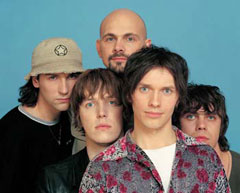
BrainStorm includes, from left, drummer Kaspars Roga, keyboardist Māris Mihelsons, guitarist Jānis Jubalts, lead singer Renārs Kaupers and bassist Gundars Mauševics. (Photo courtesy of MICREC)
Andris Straumanis is a special correspondent for and a co-founder of Latvians Online. From 2000–2012 he was editor of the website.