Reunion visitors remember Auseklis high school

“Viņš ir Filadelfijā.” He’s in Philadelphia. “Viņa mira.” She died. Snippets of conversation revealed some of what has happened in the half century since a Latvian high school in Augsburg, Germany, closed its doors as Displaced Persons began to move to new homes overseas.

Former students of the Auseklis high school, which from 1946-1950 served students from two Displaced Persons camps, met July 21 during the 11th Latvian Song Festival in Chicago. The gathering was organized by Biruta Abula of Michigan, herself a 1949 graduate of the school. She’s been collecting information about her former classmates for a number of years.

The reunion was one of several gatherings of former DPs held during the song festival. Other groups that met included those from Esslingen and Wuerzburg.

The Latvian students came from the Hochfeld and Haunstetten camps, according to Abula. The high school, or ģimnāzija, came about at the urging of American military officials who were in control of that part of Germany after World War II. About 250 students attended the school, Abula recalled. The high school represented part of a refugee educational system that included elementary schools and institutions such as the Baltic University (Baltijas universitāte).

Abula said she thought only about five people would show up. Instead, more than 25 came to peruse lists of students Abula has tracked down, reminisce over old black-and-white photographs and share stories about their classmates and teachers.

It was clear that for these former students, their high school years are remembered fondly. In one photo album, images showed smiling students posing together for class pictures. A few portrayed athletic and cultural activities, such as dancing. Reunion participants pointed out each other, telling tales as they went. Some reassembled to have new class pictures taken.

If time allowed and the participants were willing, the reunion would have been a wonderful opportunity for Abula to record what these former high school students remembered about their time in Augsburg. Abula admitted it’s hard to convince people to make the effort.

But the effort has to be made. Too much of Latvian history, both in Latvia and abroad, has been lost. In the case of the Displaced Persons camps, some work has been done to retrieve that history, but much remains. Rediscovering stories such as those of the Auseklis high school would serve not just to rekindle the memories of former students, but would help all of us understand the formative years of a generation that for many years led exile cultural, social and political life in the United States, Canada and elsewhere.

And with hundreds of thousands of displaced persons still wandering the globe, thanks to any number of conflicts that have upset many homelands, improved knowledge about the Latvian DP experience might help others to deal with their particular need for ethnic survival.
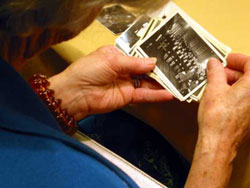
Looking at old photo

A reunion visitor looks through a handful of old photographs of the Auseklis camp high school. (Photo by Andris Straumanis)

Andris Straumanis is a special correspondent for and a co-founder of Latvians Online. From 2000–2012 he was editor of the website.

A song festival diary: Final day

CHICAGO—Compared to the excitement of the previous day, Sunday morning proved downright low key. The faithful flocked to either the ecumenical Christian church service in the seventh floor ballroom of the Marriott Hotel or—two floors lower—to a service hosted by followers of the folk religion dievturība.

Meanwhile, miles away in the UIC Pavilion, hundreds of singers were rehearsing for the main event: the unified choir concert set to start at 3 p.m.

The festival choir concert filled the UIC Pavilion with the sounds of many Latvian choral standards, such as “Gaismas pils” and “Tēvijai,” as well as some newer works. Among the latter was “Skaista, balta viešņa gāja,” an arrangement by Selga Mence commissioned by the song festival organizing committee. Conducted by Monika Dauksts-Strautniece, the performance featured the sweet soprano voice of soloist Arnita Eglīte.

Including the American and Latvian national anthems, the choir performed 26 songs. But with audience demands for six encores, the more than 600 singers presented a nearly three-hour program.

Choir conductors came from the United States, Canada and Latvia. Perhaps the most entertaining was Māris Sirmais, who also founded and conducts the youth choir Kamēr of Rīga. His sweeping signals to the choir helped the singers express the emotions of songs. Sirmais at one point rewarded the choir by running up to it and tossing flowers to the singers.

Honorary choirmaster Roberts Zuika led the choir in its performance of the classic, “Gaismas pils.” Zuika is known in part for his work in organizing Latvian men’s choirs in the United States.

The concert ended on an emotional note with a performance, sung with the audience, of Vilis Plūdonis’ patriotic hymn “Tev mūžām dzīvot, Latvija.” Perhaps realizing that the festival was coming to a close—and that many participants and festivalgoers would not see each other again for a while—a number of people had tears in their eyes.

But the festival wasn’t quite over yet.

Once again, those who wanted to take in the musical “Lolitas brīnumputns” had to rush back downtown to get to the Merle Reskin Theater. And then there was still the final dance, with music provided by Denver’s Jūrmalnieki and Chicago’s Vējš.

The dance provided clear evidence that the festival was on the wane. Gone was the formal attire of the previous night. Gone were the long lines at the bar. Gone was the smothering heat of the room. The dance provided an opportunity for reflection about the festival and, late into the night, for good old Latvian nīkšana.

By Monday morning, it seemed as if a song festival had never happened in Chicago. Only a few, fleeting bits of Latvian could be heard in the elevators and in the lobby, most of it quickly replaced by the banter of biomedical products salespeople.

But one bellboy was still in the spirit, wearing his song festival pin and telling departing guests “atā” before closing the door to their car.

Andris Straumanis is a special correspondent for and a co-founder of Latvians Online. From 2000–2012 he was editor of the website.

A song festival diary: Third day

CHICAGO—Already some song festival participants were dragging their feet when morning came, especially those who had stayed up and out the night before, perhaps forgetting that dance and choir rehearsals began early.

While they prepared for the first big show later in the day, festivalgoers had more opportunity to peruse the arts and crafts fair or take in other events. Among the first was a program focusing on prose and poetry, with readings by a number of well-known Latvian authors. The master of ceremonies was Oļģert Cakars, himself a poet and cofounder of the Latvian Writers Association (Latviešu Rakstnieku apvienība, or LaRA). He introduced the writers and spent a few minutes with each in a mini-interview. Among those presenting were Māra Zālīte, one of modern Latvia’s best known poets and playwrights, and Ingrīda Vīksna, and poet and editor of the Toronto-based weekly Latvian newspaper, Latvija Amerikā.

The sparsely attended Baltic NATO conference nonetheless provided an opportunity to hear a pan-Baltic perspective on the effort to expand the defense alliance.

Although Latvia, Estonia and Lithuania are sure to be invited to join NATO during the upcoming Prague summit, speakers warned that much work will remain. Confirmation by the U.S. Senate won’t come easy, said Jānis Kukainis, chair of the World Federation of Free Latvians. “Russia will continue dumping on us,” he said. The government of President Vladimir Putin has set aside funds to challenge NATO expansion, according to Saulius Kuprys, president of the Lithuanian-American Council.

Several speakers’ comments were focused on lobbying efforts, both within the Baltic communities as well as among state and federal lawmakers. One effort mentioned by Dace Copeland, president of the American Latvian Association, focuses on state legislatures adopting resolutions in support of NATO. To date, only six states have done so.

Valdis Pavlovskis, head of the Baltic American Freedom League, addressed various issues that face Latvia in its bid for NATO membership. Baltic organizations, he said, need to develop a strategy for confronting concerns such as perceptions of anti-Semitism and government corruption in Latvia, sticking points that could damage the nation’s NATO bid.

The morning was capped off with a program of spiritual music performed at the 4th Presbyterian Church.

However, the big event of the day was the festival folk dance performance in the UIC Pavilion. Technology and tradition merged as a large screen displayed various video feeds of dancers in action (including one bird’s eye view looking straight down) while the folk groups Jūrmalnieki and Lini provided live music for the three-hour program.

With a theme titled “Deju laika solī” (Steps In Time), the performance showcased 29 folk dances. Among them was “Dodamies uz Rīgu,” the all-around winner of the new choreography competition held July 19 (see sidebar). Other dances included favorites such as “Ačkups,” “Jūŗa, jūŗa” and “Vidzemes polka,” which saw an encore.

A total of 30 groups with more than 600 folk dancers participated in the show. Ilmārs Bergmanis, chair of the song festival organizing committee, later estimated that 9,500 people attended the performance.

While some rushed back to downtown Chicago for the second performance of the musical “Lolitas brīnumputns”—perhaps spurred by glowing word-of-mouth reviews—others trudged back to their hotel rooms to cool off before the evening’s two balls.

The two balls were held on two different floors of the Marriott Hotel, connected by escalators. On the fifth floor was the official festival ball, with music provided by Los Pintos. The ball, which started at 9 p.m., was heavy on polkas and slow dances.

Meanwhile, the youth dance on the seventh floor had to wait until 11 p.m. to get started as the Latvian rock group Prāta vētra (BrainStorm) dealt with sound checks and other technical issues. Even then, it was clear that the ballroom was no place for a rock band. BrainStorm seemed quiet and reserved, compared to the band’s performance the night before in The Metro.

Despite the heat in the room, young fans who had never seen the band play live appeared happy to be there.

Andris Straumanis is a special correspondent for and a co-founder of Latvians Online. From 2000–2012 he was editor of the website.