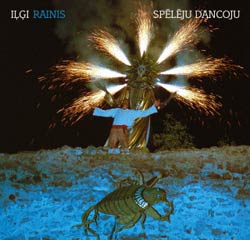
Mythological songs, atmospheric arrangements for traditional instruments and postfolkloric freedom of interpretation are qualities usually associated with Iļģi, the best-known Latvian folk music group. Therefore it was a surprise last year to see the group in the capacity of theatre music authors—and for nothing less than “Spēlēju, dancoju” (I Play and Dance), the classic Latvian phantasmagoria by Jānis Rainis.
The play was a part of the programme of the International Festival of Contemporary Theatre Homo Novus 2001 during September 2001 in Rīga. The soundtrack has now been released on compact disc by UPE Recording Co.
“Spēlēju, dancoju” was staged by the Lithuanian puppet theatre Miraklis, well-known for its phantastic stagings of mysteries. The Rainis version of the orphic myth suited it well. Iļģi were chosen to create the music, and the result is more than an hour of a fresh, vivid and inspiring material that could be labelled as an ethno-rock musical. (Imants Kalniņš in 1977 composed the play as an opera.) It is amazing that even without seeing the play, the music can reveal all the phantastic and intricate visuality of the play.
The melodies are composed basically by Ilga Reizniece and Gatis Gaujenieks. Some motifs are traditional, such as the wedding dance “Tūdaliņ, tagadiņ,” “Apaļdancis,” the funeral tune and, partly, “Spēlēju, dancoju.”
The arrangements and instrumentation not only take on the character of the episode, but add some unexpected, almost mythical, dimensions. For example, on “Ko tu ‚rdies? Vai tev pr‚ts?,” a slow and deep-pitched reggae takes us to the strange abode of the Mole-cricket, its character skillfully transmitted by the unbelievable vocalisation of the “r” sound. The heavily distorted sounds of kokles and guitar evoke the depressing feeling of the realm of Kungs, the lord of the Netherworld (“Ha, ha! Kungs, vesels dzēris!”). The appearance of the dead Lelde to the satanic society is hardly possible without unusual powers, and the electrifying sound of tanpura, providing allusion to Oriental mysticism, does the job (“Vedat Leldi! Taisat kāzas!”). Similarly, on “Acis veras—aizveras,” the tabla-like sounds accompany Lelde’s fight for life.
Both the public and professionals have given high praise to the music and to the performances. Particularly lauded have been the leading roles of Tots (played by Gatis Gaujenieks), and Lelde and the Mole-cricket (both played by Rūta Muktupāvela). Also, Kaspars Putniņš’ vocal group is excellent. My youngest daughter listened to this recording five times a day for three months, and not just because her mother (Rūta Muktupāvela) and uncle (Māris Muktupāvels) sing on it. Can you make a 9-year-old listen to any music they dislike?
All the recording, mixing and mastering was done in the GEM studio by Iļģi member Gatis Gaujenieks, who also made most of instrumentations and programming. The CD has the high-standard cover design characteristic of other UPE albums, especially those in the Latvian Folk Music Collection. Ieviņa Liepiņa wrote the liner notes about the music while Janīna Kursīte wrote about the contents and symbolism of Rainis play. Full text of the Iļģi version of “Spēlēju, dancoju” is included, thus permitting the listener to follow the play in detail and to catch all the nuances otherwise lost because of the old-fashioned language style.
(Editor’s note: In the interest of full disclosure, it should be noted that Spēlēju, dancoju performer Rūta Muktupāvela is the author’s wife and that his brother, Māris, is a principal performer in Iļģi.)
Details
Spēlēju, dancoju
Iļģi
UPE Recording Co., 2002
UPE CD 038