Why can’t being Latvian be part of our ‘real world?’

I’m in a mood to quibble, but let me first set the stage. It was a fast and furious summer for many students at the Gaŗezers summer high school near Three Rivers, Mich. Between the usual classes and other activities, there was the 11th Latvian Song Festival to attend in Chicago. And as usual, there were any number of “student life” experiences: learning once again how to live with four or five other people in one small room, falling in or out of love, not getting caught with a cigarette or a beer in hand.

But it was all good, or so it seemed based on what I saw during this past weekend’s commencement ceremony. Judging by the tears streaming down the faces of graduates and continuing students alike, there is no worse punishment in life than to be ripped from the ethnic wonder that is Gaŗezers to be replanted into the “real world.”

Symbolizing this best was Artūrs Bērziņš, the graduating student chosen to deliver the commencement speech. Listening to his emotional and tearful farewell, many of his classmates were soon crying as well. Heck, I tried to hold back tears, too, and I don’t even know the kid nor did I ever attend the summer high school.

To be sure, there’s something special about the Gaŗezers high school. My daughter tells me her Latvian friendships often run deeper and truer than those she has developed outside of Gaŗezers. Next year she’ll face the emotional roller-coaster of a Gaŗezers graduation, but she’s already vowing to return the year after as a camp counselor.

For many, Gaŗezers is a world apart.

“Zinu, ka es pēc dažām dienām atgriezīšos īstajā pasaulē,” young Bērziņš said during his commencement speech. He knows that in a few days he’ll return to the real world.

The notion that Gaŗezers is a sanctuary, a dream or a little Latvia was hinted at by other speakers as well. Out there, the real world awaits, but here, in Gaŗezers, we’re free to be ourselves.

So let me quibble: Why must we who live outside Latvia separate our “Latvian world” from the “real world”?

What are we afraid of? That people won’t understand us? That we’ll be laughed at because we have funny, non-Anglo names, eat yucky foods like smoked eel and head cheese, and go prancing around a bonfire in the middle of summer?

Or are we afraid that if we allow any linkage between our “Latvian world” and the “real world,” the creeping power of assimilation will eventually erode what sets us apart?

How many of us, once in the “real world,” avoid speaking Latvian to each other so as not to stick out in a crowd of Americans or Canadians or Australians or whatevers? How many of us have modified the pronunciation—or even the spelling—of our names, just to “make it easier” for non-Latvians? How many of us have allowed our Latvian heritage to become an interesting appendix to our life story, rather than the theme that runs throughout?

Our organizations and institutions, such as Gaŗezers, provide us a safe haven, a space in which we can recharge our Latvian batteries. But if we see them only as refuge, rather than part of our “real world,” how long will we be able to maintain them?

The majority of Latvians Online readers don’t live in Latvia. Most of us don’t have the opportunity to speak Latvian on a daily basis outside of our immediate families. The language of commerce, of education, of government and of culture, for many of us, is rarely Latvian. It seems pretty clear that the “real world” has little use for us as Latvians.

And how could it, if we keep separating it from our Latvian world?

In her fiery address to the graduating class at Gaŗezers, long-time teacher Mirdza Paudrupe summoned students to the good fight, the fight for Latvia’s future. Perhaps some of the 34 graduates will eventually live and work in Latvia, finally combining their “Latvian world” with their “real world.”

But what about the rest of us? What about our “real world?”

Sign at Gaŗezers

Gaŗezers is a refuge where Latvians can be Latvians. But why can’t it be part of the real world, too? (Photo by Andris Straumanis)
Andris Straumanis is a special correspondent for and a co-founder of Latvians Online. From 2000–2012 he was editor of the website.

Sure, they’re cute, but is that enough?

4.elements

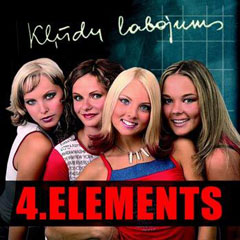
The debut recording by the all-girl group 4.elements proves several things at once: They can sing in Latvian. They can sing in English. They can take a Latvian folk song and put it to a Eurodance techno beat. And they can overdo it.

Staring at the cover of the compact disc, you really want to like these girls, named Erita Karlsone, Līga Ozola, Zane Ozola and Rūta Reinika. They’re cute, after all. And they’re not without talent and musical pedigree, as their thank-yous in the liner notes—as well as their voices—make clear. Unfortunately, this recording does little to really show what they can do.

The group was formed in 2001. Although the girls have been active in various musical productions for several years, they perhaps became best known in Latvia as finalists in the national Eurovision competition with the Arnis Mednis and Lauris Reiniks song, “Remember.” Mednis is a well-known pop and blues artist; Reiniks is a relative newcomer whose popularity has grown quickly and whose sister is among 4.elements members. Although they didn’t advance to the international contest won by Latvia’s Marija Naumova, 4.elements were in good company and certainly made their mark.

But I doubt we’ll ever see another album by them, at least not as 4.elements. Maybe it’s wishful thinking, but the era of boy bands and girl bands can’t last much longer.

Kļudu labojums is in a way two different CDs. The first four tracks, two in English and two in Latvian, are pop songs. And the first two, “Remember” and “Kļudu labojums,” are catchy.

The second part of the album, seven of the 11 tracks, is a series of well-known Latvian folk songs put to a techno beat by Mednis. They’re referred to on the album cover as “digitālas dainas” (digital dainas). I’m glad to see that folk songs live on in different genres, but this is really nothing new. The first song, “Laivinieka meita biju,” is actually rather fun. I could imagine this being played as a workout song. It’s got repetition and movement in it, with a number of “Hei!” yelps for those high kicks.

But tracks six through 11, including a “digital” version of the beautiful “Kas tie tādi, kas dziedāja,” wear on the listener. There’s only so much techno-folk one can take. Of course, this kind of music is meant to be moved to, not listened to intently.

If nothing else, Kļūdu labojums has given the four singers some exposure. Now let’s see what they can really do.

Details

Kļūdu labojums

4.elements

Platforma Records,  2002

PRCD 075

Andris Straumanis is a special correspondent for and a co-founder of Latvians Online. From 2000–2012 he was editor of the website.

Gregorian chants bring on electroshock

When the editor asked if I would be interested in reviewing a new compact disc of Gregorian chant from the Schola Cantorum Riga, my curiosity was piqued and I agreed. I couldn’t recall having come across a recording of medieval religious chant from a Latvian source before.

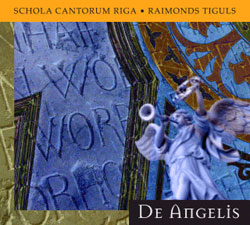
When the disc arrived, I took a quick look at it, admired the handsome packaging, then put it aside until I could spend some time with it. Eventually, I settled down with the disc, hoping for some pleasant listening. As sounds emerged from my headphones, I sat up in amazement. What’s this? A synthesizer?! I thought this was a disc of vocal music! Taking a more careful look at the back of the CD folder I examined at the fine print and saw that, in addition to the four vocalists, the group’s leader was listed as playing “keyboards.” Eventually I did hear voices, singing the traditional chant I had been expecting to hear, but the electronics continued in the background throughout the entire disc.

So, what did I make of this unexpected accompaniment? My first reaction was shock. Why would anyone want to “enhance” these beautiful, unaccompanied tunes that had survived over the centuries and are still being sung plain and unadorned to the glory of God? My second reaction was anger. The disc was credited as having been “arranged and produced” by Raimonds Tiguls, the group’s leader. However, nowhere on the packaging does it clearly state that all the tracks feature a synthesized backdrop of sound. Inside the trifold jacket, the skimpy notes (three sentences!) open with the statement “This album is based on traditional Gregorian chant…” but provides no rationale for the arrangements.

Well, in all fairness, plainchant did undergo an evolution over the centuries, serving as a basis for much of the glorious polyphony that presaged choral music as we know it. However, this was organic development that grew directly from the chant itself and the resulting polyphony successfully stood on its own, with the original chant often submerged and only subtly apparent. Instrumentally, many of Johann Sebastian Bach’s organ preludes based on Lutheran chorales were created in much the same fashion, with composers before and after him applying the same compositional principles, with varying degrees of subtlety and complexity.

So, there is precedent for using chant as a basis for new musical works. But that’s not what’s happening here. These newly composed electronic backgrounds are mostly an annoying, unnecessary distraction rather than an outgrowth or development of the original melodies, and often seem to be a rather blunt attempt to “strengthen” the sense of implied harmonic progression in the melodic outline of the original chant. While sometimes imitating familiar instrumental timbres, they are all too often just a variety of generated and sampled sounds clearly emanating from an electronic source, their gentle swooping a sort of aural equivalent of a lava lamp.

Nonetheless, there are some positive aspects. First, the singers are terrific! Not quite the seamless blend of Anonymous 4, but a very skilled and musically attractive male counterpart at the very least. I would love to hear them sing this repertoire without the superfluous backgrounds. Second, their Latin pronounciation is impeccable! After the many discs I’ve heard and reviews I’ve written complaining about the localized pronounciation of Latin, this comes as a breath of fresh air. Bravo! Third, the final track, an original, purely instrumental composition by Raimonds Tiguls, is intriguing.

I will admit, after additional hearings, that the accompaniments are varied, generally artfully and musically done, and become less offensive (except when a “pop” beat threatened to break out in the background a couple of times!). But they’re superfluous! Are contemporary listeners truly afflicted with such limited attention spans that they need additional aural stimulation to make this beautiful music more palatable?

If you think this may be your cup of tea, or if you’re desperate to hear this wonderful group despite the electronic baggage, then go for it. Otherwise, buyer beware!

Details

De Angelis

Schola Cantorum Riga and Raimonds Tiguls

UPE Recording Co.,  2001

UC004