Concerns raised over Radio Free Europe’s future

Leaders of the Baltic states, including Latvian President Vaira Vīķe-Freiberga, have sent letters to U.S. President George Bush asking that his new budget not slash Latvian, Estonian and Lithuanian broadcasts on Radio Free Europe.

Although the proposed budget for fiscal year 2004 won’t be announced until early February, rumors have circulated for weeks that the Baltic language services could be dropped as early as October, now that Estonia, Latvia and Lithuania have been invited to join the NATO defense alliance.

Lithuanian President Valdas Adamkus and about a third of the country’s members of parliament sent a letter Jan. 15 to Washington, D.C., asking the Bush administration and the Congress to spare Radio Free Europe and Radio Liberty (RFERL) from the budget axe, according to Baltic News Service.

Also sending a letter was President Vīķe-Freiberga, said her press secretary, Aiva Rozenberga.

A similar letter was sent by Estonian Prime Minister Siim Kallas, government spokesperson Hanna Hinrikus told Latvians Online by telephone from Tallinn.

“[I]n these uncertain times, and as the war on terrorism continues, it is very important that Estonians continue to receive timely and comprehensive information about international affairs that will help elucidate the meaning and significance of world events,” the letter from Kallas says. “Radio Free Europe is the Estonian-language media organization most capable of meeting this challenge.”

Publically, RFERL officials are saying little about what the proposed budget might hold for them.

“We’re gratified by the support that President Adamkus and the parliamentarians have expressed,” Mārtiņš Zvaners, RFERL’s associate director of communications, told Latvians Online in reaction to news of the Lithuanian letter.

The Broadcasting Board of Governors, which oversees Radio Free Europe and other services such as the Voice of America, also said it was not aware of plans to cut back service.

White House officials did not respond before this story was published.

Rumors about the Bush budget suggest that the language services for all seven NATO candidates could be slashed from RFERL. In November, NATO invited Bulgaria, Estonia, Latvia, Lithuania, Romania, Slovakia and Slovenia to join the defense alliance. The membership process could be completed by 2004, but the new federal budget, which will have to be approved by Congress, would go into effect this October.

The Broadcasting Board of Governors’ fiscal 2003 budget totals more than USD 477 million.

The broadcaster’s Latvian service includes editorial offices in RFERL’s headquarters in downtown Prague, capital of the Czech Republic, as well as a local office in Rīga. The Latvian service broadcasts every day with programs lasting from 5 minutes to an hour. The broadcasts may be heard on shortwave and, through local affiliates, on Latvian medium wave stations, as well as on the Hotbird 3 satellite service.

Andris Straumanis is a special correspondent for and a co-founder of Latvians Online. From 2000–2012 he was editor of the website.

Arts fest inspires a northern youth

Brisbane is an Australian city often perceived as a country town, but that just happens to house almost two million people. Part of this perception comes from very public instances—both historical and contemporary—of not only intolerance toward cultural diversity, but active campaigning against it. Despite this, Brisbane is a rapidly growing city that has come to celebrate its cultural diversity.

The Brisbane Latvian community is not only significantly smaller than its southern counterparts, but is also aging—rapidly. The Senatne Dance Group disbanded more than a year ago (and prior to that danced without boys for eight years). My generation is rarely even seen as members of the audience, let alone participating, and sadly my parents’ generation is the same. Culturally, the Brisbane Latvian community has three active groups: Beverīna Choir, Senči Dance Group and Zigrīda Ensemble (the latter being the only one composed of young people, and we vary in size from two to six participants, all of whom are female).

Therefore, traveling from Brisbane to the 49th Australian Latvian Arts Festival in Sydney was indeed an experience.

My initial shock concerned the amazing array of young people who not only participated—dancing, singing, acting and playing instruments of all descriptions—but who also were an extraordinarily supportive audience. Those who attended the youth concert will recall the cheers of support issued to the performers not only by their families, but their peers.

I mention this phenomenon especially in relation to recent political policies that have made a commitment to recognising the importance of youth participation. Young people are the future, and without nurturing, supporting, encouraging and celebrating their active participation, Latvian philosophies, ideals and communities will cease to exist. I hope everyone involved in the arts festival is aware of how special it is in contemporary society to have young people participate in community activities. Not only do your young people have language skills and a desire to participate in a unique cultural expression, but an interstate network of peers with whom they have shared, explored and grown with.

My alienation from this gave me the opportunity to observe the phenomenon with both great pride and great sadness. Pride in knowing that despite cultural policy and social intolerance, my community managed to pass on its cultural heritage to younger generations. Sadness, because my participation in that was inevitably restricted, due (in part) to my somewhat self-induced alienation.

The second phenomenon I experienced—a phenomenon that is still having repercussions on my life—was the post-folk group Iļģi.

I have been part of Zigrīda Ensemble for about seven years and in this time have witnessed (and perhaps encouraged) a move to diversify our repertoire. Having limited access to sheet music has meant that much of our evolution has come from listening to compact discs brought back from overseas and attempting to emulate those sounds. Iļģi have played a part in that evolution, especially with regard to presenting the possibility of erring away from a classical aesthetic and edging towards a uniquely Latvian sound.

I am aware that Iļģi have made a commitment to maintaining and developing the tradition of folkloric practice. I am also aware that UPE Recording Co.‘s “Latvian Folk Music Collection” has a similar philosophy. This series has played a significant part in our commitment to understanding the sociohistoric context of the music we play. In this understanding we have been able to connect with the music on both a technical musical level and a personal one. The booklet accompanying each CD in this series translates the lyrics and contextualises the songs, opening up new possibilities for our personal interpretation.

Prior to our sojourn to the Sydney arts festival, we had a certain amount of motivation to explore music and folkloricism. Now that I have seen Iļģi live, the possibilities are endless.

When I walked out of the theatre I felt as though I had just arrived home from a magical journey. Iļģi began gently, inviting the audience to participate in something akin to a trance: the droning bass notes accompanied voices that resonated through my body and ignited something deep in my soul. And then the soundscape transformed from spine tingling blue to fiery red. The traditional combining with the contemporary to create a tempest of passion that connected me to a part of my psyche I wasn’t sure existed any more. I watched, awestruck, at the energy they emitted without having to destroy furniture or jump around like beings possessed. I sat, bewildered, at the diversity of sounds created though different combinations of instruments, rhythms and vocal timbre. I listened to ancient melodies come alive.

I was in the presence of musicians who not only have a masterful command of the technical, but the incredible ability to put their hearts into every note. What’s more, they invite the audience to participate in every poignant moment. That’s part of what makes Iļģi masters of their art.

Iļģi are able to recreate the antique so it becomes accessible to a contemporary audience.

In my opinion, the organisers of the 49th Australian Latvian Arts Festival could not have offered their audience a more potent live experience. Iļģi are not only magnificent performers and exceedingly talented musicians, but folklorists with a passion that inspires. Now, I don’t want to go to Latvia, I need to go. I don’t want to learn about my ancestry, I need to learn. I don’t want to participate in my community, I need to participate.

As a young person, I could not think of a greater gift than inspiration, nor a more beautiful feeling with which to leave what was a magnificent arts festival.
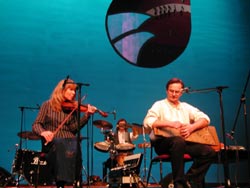
Iļģi on stage

Ilga Reizniece, on fiddle, and Māris Muktupāvels, on kokle, perform as part of Iļģi at the 49th Australian Latvian Arts Festival. (Photo by Arnis Gross)

Ārkārtīgi jauka feinšmehera bufete

Savā veidā esmu Austrālijas Kultūras dienu veterāne. No bērnu dienām tiku vilkta līdz uz KD—tās bija mūsu ģimenes gadskārtējās brīvdienas. Kopā esmu apmeklējusi apmēram 15 mūsu kultūras svētkus. Ar patiesu sirdi varu teikt, ka šīs KD mani saviļņoja tāpat kā septiņdesmitajos gados, kad pati piedalījos dejojot tautas deju uzvedumos un piedaloties jauniešu koncertos.

Atklāšanas koncerts bija vienkārši pirmklasīgs. It īpaši bija patīkami novērot mūsu jaunos topošos mūziķus saspēlējoties ar mūsu profesionāliem mūziķiem; klausīties Austrālijas latvietes jaundarbu blakus Latvijas latviešu kompozīcijām; izbaudīt pirmo reizi Austrālijā niancētos Gaudeamus vīrus un iepazīties ar jau pirms 14 gadiem šeit viesojušos Iļģu attīstību. Viktorijai Mačēnai izdevās izveidot augsta līmeņa līdz šim neredzētu kopainavu savijot kopā pasaules latviešu talantus patiesi elegantā veidā!

Kultūras dienu ietvaros notika līdz šim neredzēts “danču vakars”. Jānis Čečiņš pēdējos 12 mēnešus neatlaidīgi piestrādāja pie savas koncepcijas īstenošanas, proti, savest kopā īpaši šim nolūkam izveidotus Austrālijas latviešu muzikantu ansambļus, un saspēlēt kopā ar Latvijas muzikantiem. Sanāca kopā muzikanti no Adelaides, Brisbanes, Melburnas un Sidnejas kuriem piebiedrojas Iļģi un Ceirulītis no Latvijas. Ansambļi spēlēja gan atsevišķi gan kopēji radot tik spēcīgu vilinošu enerģiju kurai tikai pavisam retais spēj pretoties! Sadancoja veci ar jauniem; jauni ar jauniem; bērni ar vecākiem; vecāki ar vecākiem! Vienreizēji jauks iesākums pirmās dienas kultūras svētkiem!

Aizrāvos arī ar Iļģiem! Laikam kaut kur būtu dzirdēts izteiciens “pastāvēs, kas pārvērtīsies”. Jūtos pagodināta un novērtēju to, ka Iļģi uzskatīja par pietiekoši vērtīgu, vai pat par vajadzīgu, lai atbrauktu pie Austrālijas latviešiem, it īpaši tādā gada laikā kad parasti ģimenes sanāk kopā un profesionālie pienākumu arī netrūkst. Iļģi mums pasniedz mūsu tautas mantojumu mūsdienīgā apdarē, kas manāmi publiku saviļņoja saucieniem un nerimstošiem aplausiem izskanot. Bija daļa publikas, kuŗa nebija izsekojusi Iļģu attistībai kopš viņu viesošanās šeit pirms 14 gadiem. Cik nojautu, tiem bija neliels pārsteigums. No zāles izejot visur bija pamanāma melodiju dūdošana. Ko vairāk var prasīt?

Kaut gan atsevišķs “bērnu rīts” nebija KD ietvaros, bērnu—un jauniešu—sejas bija redzamas vairākos sarīkojumos. Gribēju it īpaši pieminēt teātri “Emīls un detektīvi” un jauniešu sarīkojumu. Ilona Brūvere apvienoja jauniešus un bērnus galvenās lomās kopa ar pieredzējušiem teātra veterāņiem “kameo” lomās. Ja padomā par to, tas ir vispār diezgan ģeniāls gājiens. Jūs jau paši izdibināsit kamdēļ. Bija iespaids, ka jauniem aktieriem bija prieks piedalīties—stāsts jau pats par sevi atbilstošs ziņkārīgai un uzņēmīgai Harija Potera paaudzei—un ar vecāku paaudžu piespēles rezultāts atkal bija elegants. Jāpiemin arī režijas vizuāli saistošas starpspēles nomainot dekorācijas.

Jauniešu sarīkojums, pēdējais KD sarīkojums, bija atkal kā dārgakmens kronī. Piedalījas ap 65 dalībnieku vecumā starp 3 un 23 gadiem. Viktorija Mačēna un Maija Upeniece bija piestrādājušas, lai izveidotu daudzpusīgu, bagātīgu un augstvērtīgu priekšnesumu sakopojumu. Varēja baudīt topošos solistus (klavieres, čellu, vijoli) kā ari balss duetu, flautu trio, ģitāru un trompētas džezistus, multi-instrumentālus ansambļus un vokālos ansambļus. Līvānu Ceiruleits mūs pacienāja ar mazu gabaliņu Latgales. Pārrunas par šo burvīgo sarīkojumu vēl bija manāmas Gaudeamus kora koncerta starpbrīža laikā dažas dienas vēlāk Melburnā.

Ar Jāni Graudu pie stūres, sidnejiešu sagādāja daudzpusīgu, interesantu un ārkārtīgi jauku feinšmehera bufeti! Jūtos labi un kvalitatīvi uzēdusi. Ļoti gaidu nākamo mielastu Melburnā 50. Kultūras dienu laikā pēc diviem gadiem, 2004. gada beigās.