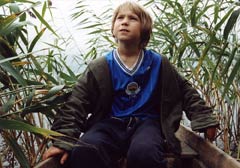
Dāvis Bergs portrays Dauka in the Viesturs Kairišs feature film, Pa ceļam aizejot.
Pa ceļam aizejot (Leaving by the Way) is a lyrical and mystical film that is hampered at times by uneven performances, but bolstered by excellent direction from Viesturs Kairišs.
The winner of the 2002 Lielais Kristaps (Latvia’s equivalent of the Oscar), and based on the classic Latvian story Dullais Dauka (Crazy Dauka) by Sudraba Edžus, Pa ceļam aizejot transports the viewer into a world filled with beauty and heartbreaking tragedy. It transforms a fanciful fairy tale filled with symbolism to the present without losing a single beat or softening its mystical approach. The setting and characters might be “modern,” but the forces that drive them are as old as love and jealousy, curiosity and faith.
Set in a Latgalian village, Pa ceļam aizejot follows the lives of the villages inhabitants in the wake of a tragic event: the loss at sea and presumed drowning of Ivars (Andris Keišs), husband of Ilga (Elita Kļaviņa) and father of Dauka (Dāvis Bergs) and Līga (Līga Čiževska). Ilga is so overcome with grief that she can’t bring herself to tell her children of the death of their father. This is her way of not only protecting them, but also of shielding herself. Despite her best efforts, however, all of them have to deal with the same thing, their longing for someone (or something) whom they love but who is out of reach. Maybe forever. Each copes in their own way. Ilga has an affair with Viktor (Ēriks Vilsons), a local married man. Dauka skips school. Līga often runs away from home.
In many ways it’s a tried and true dramatic formula no different from countless other films that have traversed similar tragic terrain. Some audiences might be turned off by a story that starts out unhappy and ends unhappier.
What separates this film from the pack is its poignant lyricism and mystical approach to the subject matter, and, in a manner of speaking, its very “Latvianess.” Ilga might be having a run-of-the-mill tawdry affair, but the wife (Ruta, played by Guna Zariņa) of Ilga’s lover happens to be not only the local postmistress, but also a practicing witch and healer to whom quite a few of the villagers turn for aid and comfort—or to deny others aid and comfort as the need arises. There’s magic, but it’s neither black nor white. When Dauka skips school it’s not to watch TV, but to hike through the forest while having imaginary (or are they?) conversations with his father. When Līga runs away she melts into the countryside like a woodland nymph. All of this is handled with such everyday matter-of-factness that it seems as real and natural as using a phone or riding in a car. When Ruta dances naked at midnight in the middle of a field to ensure that a potion she has prepared will accomplish what’s needed, it seems as normal and familiar as when earlier in the day she delivers a telegram.
Pa ceļam aizejot is not a perfect film, but it’s not trying to be. It’s not really interested in telling a story or following a linear narrative so much as desiring to capture a mood or a feeling. It’s a film that, supplemented by rich and lush cinematography from Jānis Eglītis and almost seamless editing by Juta Brante, shows great promise for Kairišs. This was his feature-length debut, and hopefully another step in what will be a long and prolific career.
Details
Pa ceļam aizejot
Viesturs Kairišs, director
Kaupo Filma, 2001
Notes: In Latvian. Feature, 90 minutes, in color. Screenplay by Inga Ābele, Viesturs Kairišs, Kaspars Odiņš; cast: Baiba Broka, Dāvis Bergs, Līga Čiževska, Andris Keiss, Elita Kļaviņa, Jānis Paukštello, Vigo Roga, Ēriks Vilsons and Guna Zariņa; producer: Guntis Trekteris; editor: Juta Brante; director of photography: Jānis Eglītis.