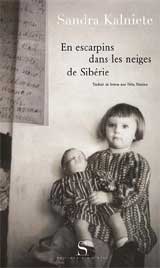
Kalniete’s book nominated in Elle contest

Latvian Foreign Minister Sandra Kalniete’s documentary book En escarpins dans les neiges de Siberie (With Dancing Shoes in Siberian Snows) has been nominated as one of December’s picks in an annual book contest sponsored by Elle magazine.

The magazine’s “Prix des lectrices de Elle” will be announced in May, according to a press release from the Latvian Foreign Ministry. Books chosen each month from August to April in three categories—novels, crime novels and non-fiction—will be in competition for the 2004 prize.

A panel of 120 judges names each month’s selection.

The contest has been held every year since 1970.

Before becoming foreign minister, Kalniete was Latvia’s ambassador to France.

The book was published in France by Editions des Syrtes. In Latvia, under the title Ar balles kurpēm Sibīrijas sniegos, it was published in 2001 by Atena.

En escarpins...

The French version of Sandra Kalniete’s book has been nominated for an Elle magazine prize.

Andris Straumanis is a special correspondent for and a co-founder of Latvians Online. From 2000–2012 he was editor of the website.

RFERL’s Latvian broadcasts to end Dec. 31

Radio Free Europe and Radio Liberty’s programs to Latvia and six other East European countries will end Dec. 31, the U.S. government-funded broadcaster has announced from its headquarters in Prague in the Czech Republic.

But Baltic lobbyists, who have appealed continuously to the federal government to restore funding, are not ready to give up their fight while an omnibus appropriations bill remains under discussion in Congress.

The U.S. Senate may take up a conference committee’s report on the appropriations bill on Dec. 9. The bill includes USD $546 million for the Broadcasting Board of Governors, the Washington, D.C.-based agency that oversees RFERL, Voice of America and other U.S.-funded international broadcasters.

RFERL President Thomas Dine announced the pending end-of-the-year closure to his staff in Prague on Nov. 28, according to a press release from the broadcaster. In addition to Latvia, broadcasts to Bulgaria, Croatia, Estonia, Lithuania, Romania and Slovakia also will cease “under a directive from the White House and the Broadcasting Board of Governors,” the press release said.

VOA broadcasts to Latvia also are expected to end, although a broadcasting board spokesperson declined to comment. “We won’t have any statement about languages until after Congress passes a bill and it is signed into law by the president,” Joan Mower told Latvians Online.

The end to the broadcasts, which will mean the loss of jobs for more than 100 journalists and other staff, is the result of shifting priorities within the Bush Administration. The White House’s proposed fiscal 2004 budget called for cutting broadcast services to those countries—including Latvia—scheduled to join the NATO defense alliance and the European Union, using the money saved to bolster new programs to the Middle East.

“Over the last six years, RFERL has rapidly expanded its operations in Eurasia and Southwest Asia,” Dine said in the press release. “It is now time to focus fully on these very troubled areas.”

When news of the proposed cuts first broke in January, Baltic-American lobbyists and government leaders in the Baltics tried to convince the White House and Congress to save the broadcasts. The Joint Baltic American National Committee, for example, expressed “profound alarm” at the threatened end of both RFERL and VOA broadcasts and what it could mean for U.S. efforts at public diplomacy in Europe.

In addition to continuing their appeals to members of Congress, supporters of broadcasts to the Baltic states are now trying to raise public awareness. Among their efforts are contacting conservative radio host Rush Limbaugh and a call-in show on the C-SPAN cable television channel.

Funding for American broadcasts overseas falls under the Foreign Operations budget, which has now become part of HR2673, the Consolidated Appropriations bill approved Nov. 25 by a House-Senate conference committee. Both the House and the Senate have yet to agree to the conference committee’s report.

Andris Straumanis is a special correspondent for and a co-founder of Latvians Online. From 2000–2012 he was editor of the website.

Director’s feature debut is lyrical, mystical

Pa ceļam aizejot

Dāvis Bergs portrays Dauka in the Viesturs Kairišs feature film, Pa ceļam aizejot.

Pa ceļam aizejot (Leaving by the Way) is a lyrical and mystical film that is hampered at times by uneven performances, but bolstered by excellent direction from Viesturs Kairišs.

The winner of the 2002 Lielais Kristaps (Latvia’s equivalent of the Oscar), and based on the classic Latvian story Dullais Dauka (Crazy Dauka) by Sudraba Edžus, Pa ceļam aizejot transports the viewer into a world filled with beauty and heartbreaking tragedy. It transforms a fanciful fairy tale filled with symbolism to the present without losing a single beat or softening its mystical approach. The setting and characters might be “modern,” but the forces that drive them are as old as love and jealousy, curiosity and faith.

Set in a Latgalian village, Pa ceļam aizejot follows the lives of the villages inhabitants in the wake of a tragic event: the loss at sea and presumed drowning of Ivars (Andris Keišs), husband of Ilga (Elita Kļaviņa) and father of Dauka (Dāvis Bergs) and Līga (Līga Čiževska). Ilga is so overcome with grief that she can’t bring herself to tell her children of the death of their father. This is her way of not only protecting them, but also of shielding herself. Despite her best efforts, however, all of them have to deal with the same thing, their longing for someone (or something) whom they love but who is out of reach. Maybe forever. Each copes in their own way. Ilga has an affair with Viktor (Ēriks Vilsons), a local married man. Dauka skips school. Līga often runs away from home.

In many ways it’s a tried and true dramatic formula no different from countless other films that have traversed similar tragic terrain. Some audiences might be turned off by a story that starts out unhappy and ends unhappier.

What separates this film from the pack is its poignant lyricism and mystical approach to the subject matter, and, in a manner of speaking, its very “Latvianess.” Ilga might be having a run-of-the-mill tawdry affair, but the wife (Ruta, played by Guna Zariņa) of Ilga’s lover happens to be not only the local postmistress, but also a practicing witch and healer to whom quite a few of the villagers turn for aid and comfort—or to deny others aid and comfort as the need arises. There’s magic, but it’s neither black nor white. When Dauka skips school it’s not to watch TV, but to hike through the forest while having imaginary (or are they?) conversations with his father. When Līga runs away she melts into the countryside like a woodland nymph. All of this is handled with such everyday matter-of-factness that it seems as real and natural as using a phone or riding in a car. When Ruta dances naked at midnight in the middle of a field to ensure that a potion she has prepared will accomplish what’s needed, it seems as normal and familiar as when earlier in the day she delivers a telegram.

Pa ceļam aizejot is not a perfect film, but it’s not trying to be. It’s not really interested in telling a story or following a linear narrative so much as desiring to capture a mood or a feeling. It’s a film that, supplemented by rich and lush cinematography from Jānis Eglītis and almost seamless editing by Juta Brante, shows great promise for Kairišs.  This was his feature-length debut, and hopefully another step in what will be a long and prolific career.

Details

Pa ceļam aizejot

Viesturs Kairišs, director

Kaupo Filma,  2001

Notes: In Latvian. Feature, 90 minutes, in color. Screenplay by Inga Ābele, Viesturs Kairišs, Kaspars Odiņš; cast: Baiba Broka, Dāvis Bergs, Līga Čiževska, Andris Keiss, Elita Kļaviņa, Jānis Paukštello, Vigo Roga, Ēriks Vilsons and Guna Zariņa; producer: Guntis Trekteris; editor: Juta Brante; director of photography: Jānis Eglītis.