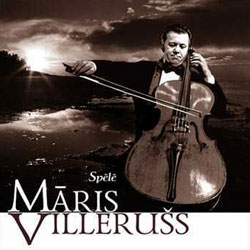
Villerušs and his cello shine on two-disc release

Spēlē Māris Villerušs

Like most reviewers, I tend to recycle material from time to time. Words and phrases get reused, sometimes deliberately, sometimes because I can’t think of anything better to say. Sometimes you want to say something nice about a song you like, but it is hard to put your finger on exactly why you like the song, so you just pick one of a number of stock phrases. I think the word that I am personally most guilty of overusing is “melancholy.”

Once again this word will be overused, this time in reviewing a recording of the instrument that perhaps best expresses melancholy: the cello. This cello is performed by distinguished Latvian artist Māris Villerušs on the exhaustive two compact disc set Spēlē Māris Villerušs.

I first became acquainted with Villerušs through his performance of the Latvian composer Jānis Ivanovs’ “Cello Concerto.” While unfortunately not included in this set, the full cello concerto with Villerušs can be heard on the Campion CD Janis Ivanovs: Orchestral Works, Vol. 2 (Campion Records 2009). Besides being a fan of Ivanovs, the cello performance made me a fan of Villerušs as well. When I saw Spēlē Māris Villerušs at the record store, I had to pick it up.

And I was not disappointed. The set contains approximately two and a half hours of melancholy cello goodness! The recordings focus on the cello in a chamber music setting, with piano or solo cello. They also run the gamut from the baroque (a “Concerto for Cello” by Antonio Vivaldi) to the modern (Latvian composer Maija Einfelde’s “Monologue for Cello and Piano”) to just about everything in between. You can have your pick of Spanish (Isaac Albeniz’s “Malaguena”), French (Gabriel Faure’s “Revival” or Claude Debussy’s “Minstrelsy”), Russian (a few each from Sergei Rachmaninov and Pyotr Il’yich Tchaikovsky, including the full “Sonata for Cello and Piano in G Major” by Rachmaninov and Tchaikovsky’s “Nocturne”). The Latvian representatives on this disc, though few, are Jāzeps Mediņš’ “Maza serenāde” (Little Serenade) and “Ārija” (Aria), as well as the aforementioned Einfelde piece. Villerušs proves himself to be capable of performing pieces from many different composers, over many different genres.

Accompaning Villerušs on piano on most of the recordings is his wife, Inta. One of my favorite tracks is the Karl Maria von Weber “Rondo.” Though short, it shows the cellist’s technical ability, as well as the interplay between the cello and the piano.

The recordings also span many different decades. They are all taken from the immense archives of Latvian Radio, which are full of some of the best performances by Latvian artists. The oldest recordings on the CD date back to 1962. Villerušs’ durability as a performer cannot be questioned—he has been playing now for better than half a century, and is still going strong.

The only orchestral work on the album is the Vivaldi “Cello Concerto.” It is performed with the Latvian Philharmonic Chamber Orchestra, conducted by Tovijs Lifšics. It has been said that when you’ve heard one Vivaldi concerto, you have heard them all. Although many baroque compositions are “simpler” than music that came later, I think that makes them difficult to perform well. Though the melodies might be simple, only the best performers can make the work truly compelling. Starting with the sad and easy melody of the first movement, Villerušs is able to keep your attention throughout the entire concerto.

Another favorite is Mediņš’ “Ārija.” Once again accompanied by his wife, Villerušs is best qualified to performing this beautifully haunting melody.

Villerušs’ biography is provided in the liner notes by Oļģerts Grāvītis. The liner notes also have the dates of recording for each of the pieces.

This expansive collection is highly recommended for any cello fans or any fans of Latvian classical music. It reinforces why the cello is one of my (and many other people’s) favorite instruments. The cello in the hands of the best cello players provides a truly moving experience. Two full CDs of some of the best cello playing by Māris Villerušs—how could you go wrong?

Details

Spēlē Māris Villerušs

Māris Villerušs

Radio SWH Ieraksti,  2003

RSWH 047

On the Web

Radio SWH ieraksti

The Web site for Radio SWH ieraksti, a branch of one of Latvia’s most popular radio
stations. The recording company released the two-disc set featuring the work of cellist
Māris Villerušs. LV

Egils Kaljo is an American-born Latvian from the New York area . Kaljo began listening to Latvian music as soon as he was able to put a record on a record player, and still has old Bellacord 78 rpm records lying around somewhere.

Finnish plan would limit Latvian workers

Latvians and citizens of seven other new European Union countries would still be treated as non-EU workers for the next two years under a proposal being considered by the Finnish government.

The proposal, which is scheduled to be taken up by the parliament next week, would require workers from the new EU member states to get the Finnish employment office’s approval that there are no workers in Finland who can perform the job, the daily newspaper Helsingin Sanomat reported. The government accepted the proposed legislation Jan. 15.

The two-year transition period could be extended based on the findings of a report the government would have to submit to the parliament, according to the Finnish government’s Web site.

One principle of the European Union is the free movement of people across borders, although many member states have restrictions in place.

The Finnish proposal would affect new workers from eight of the 10 countries scheduled to join the EU in May: Latvia, Estonia, Lithuania, the Czech Republic, Hungary, Poland, Slovakia and Slovenia. Only workers from Malta and Cyprus would be exempt from the rule.

Finland joined the EU in 1994.

In 2002, according to Finnish Ministry of Labour statistics, a total of 21,807 work permits were issued to foreigners. More than two-thirds of those went to workers from Estonia and Russia. A total of 483 permits were issued to Latvians, half of them for garden workers.

Andris Straumanis is a special correspondent for and a co-founder of Latvians Online. From 2000–2012 he was editor of the website.

Five years of getting the word out

Latvia’s image abroad may be shaped by the people of Latvia, but it is conveyed for the most part by non-Latvians.

Although no hard data are available, my guess is that 90 percent of the people in the world who know something about Latvia today learned about it from a non-Latvian. Apart from those who actually visit Latvia, most people in the world have heard, read or seen something about Latvia that was written, produced, edited, published or broadcast by the international media. Now that Latvia is joining the European Union and the NATO defense alliance, the amount of material produced by non-Latvians in the international press or on TV and radio is increasing by leaps and bounds.

That’s one of the reasons why during the first five years of its existence, the Latvian Institute (LI) has focused on developing relations with the foreign media as one of its strategic priorities. Limited funding is another. If you don’t have the money to make your own films, videos, news programs, commercials or magazines that will reach millions of viewers and readers, you have to work with those who do.

The institute was established by the Latvian government in 1998 to promote Latvia’s image abroad. But before you can “promote” an image, you have to establish an information base that people can access and understand. When Latvia restored its independence in 1991, there was very little information available about Latvia in English, or any other language, other than that which the Soviets had provided to encyclopaedias and the international news media for 50 years.

The first task of the LI was to begin building a new information base, in English, about all the various aspects of Latvian life that foreigners could be interested in. Although the ministries of Foreign Affairs and Economics had begun producing some materials for their specialized audiences, there was very little about Latvian culture, history, society or nature that was of interest to a broader public.

Over the last five years the LI has developed an Internet home page and a series of brochures, booklets and fact sheets to fill this gap. While these materials do reach some foreigners directly, they are just one part of a strategy designed to reach a much broader audience. The LI also assists Latvian ministries, government agencies and the private sector in the development and organization of conferences, seminars and other events targeted at international audiences.

The audiences at international events consist of specialists who, like journalists, take information they have received and pass it on. They write articles, reports and books that reach an even wider audience. They also make policy, convey opinions, initiate programs and develop projects that people in Latvia could never dream of undertaking.

We live in an information age, where those who have the resources, money, skills and talent to make information interesting and relevant can reach billions. Our goal at the LI is to inform the informers about Latvia. As we enter our sixth year of operation, the LI has established contacts with thousands of the “information elite”—journalists, editors, producers, publishers, researchers, academicians and promoters. Most have produced print and multi-media materials about Latvia based on our contacts with them. We arrange interviews and briefings, organize tours or simply answers questions. Many are return customers who come to rely on the LI for reliable and useful information about Latvia’s past, present and future.

The LI recently introduced a new law to the Latvian government that would expand the role and resources of the institute in coordinating the way government ministries and agencies provide information about Latvia. The initial goal is to review what is already being done, and do it better.

Until now, we have simply tried to fill the knowledge gap and provide useful information to those around the world who are interested in this country called Latvia. Informing about Latvia is one thing. Promoting it is something else altogether. Toward this end we have begun research on the prospect of “branding” Latvia, i.e. developing a targeted marketing concept, strategy and campaign to promote tourism, foreign investment and export sales. But that will take time, money and considerable coordination.

For now, the Latvian Institute remains Latvia’s only “one-stop shopping” source for any and all information about Latvia. We collect it, we convert it, we convey it and we share it. Finally, after a half century of silence, the word is getting out.