Notes from an ugly duckling

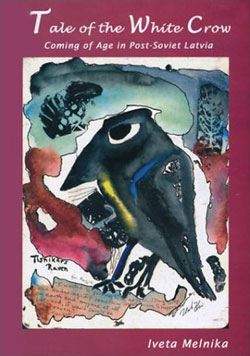
Tale of the White Crow

The white crow of Iveta Melnika’s memoir is an outcast: an ugly duckling among the swans, a white crow among the black. This is how the teenaged Melnika perceives herself: ugly, shy, and despised by her peers. Tale of the White Crow tells the story of her coming-of-age in the turbulent period of Latvia’s independence from the Soviet Union.

Although Tale of the White Crow is subtitled “Coming of Age in Post-Soviet Latvia,” Melnika’s painful journey through adolescence begins before Independence, while Latvia is firmly under Soviet rule. Melnika is conscious of the inequities of life under the Soviets: though everyone is supposedly equal, families who are well-connected or who have relatives in the West enjoy a superior lifestyle. Meanwhile, Melnika’s family struggles along in one room of a communal apartment. Her father cannot work because of a severe heart condition and Melnika’s white crow status at school is exacerbated by her family’s poverty.

Change begins slowly, with a few people wearing badges of the Latvian flag. Political events are filtered through Melnika’s teenaged consciousness: “I had to stand for hours in the hot sun, listening to boring talks, and watched some weird people putting the flowers at the foot of the Freedom Monument.” Gradually, she becomes more interested. Deeply moved by the human chain holding hands across the Baltics (on Brīvības Street there were “so many that they had to stand three, four deep”), Melnika joins a pilgrimage of thousands to commemorate Latvians lost in the mass deportations of the 1940s. Should the Russians invade again, she doesn’t expect the West to intervene. “And why should they care? …Pampered by their good fortune, they are unable to comprehend our desperate, even ridiculous fight for survival as a nation with its own language and cultural values.”

Melnika’s adolescence is rocky but not untypical. She thinks she is ugly and repulsive, that others hate and mock her. Sometimes she wonders if she isn’t crazy. “Maybe if I had jeans my classmates would look differently at me.” Her own jeans are undesirable Polish knock-offs. Or if only she had a boyfriend! Melnika craves the change of status that such a commodity would bestow on an ugly duckling like herself. She doesn’t even aspire to turn into a swan, she says, but would settle for becoming a decent duck.

Her grandmother has taught her to believe in God, to whom, she says, looks don’t matter. “Yeah, not to Him,” Melnika comments, “but they definitely matter to people, and very very much, by the way.” Her hunger for love and belonging leads Melnika to join the Church of Christ, which is aggressively evangelizing in post-Soviet Russia and eastern Europe. Her parents disapprove, afraid that the church is a cult that preys on young people. Melnika tries hard not to believe this, though she has her own misgivings. The church leadership demands unquestioning obedience: “Do you know why Satan is in hell? It’s because he is proud and rebellious. Just like you are now.”

After years of repression, Latvia is vulnerable to the tactics of American cults, and to corruption. Unbridled capitalism exacts a savage toll from Latvian society. The result is immense suffering, and nostalgia for the meagre certainties of Soviet times. Former inequalities seem slight in view of the widening gulf between rich and poor. While the elderly starve or commit suicide, Rīga’s streets are clogged with luxury cars. Gangsters buy huge flats downtown and spend their evenings in expensive discos and restaurants.

Iveta too has her disco period, a time of emptiness and searching that leaves her even lonelier than before. Afterwards she is as depressed as she has ever been, still without the love she longs for and outside the church where she found, at least briefly, a sense of community. However, she manages to obtain an education and stay afloat. As she points out after one typically disastrous social encounter, she must learn from these experiences for they will help to prepare her for the future: “If I manage to get through this, I am one step closer to the big life now.”

Tale of the White Crow came into being because of a chance meeting of the author and David Pichaske, the publisher, while the latter was teaching in Rīga on a Fulbright fellowship. (The book actually was printed in Mongolia, another of Pichaske’s foreign assignments.) Part of the book’s considerable charm derives from its idiosyncratic idiom, which the author wished to “normalize” as her English language skills became more sophisticated. Happily, Pichaske argued for the original and to some extent prevailed. His photographs of Latvia are included.

Details

Tale of the White Crow: Coming of Age in Post-Soviet Latvia

Iveta Melnika

Granite Falls, Minnesota:  Ellis Press,  2003

ISBN 0-944024-46-7

Where to buy

Purchase Tale of the White Crow: Coming of Age in Post-Soviet Latvia from Amazon.com.

Note: Latvians Online receives a commission on purchases.

Latgallian album is fun, but confusing

A German-influenced word in Latvian describes this compact disc well: lustīgs. Basically, it means “fun.” Gonam gona (The Shepherd Has Had Enough) by Laimas muzykanti is a combination of pumped-up Latgallian songs and tender, other-worldly melodies, with a winter solstice song added at the end for good measure.

It’s real folk music, but updated by the addition of bass and percussion on nearly every track. The quick folk-rock accompaniment got to me a little by the end of the CD, but there was enough variety in the middle to break it up. A synthesizer is also used, mostly as tasteful background for the quieter songs. All in all, I enjoyed the CD.

Artūrs Uškāns, who plays about nine instruments on this CD, is the head man behind Laimas muzykanti (Laima’s musicians). Another name that some may recognize is the young Kristīne Kārkle, who plays violin and lends her distinctive, wonderful voice to the group.

The CD begins with a Cajun-flavored song about a young man telling a girl to get ready to marry him, and it is followed by another fun wedding song. But then comes the girl’s point of view: ambivalence and even sorrow about marriage. Luckily, it sounds like she needn’t have worried, because in the next song, “Toli dzeivoj,” the young man vows to never love another. Then she sings a song about singing, and then it’s his turn to tell how well he gets along with her mother. Next, the fragile and tender sound of “Kur gaismeņa” is deceptive: the girl has made up her mind to get married despite her young age. Men’s voices add a nice harmony, and the result is almost like a choral arrangement. But, of course, the girl is nevertheless sad to leave her home, as heard in “Spūža saule.”

By the 10th song, with its rock beat and risque lyrics, I assumed we must be back at the wedding festivities. “Not more grunting a la UPE’s Alus dziesmas CD,” I thought, upon hearing the 12th song. But a look at its title—“Dzārojeņš” (Drunkard)—and it made perfect sense. In the next-to-last song, “Sasukoju bāru zyrgu,” a girl snubs a guy, and he says he’ll find another girl elsewhere. Is the wedding off? Is this about another couple? Or am I just reading too much into this CD? In any case, the CD ends with a winter solstice song, an odd ending to a collection of mostly wedding and love songs. But it does sound good with the folk-rock accompaniment.

The small Latgallian-Latvian glossary at the back of the liner notes helps decipher the texts. But other than that there are no additional explanatory notes, nor is there anything written in English. And, by the way, the photographs of the shepherd and her charges are great!

Details

Gonam gona

Laimas muzykanti

Izteiksme,  2002

On the Web

Laimas muzykanti

Official Web site of Laimas muzykanti, with background on the group, samples of songs, and other material. EN LV

Laimas muzykanti

Background on Laimas muzykanti from Ansis Ataols Bērziņš’ folklora.lv Web site. EN LV RU

EU membership to test Latvia’s maturity

May Day 2004. Instead of the workers of the world (or at least Europe) uniting, ten new nations of the European Union celebrated their membership. Eight of the 10 new members are former socialist states trying desperately to prove their democratic, free market and liberal credentials to a still somewhat sceptical West. Of these, Latvia gained a somewhat unexpected prominence during the day. Several international observers noted that the EU celebrations were much louder and more jubilant in Latvia than anywhere else. This was a very public event in Latvia, and comments flew that one of the poorest of the new countries was the one celebrating hardest.

Can we speculate on why this was the case? Are Latvians naturally the celebratory type? Have the experiences of Eurovision and Rīga 800 got the locals into the habit of celebrating? Or more cynically or practically, depending on your perspective, were the celebrations in anticipation of plentiful EU money flowing in Latvia’s direction—and who indeed does not want to escape poverty?

As in many cases, the perceptions from outside were not the perceptions from inside. Within Latvia, the feeling was one not only of joy but of a kind of safety being reached. Even accession to the NATO defense alliance, which had already been finalised in March, did not bring about such a fundamental emotion of relief and a daring to hope for lasting security.

Such a feeling did have some solid basis in the diplomatic settlements that were made surrounding accession to the EU. The EU and Russia, after negotiations that went up almost to the last day, finally agreed on a formula by which Russia would agree to treat all new nations as they treated any other EU nation in terms of economic relations. Russia’s long-standing claim that the Russian minority situation in Estonia and Latvia demanded an exceptional relation to these countries was eventually written out of the final agreements.

Yet this will not be the end of the matter because the stakes, in Moscow’s view, are very high indeed. The long-cherished aim of having Russian become an official state language in Estonia and Latvia could lead to Russian becoming one of the official languages of the EU, as well as strengthening Moscow’s voice internally in these countries in support of the Russian-speaking population. With border agreements between Russia and Estonia and Latvia not yet finalised, battles over minority issues may well intensify, as seen in the recent opposition to secondary school reform in Latvia. Moreover, the willingness of the EU to grant membership to countries that still had unresolved border issues testifies to the determination of the EU to press for new membership despite Moscow’s objections. For me this was one of the most encouraging signs of Europe not being seduced by newly re-elected President Vladimir Putin’s dark charms.

On this as on so many other matters, internal political strength, sense and consistency in Estonia and Latvia will determine the issue, not directives from the EU or relying on a still nebulous security guarantee. The worst outcome would be self-satisfaction with what has been achieved and an expectation that the EU will solve everyything, while continuing the worst of local practices of diverting EU money to private coffers.

But in fact accession to the EU will pose genuine dilemmas and issues that will not be able to be ignored.

One relates to foreign policy, and the clear split that has emerged in Europe between pro-American countries (basically the new candidate countries from Eastern Europe, with Poland very much in the lead) and perceived anti-American countries led by France and to some extent Germany. Latvia will need to make decisions on where it stands on a host of issues from the Iraq war (where it backs America) to the scope of the International Criminal Court (where it backs Europe) to what will become intensifying American attempts to fracture Europe and deny it a unified voice. There will be no hiding on many of these issues.

A second and more painful issue relates to how well Latvia’s own political and economic decision-making will be able to cope with the demands of EU membership. The frank question that must be asked is whether Latvia’s political system is up to the task of effective policy-making and administration of the standard expected of EU members. The appalling debacle of the fall of Prime Minister Einars Repše’s government just a few weeks before May 1, a string of poor appointments to ministerial posts, continuing concerns over corruption, and the immaturity and volatility of the political party system raise doubts as to the ability of the government to manage the benefits of EU membership in a way that will be felt by the ordinary citizen.

Ironically, what benefits will flow from EU membership now rest much more upon Latvia’s own maturity and its political and economic will, than upon the bureaucrats of Brussels. Latvia was right to celebrate a historic alliance in a union with an unprecedented record of progress and achievement. But an alliance can only ever be as strong as your own efforts to make it work and prosper.