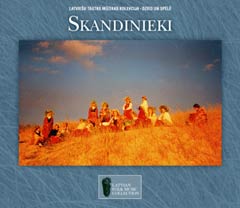
I was flying back to the United States from Latvia for Christmas, and wanted to pick up some gifts for my parents. I saw the new Skandinieki compact disc, Dzied un spēle Skandinieki, and bought a copy. Although I enjoy a good folk song every now and then, overall I am not a fan of the genre. I wasn’t expecting much from this CD, but since I had a long flight, I gave it a listen. I must have liked it, because as soon as I got back to Latvia, I bought a copy for myself. Though it is in the traditional folklore vein, there is enough good stuff on this CD for me to strongly recommend it to anyone, even those outside of the folklore connoisseur set.
Skandinieki is a collective of singers and instrumentalists (a total of 23 are credited on this recording) that marked its 27th anniversary last November. The core of Skandinieki is the Stalts family. Dāvis, Helmi, Julgī, Marga and Ričards Stalts perform on this CD. Of note is that the Stalts are of Liv descent. Though their numbers have fallen through the years, the Livs are still alive and well in Latvia. The 30 songs contained on this CD cover all aspects of folklore, with beautiful singing and melodies, some of them in Livonian.
Most of the songs are sung a capella, but there is occasional musical accompaniment. Unfortunately, the liner notes don’t detail who plays what, or even what kind of instrument is being played.
Favorites on the album include the opening song, “Gauži raud saulīte,” which is about the sun crying its eyes out over a golden apple falling from an apple tree—among other things. The singer tells the sun not to worry about it, as God will make another one. It’s a truly beautiful way to begin the recording and, I’m not sure why, but this song gets me all weepy whenever I hear it.
Another beautiful song is “Kam, muomeņ, tu audzēji,” in which the narrator chastises her mother for growing a birch tree in the yard, because a potential suitor caught her napping by it in the middle of a day.
I also liked “Skaļi dziedu, gavilēju.” It reminds me of one of my favorite songs from when I was in the London Latvian Choir, “Aurēdama vēju māte.” Both songs have similar melodies and each verse begins with the “teicējs” singing the first line with the chorus joining in afterwards.
Skandinieki sing in Livonian on “Sūr rīnda.” It is interesting that in the liner notes this song is not just translated into English, as is every other song, but into Latvian as well, though it appears that only the first verse is translated. The song is about a girl who apparently has low self-esteem. She asks her mother what to do: all the pretty girls are standing in a line, but where should she stand, being “unattractive.” Unfortunately, because the second verse is not translated, I don’t know how the story ends. I especially enjoyed the interesting instrumentation on this one, with what sounds like an accordion, some kind of guitar, and a recorder-like instrument.
And fear not, droning fans, there is some droning for you here, too. For example, on “Tumsināja,” for those of you who can’t sing, you can drone that “ēēēēēē” to your heart’s content! The occasional droning song does not decrease my enjoyment of this CD, as it helps provide a more “complete” folklore picture.
Skandinieki has done an admirable job of bringing these songs to life, and keeping alive not just Latvian folk songs, but Livonian as well. This CD truly captures the simple joy of singing, and it is very infectious.
Details
Dzied un spēlē Skandinieki
Skandinieki
UPE Recording Co., 2003
UPE CD 049
Where to buy
Purchase Dzied un spēlē Skandinieki from BalticShop.
Note: Latvians Online receives a commission on purchases.
Egils Kaljo is an American-born Latvian from the New York area . Kaljo began listening to Latvian music as soon as he was able to put a record on a record player, and still has old Bellacord 78 rpm records lying around somewhere.