Jumprava remains at top of its game

Inkarmo

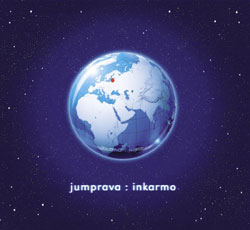
Jumprava, one of the old guard of Latvian rock music, celebrated its 20th anniversary this year with a big concert at the Dzintari Concert Hall in Jūrmala. Shortly before the concert, the band released its latest album, Inkarmo. According to the group, “inkarmo” means “the place and time we find ourselves in at this moment.” This is illustrated by the album’s cover, which features a map of the world with a small red dot to indicate Latvia.

Jumprava’s prior two releases, 1998’s Laika atšķirību romance and 2001’s Trajektorija, were among the band’s best albums. Though Jumprava’s most popular works remain old standards like “Vēlreiz” and “Ziemeļmeita,” I actually prefer their newer songs. And I think that Inkarmo continues where the band left off with Trajektorija—another very strong album of Jumprava’s blend of electronic and acoustic music with thoughtful lyrics, smoothly going from laid back and pensive songs to highly emotional and energetic songs without missing a beat.

The group’s lineup has not changed: Aigars Grāvers, Aigars Grauba, Aigars Krēsla and Ainārs Ašmanis.

The album starts out in a particularly odd way, with the low-key song “Elpas cena” (The Price of a Breath). It’s a very quiet song that sounds more like it would have fit better on one of the Rama Dance albums (Grāvers’ side project, melding Latvian and Indian music). Also interesting is that the music’s author is Krēsla, and not Grāvers as I originally thought when I listened to the song. This song’s refrain includes lines about a lonely yak in Tibet, certainly a topic rarely mentioned in popular music.

The album does have a number of mellower moments, including the songs “Man pietiek ar to” (That is Enough for Me) and the lullaby “Miega dziesma mazajai meitenei” (A Sleepy Song for a Young Girl), both composed by Krēsla. “Miega dziesma,” featuring lead vocals by Grauba, is a sweet, quiet song—uncharacteristic for Jumprava, but still effective.

But that, of course, does not mean the album is not without its up-tempo songs, such as “Laimīgs” (Happy) and “Liekos dīvains” (Seem Strange), which includes one of my favorite lines from any Jumprava song: “Ja es Tev liekos dīvains, tad kāds Tu liecies man?’ (If I seem strange to you, how do you seem to me?)

Jumprava also continues the dabbling in techno music that was started on the Trajektorija album. This is most notable in “Stacijā” (At the Station), a song about a chance encounter at a train station. Honestly, I’m not a fan of this song, though I do like the almost-techno title track, “Inkarmo.”

Production of the album is almost too perfect, and as a result it sounds too polished, almost sterile. One of the reasons Jumprava became so popular was its experimentation with non-traditional arrangements and melodies, much different than what was popular in the 1980s and 1990s.

It could be said that this album is a bit too safe. But this is a minor complaint. One of the drawbacks of music made almost entirely with synthesizers is that at times it will sound mechanical. Don’t let that frighten you, because the songwriting on Inkarmo is top-notch.

Almost all the lyrics on the album are written by outsiders. Rolands Ūdris (a.k.a. Ūdrītis), lead singer of The Hobos, wrote the words to “Inkarmo.” Also writing lyrics were Ingus Bērziņš, Viktors Duks and Aija Strazdiņa. Curiously, no lyrics were provided by frequent collaborator and poet Nataradža.

The booklet accompanying the compact disc contains all the lyrics, but very little else. The CD is presented in Digipak form (a cardboard case) as opposed to the regular plastic jewel box. To be honest, I prefer the regular CD cases, as the cardboard cases tend to get worn out after a while and cannot be replaced.

Inkarmo is a worthy addition to the Jumprava canon. In a time when many bands (Latvian and otherwise) with a strong back catalogue are content to rest on their laurels and release sub-par albums, Jumprava still is at the top of its game, challenging itself musically and pleasing old fans as well as bringing in new fans. At the close of the anniversary concert in the Dzintari hall, the band seemed taken aback by the sight of 3,000 fans, all on their feet and screaming for the group’s return to the stage. But such is the strength of Jumprava, and it shows no signs of diminishing.

Details

Inkarmo

Juprava

Platforma Records,  2005

PRCD 164
Egils Kaljo is an American-born Latvian from the New York area . Kaljo began listening to Latvian music as soon as he was able to put a record on a record player, and still has old Bellacord 78 rpm records lying around somewhere.

Latvia still viewed as corrupt, but less so

Latvia still is viewed as the most corrupt Baltic state, is seen as the second-most corrupt in the expanded European Union, but nonetheless has improved since last year, according to the latest Corruption Perception Index by the Berlin-based Transparency International.

Latvia ranked 51st on the list released Oct. 18, an improvement from last year’s ranking of 57th. The nation shared the spot with the Central American countries of Costa Rica and El Salvador and with the Indian Ocean country of Mauritius.

The Corruption Perception Index is based on polls of business people, academics and country analysts. A total of 159 countries are included in the index, which measures opinion about the level of corruption and is based on a 10-point scale.

Latvia’s score continues to improve, climbing from 3.8 in 2003, to 4.0 last year, to 4.2 this year.

But Transparency International, as well as its Rīga-based affiliate Delna, warned that scores below 5 indicate “serious levels of corruption.”

Among the three Baltic republics, Estonia climbed four spots to a ranking of 27th with a score of 6.7, while Lithuania maintained a ranking of 44th with a score of 4.8. Transparency International singled out Estonia as among those countries where wealth is not a prerequisite for controlling corruption.

Among European Union members, only Poland scored lower than Latvia. Poland ranked 70th with a score of 3.4.

Iceland this year edged out Finland for the top spot on the index, scoring 9.7. Finland and New Zealand shared the No. 2 slot, scoring 9.6. The United States maintained its 17th place ranking, but Russia sank to 126th, sharing the spot with Albania, Niger and Sierra Leone. Last year Russia ranked 90th.

Andris Straumanis is a special correspondent for and a co-founder of Latvians Online. From 2000–2012 he was editor of the website.

Latvian joins Canadiens hockey team

The Montréal Canadiens professional hockey team has a new enforcer. Raitis Ivanāns measures 6 feet 4 inches (1.93 meters) and weighs 263 pounds (119 kilograms). He’s the biggest Canadien in the team’s storied history. But unlike most hockey pugilists, he’s from Latvia.

Ivanāns has attracted a lot of attention since making the Canadiens roster.

Now 27, Ivanāns came to Canada as a 17-year-old to play Tier 2 junior hockey near Toronto. Since then he has played in just about every minor hockey league in North America. His tour has included the Flint Generals, New Haven Knights and the Rockford IceHogs of the United Hockey League, the Macon Whoopee and the Tulsa Oilers of the Central Hockey League, the Pensacola Ice Pilots, Toledo Storm and Baton Rouge Kingfish of the East Coast Hockey League and the Hershey Bears of the American Hockey League.

By the 2003-2004 season he was established in the AHL as a member of the Milwaukee Admirals, one step away from the National Hockey League. He was on the Admirals roster that won the league’s championship and the Calder Cup. The following summer he was signed as a free agent by the NHL’s Montréal Canadiens and played during last year’s lockout with their Hamilton Bulldogs AHL farm team.

Ivanāns started out as a defenseman. Along the way he shifted to forward and learned how to use his size and fight. The penalty minutes racked up, 270 in New Haven, 208 with Rockford and 259 last year in Hamilton.

The Canadiens were looking to add muscle to their young and fast lineup and Ivanāns fit the bill. He beat out veteran minor league enforcer Peter Vandermeer for the tough-guy spot after taking on Toronto’s Nathan Perrott and Ottawa’s Brian McGrattan in exhibition games. A healthy scratch for Montréal’s first two regular season games, he suited up Oct. 8 for Montreal’s 5-4 victory against the Toronto Maple Leafs and logged just under three minutes. He had no penalties and went down in the books as the latest Latvian to play in the world’s best hockey league.

While Ivanāns’ role is to protect his teammates when the going gets rough, he shouldn’t be discounted as a hockey player.

“He certainly earned himself a spot,” Canadiens Coach Claude Julien told the Toronto Sun. “He’s a good person who came from a long way to adapt to the North American lifestyle, made sacrifices to leave his country and groom himself to be a hockey player. Sure he has a role on this team. Anyone who watches him sees he’s not a bad skater for his size. He creates some space for himself. He does have skills and he earned his spot with us. He deserves a lot of credit.”

Ivanāns also has taken young Russian-speaking players under his wing helping them with English and adjusting to life in Canada. Last year in Hamilton, his protege was Belarus rookie sensation Andrei Kostitsyn. Canada’s Rogers Sportsnet broadcast a 10-minute segment showing the two on and off the ice—in the dressing room, going out for fast food and bowling. This year he’s interpreting for talented Russian Alexei Perezhogin on the Canadiens roster.

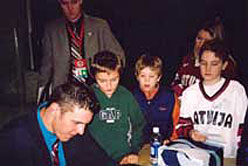
Last winter parents and students of Toronto’s Latvian School Valodiņa went out to watch Ivanāns play in Hamilton. Afterwards he took time to meet with them, spoke to them in perfect Latvian and patiently signed autographs. However, he was stumped when asked to name every Latvian’s most favorite food in order to receive a present from the school. His answer was “kaposti” (sauer kraut). Not quite, but he still walked away with a box a 40 pīrāgi.

On the Latvian Web sites Hockey.lv and Delfi.lv, some readers have downplayed Ivanāns’ skills as a player due to his role as a “policeman.” However, most have cheered his success and are urging that he be given a place on Latvia’s national team. By all accounts the team could use someone who’s not afraid to go into the corners to dig the puck out or to park his massive frame and screen an opposing goalie. But then come springtime, it’s very likely that Ivanāns will be in the thick of Stanley Cup playoff action with the Canadiens. The World Championships may have to wait. —Viesturs Zariņš

Raivis Ivanāns

New Montréal Canadien hockey player Raivis Ivanāns signs autographs for pupils from the Toronto Latvian School Valodiņa. (Photo by Viesturs Zariņš)