‘Light’ version of anthem should be outlawed

As national anthems go, the Latvian hymn “Dievs, svētī Latviju!” is a rather short one. So why bother even having a short version?

Because some politicians apparently think it’s necessary. The conservative Latvian party Tēvzemei un brīvībai / LNNK (For Fatherland and Freedom / LNNK) wants to define what counts as the short version of the national anthem.

The party on Nov. 16 introduced an amendment to Latvia’s law on the national anthem that fixes the short version of the song as one that does not repeat the first stanza. In other words, the short version would call for singing “Dievs, svētī Latviju, Mūs’ dārgo tēviju, Svētī jel Latviju, Ak, svētī jel to!” just once, then, as usual, twice singing “Kur latvju meitas zied, Kur latvju dēli dzied, Laid mums tur laimē diet, Mūs’ Latvijā!”

That would shave a whopping 30 seconds from the song composed by Kārlis Baumanis and first performed in 1873. The version of the song available on the Saeima’s Web site clocks in at 2 minutes and 15 seconds. Snipping the repeated first stanza reduces it to 1 minute and 45 seconds.

The Saeima, Latvia’s parliament, may take up the amendment later this week.

According to the bill, the amendment is necessary because a Cabinet of Ministers decree approved earlier this year allows for performance of a short version, but doesn’t say what the short version should be. Given the growing number of occasions when the national anthem must be played, according to the bill, “this allows unfettered interpretations, which during various events (especially sports) and official ceremonies increasingly debase not only the point and essence of our nation’s symbol, but also degrade the overall artistic quality of the hymn.”

During some sporting events “Dievs, svētī Latviju” is cut to no more than 55 seconds, according to the Cabinet of Ministers.

The cabinet in 1999 first adopted rules for the publication of notes and recordings of the anthem. Based on recommendations from the National Anthem Commission, those rules were replaced this June with clearer standards. Unfortunately, the only standards for the short version are that it use the same arrangement as that for symphonic and brass orchestras and that it be in B flat major.

The tēvzemieši are right to be concerned about different interpretations. But rather than etching in stone what the short version of the anthem should be, why not just disallow a short version? It won’t kill anyone to stand at attention for 30 seconds longer. Some things in life deserve more than the radio edit.

If we are to have an official “light” version of the national anthem (now with 22 percent less lyrics and music!), why not take on waste in other Latvian national symbols, too? Let’s make the maroon proportion of the flag smaller, because so many folks anyway forget there’s a 2:1:2 ratio to the colors in the sarkanbaltsarkans, not to mention that it’s supposed to be twice as long as it is wide. And, even though there are three approved versions of the coat of arms, why have three stars in it? Won’t one do?

No, it’s a bad idea. National symbols should set a standard. To even acknowledge that a short version of the national anthem is acceptable is the wrong course of action. The tēvzemieši should instead insist that the only acceptable version of Latvia’s national anthem is the long one.
Andris Straumanis is a special correspondent for and a co-founder of Latvians Online. From 2000–2012 he was editor of the website.

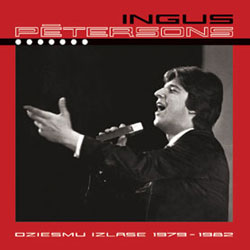
Album reviews Ingus Pētersons before opera career

Ingus Pētersons

Every so often, I go to a Latvian club in Rīga called Četri balti krekli, where music by only Latvian artists is played. One song that always seems to throw the crowd into a frenzy is this strange tune about windsurfing. At first, I had no idea who performed the song. It was nice enough, if a bit cheesy (especially the English-language chorus: “Surfing, surfing—windsurfing!”). I was surpised to learn that the song is performed by Ingus Pētersons.

From what I knew about Pētersons and his repertoire, I would never have guessed that he was the singer. Pētersons, the artist who in his youth sang slightly more serious songs? Pētersons, the popular singer who abandoned popular music completely to focus on opera? That Pētersons? I didn’t believe it.

But it was true. Though he has had success as an opera singer, his popular songs recorded in the late 1970s and early ‘80s live on, and are being enjoyed by listeners who weren’t even born then.

The recording company MICREC, wisely realizing that there is still a market for these old songs by this older singer, in March released Dziesmu izlase 1979–1982, a career retrospective of Pētersons’ work. The release is part of MICREC’s “Latvijas populārās mūzikas klasika” series. (MICREC competitor Platforma Records in June re-released Pētersons’ first album, Zelta dziesmas šodien in June.)

Up until now, most of these songs were not available on compact disc. One had to go back to scratchy 20-year-old records to find them. Pētersons’ popular music career lasted only about three years, but what a rich three years it was.

The CD collects 22 of Pētersons estrādes songs (“stage” is the most direct translation, but probably translates better as “popular”) from the years 1979-1982. For anyone who listened to the old Mikrofons records back then, many of these songs already will be well known, including classics such as “Par nesatikšanos” (About Never Meeting Again) and “Varavīksne” (Rainbow).

The CD starts off with “Dziesma par skūpstīšanu” (A Song About Kissing), which sounds like it was recorded when Pētersons was a teenager. That’s rather appropriate, as it’s a song about a young guy who has had no luck with the young ladies of the town, and he wonders what he is doing wrong. Hopelessly out-of-date synthesizer sound notwithstanding, this is one of my favorites on the album.

Also on the CD is the aforementioned windsurfing song, “Dziesma par vindserfingu,” which I have grown to like. I originally saw this as just about the cheesiest song in the entire Latvian repertoire, but it is catchy enough that I have even gone as far as to learn to play it on the guitar. “Dziesma par vindserfingu” was originally done as “Windsurfin’” by the Dutch band The Surfers. The Latvian lyrics were written by the well-known songwriter and activist Kaspars Dimiters. The CD booklet contains a biography by Daiga Mazvērsīte, who notes that Pētersons was interested in taking popular songs from outside of Latvia and having them redone in Latvian. Another example is “Mana sirds ir brīva” (My Heart is Free), taken from a Hungarian song.

Another favorite on the album is “Jūra, es dziedu tev,” with music by Raimonds Pauls and lyrics by Jānis Peters. It’s one of many songs that shows not just Pētersons’ range vocally, but also emotionally. On these songs, he is backed by the Latvian Radio Popular Music Orchestra, directed by Alnis Zaķis, or by the Ivars Vīgners Instrumental Ensemble.

Many composers wanted to work with the young Pētersons. As one can see by looking through the credits, practically every important Latvian composer of the day wrote a song for Pētersons, including Pauls, Ivars Vīgners and Uldis Stabulnieks. It is actually a shame that Pētersons left the popular music world so quickly. If he was able to accomplish this much in three years, what could he have done in 10 years or more?

The CD booklet only contains the biography and some pictures. It would have been nice to have the lyrics as well. The sound of the CD is excellent, considering that all these songs are more than 20 years old. Thanks must be given to MICREC for releasing this and many other albums and songs from the classic Latvian popular music repertoire, as well as for spotlighting artists who perhaps aren’t as well known as Pauls. Though some songs clearly show their age, many are still as fresh as when they were released. This album is highly recommended, not just as a historical document, but also as a great collection by one of the great Latvian popular singers.

Details

Dziesmu izlase 1979-1982

Ingus Pētersons

MICREC,  2005

MRCD 264

Egils Kaljo is an American-born Latvian from the New York area . Kaljo began listening to Latvian music as soon as he was able to put a record on a record player, and still has old Bellacord 78 rpm records lying around somewhere.

Lazda, Grava earn PBLA’s top honor

Two Latvia-born men, both of whom immigrated with their families to the United States and became champions of freeing their homeland from Soviet rule, have been named this year’s winners of the World Federation of Free Latvians Award.

Paulis Lazda, a professor of history at the University of Wisconsin – Eau Claire, and Uldis Grava, now a politician in Latvia, share this year’s honor. The federation (Pasaules brīvo latviešu apvienība, or PBLA) announced the awards Nov. 3.

Lazda is perhaps best known for his work initiating the Occupation Museum of Latvia in Rīga, as well for establishing a study abroad program that has sent dozens of American college students to Latvia for a semester.

“The Occupation Museum has become for its visitors the best documentation and explanation of the history of Latvia’s occupation,” the PBLA said in its announcement. “The museum has been added to the Latvia’s diplomatic protocol and its visitors include accredited ambassadors to Latvia, embassy staff and foreign delegations, including government officials and heads of state.”

In recent years Lazda has been responsible for the museum’s traveling exhibition, often traveling to venues to introduce the material.

Lazda, 67, arrived in the United States in 1950. He received his doctorate in history in 1987 from the University of Wisconsin – Madison. He has previously been honored by the Latvian Academy of Sciences, which in 1998 granted him an honorary doctorate; by the University of Latvia, which in 1999 also granted him an honorary doctorate, and by the Latvian government, which in 2000 awarded him the Order of Three Stars.

Grava is a rarity among Latvian community activists, the PBLA said, noting his untiring and successful work. The association credited him for bring professionalism to the organizations he headed, which helped those groups expand their financial base.

Grava joined the board of directors of the American Latvian Association in 1962. From 1970-1972 he was the organization’s chairman. In 1972 he helped found the PBLA and became its first chairman. He left his stamp on both organizations.

“Among Uldis Grava’s innovations are the decentralization of work, delegation of responsibilities to section heads and the confidence to take a role in world politics, as well as successfully finding the means to expand the Latvian community’s financial support of new efforts,” the PBLA said.

Grava gained wide media notice in 1973 in Helsinki, Finland, when as a member of the Baltic delegation to a conference on European security he confronted the Soviet Union’s foreign miniser, Andrei Gromyko. The Baltic delegation was arrested, an action that gained it and the Baltic cause media exposure.

Grava also helped found the Latvian Freedom Fund (Latvijas Brīvības fonds).

Grava, 67, also came to the United States in 1950. Educated at Columbia University in New York, he worked for the Newspaper Advertising Bureau for many years. In 1993, he became head of Latvian bureau of Radio Free Europe in Munich, Germany, and later in Prague in the Czech Republic. In 2002, he moved to Latvia and became head of Latvian State Television for three years. Grava then joined the Jaunais laiks (New Era) political party and now serves on the Liepāja City Council.

Grava also is a recipient of the Order of Three Stars as well as other honors.

Andris Straumanis is a special correspondent for and a co-founder of Latvians Online. From 2000–2012 he was editor of the website.