Lack of money, lack of teachers, lack of pupils, lack of Latvian language ability—these are just some of the recurrent themes heard from many Latvian schools in North America, Europe and Australia. Still, many Latvian colonies continue to provide programs with an eye toward maintaining ethnic identity, according to a survey by Latvians Online.
Some schools, such as the one in Portland, Ore., have fallen into inactive status. But in other communities, new schools have been formed to serve growing Latvian populations, such as the Stariņš daycare and preschool in Chicago and a new program in Dublin aimed at serving Ireland’s large population of recent Latvian migrants.
As the new school year began in the northern hemisphere, Latvians Online e-mailed a short survey to Latvian schools in North America and Europe. Information also was gathered in Australia, where schools were enjoying summer recess. The responses reveal a strong commitment to maintaining Latvian heritage by educating the youngest generation. But, in many cases, the responses also show continued concerns about shoestring budgets coupled with shifting demographics and declining cultural memory.
“We don’t lack for problems, but so far have solved them,” said Jānis Andersons, chair of the Stockholm Latvian School’s board.
Language remains at the core of most school programs, although several principals expressed concerns about pupils’ declining abilities.
“Today we try to work together to maintain our Sunday school, to get more parents involved in language instruction in the school as well as in the home, especially for those (pupils) who have to learn Latvian as a foreign language,” said Māra Kaugura, principal of the school run by the United Latvian Ev. Lutheran Church of Cleveland. “We continue to try to sow the seed of language, thereby giving everyone the opportunity to find the beauty and treasures of Latvian culture, as well as to know where they came from.”
Rasma Kārkliņa, principal of the Indianapolis Latvian School, agreed.
“The greatest hardship is the uneven Latvian language knowledge of pupils, even though all pupils so far have been capable of participating in the annual American Latvian Association examinations,” she said. “The lack of teachers also is a hardship. The work of the school also is disrupted by the various out-of-school activities in which pupils participate.”
Finding teachers is a difficulty for many schools.
“The biggest problem probably is the lack of teachers, because it is hard to find younger teachers who are agreeable to taking on a teacher’s workload,” said Ilze Valdmane, principal of the Toronto Latvian Folk High School. Still, she said, the fact that the Toronto school has existed for 60 years and continues to teach Latvian should be praised.
Locating appropriate materials for ethnic language schools is a challenge, too, said Aija Celma-Evans, co-principal of the Latvian Ev.-Lutheran Church of Washington. Books published by the American Latvian Assocation have aged, but those published in Latvia are usable only in part.
“It is hard to find easy-to-understand, interesting reading material, especially for the youngest,” Celma-Evans said.
Despite the challenges, the schools continue to operate, fueled in some cases by rising enrollment, in others by the sheer conviction that they must continue to teach Latvian language and culture.
* * *
Canada’s Latvian population is concentrated in the eastern provinces of Ontario and Québec, with the greatest numbers found in the Toronto metropolitan area.
Montréal
The Latvian School of Montréal (Latviešu skola Montreālā) is an independent organization. No response to the survey was received from the school, but further information may be obtained from Principal Kristīne Ortmanis-Thompson at +1 (514) 486-0224.
Toronto
Canada’s largest city also is home to the greatest concentration of Latvians abroad. Across Canada, the 2001 census showed 22,615 persons claiming at least some Latvian ancestry. About two-thirds of them, 14,575, lived in Ontario province, and more than half of those, 7,870, lived in the Toronto area, according to Statistics Canada. It’s no surprise, then, that Toronto has three Latvian schools.
On the primary level, the Latvian community is served by the Toronto Latvian School Valodiņa (Toronto Latviešu skola Valodiņa) and the older Toronto Latvian Society Saturday School (Toronto Latviešu biedrības Sestdienas skola, or TLBSS). Valodiņa was started in 1977 as an alternative to TLBSS. Both schools meet in the Latvian Canadian Cultural Centre, 4 Credit Union Drive, with Valodiņa taking Friday night and TLBSS active on Saturdays.
Enrollment in Valodiņa has been holding at about 50 pupils each year, said Viesturs Zariņš, a member of the school’s board. The school offers instruction at the kindergarten and preschool levels up through eighth grade.
Last year, the school at eight classes and teachers, Zariņš said, and the kindergarten also had teacher’s aides. The school also had a music teacher, a librarian and a geography instructor.
“Valodiņa recognizes that in the Latvian community there are children and families with varying Latvian language abilities and needs,” Zariņš noted. That’s why Valodiņa offers three levels of instruction: A Level, taught in Latvian; B Level, taught with a mixture and Latvian and English, and C Level, taught in English.
Annual tuition is CAD 320 for the first child in a family, with reduced rates for subsequent children.
Valodiņa this year has reorganized parental involvement, Zariņš explained. The school is led by new Principal Norm Lee, while four committees oversee various functions: finances, curriculum and staffing, external affairs, and events. The structure is similar to how Valodiņa operated in its early years, Zariņš said.
For further information about the Valodiņa school, contact board member Viesturs Zariņš via e-mail at starkis@sympatico.ca or by telephone at +1 (905) 842-8849. Some background also is available from the Latvian Canadian Cultural Centre’s Web site, latviancentre.org, which includes a section on Valodiņa. One goodie worth downloading is Teici, teici, valodiņa, a song dedicated to the school’s 25th anniversary.
No response to the survey was received from TLBSS, but further information about the school may be obtained from Principal Moira Campbell at +1 (905) 763-6188.
The Toronto Latvian Folk High School (Toronto latviešu tautas augstskola, or TLTA) for the past two decades has had about 30-35 students each year, said Ilze Valdmane, chair of the TLTA presidium.
The school year runs from early September until the beginning of June. Classes meet Friday evenings in the Latvian House, 491 College St., Toronto. Tuition is CAD 280.
TLTA has seven teachers, two of whom have pedagogical training. They teach classes in Latvian language, literature, history, geography, art history, ethics and folklore, Valdmane said. Instruction is in Latvian.
The school has an active theatre troupe, Valdmane added. Last year it presented “Napoleons trimdā,” a comedy by Uldis Siliņš. The school also traditionally observes Mārtiņi, has outings and puts on a Christmas program. The graduating class each year produces the school journal Sīkumi.
For further information about the high school, contact Principal Rasma Gaide at rmgaide@sympatico.ca or Ilze Valdmane at ilzeval@hotmail.com.
Other locations in Canada
In Canada, schools also operate in Hamilton and Ottawa, Ontario. However, responses to the survey were not received from these schools.
All of the Latvian schools are members of the school board of the Latvian National Federation in Canada (Latviešu Nacionālā apvienība Kanādā, or LNAK). More information about LNAK may be found by visiting www.lnak.org.
* * *
The greatest number of schools is found in the United States, with almost every large colony of Latvians having at least one. While the days when schools might report more than 100 students are long gone, several are maintaining respectable enrollments and at least a couple are reporting increasing numbers because of recent arrivals from Latvia. In addition to the elementary programs that run from September to late May or early June, the United States also has two summer high school programs, one at the Gaŗezers Latvian Center near Three Rivers, Mich., and the other, called Kursa, at the West Coast Latvian Education Center near Shelton, Wash.
Boston
“We’re a very active group,” said Maira Galiņa, principal of the independent Boston Latvian School (Bostonas Latviešu skola).
The school keeps busy with classes, marking Latvian traditional holidays such as Mārtiņi and Easter, going on outings and participating in the New England Folk Festival, she said. Last year, the school published Labu apetīti, a recipe book in Latvian and English. This year, the school was planning a friendship project with the New Jersey Latvian School. Pupils in both schools are to exchange letters and photographs and, sometime in the spring, they will meet somewhere halfway between the two schools.
Enrollment in the school has increased over the past two years, Galiņa said, and was expected to be at 33 pupils when classes began in September. Annual tuition is USD 300 for the first child in a family and less for each subsequent child. The school meets in the Latvian Ev.-Lutheran “Trimda” Church of Boston, 58 Irving St., Brookline.
Pupils are taught by 15 teachers, three of whom have pedagogical training. The curriculum follows the American Latvian Association’s guidelines. All classes study Latvian language and grammar, literature, religion, singing, folk dancing and crafts. Beginning with the third grade, pupils also learn geography, and beginning with the fifth grade they also learn history and how to play the traditional Latvian instrument, the kokle.
For further information about the Boston school, contact Principal Maira Galiņa at mdgalins@concoursgroup.com or school board Chairman Valda Grinberga at valdagints@earthlink.net. The school also has a Web site maintained by Juris Žagariņš.
Chicago
America’s “Second City” boasts a growing Latvian population, evidenced by the existence of two schools, one a long-standing community institution, the other—Stariņš—a new program aimed at the youngest Latvians.
The Krišjānis Barons Latvian School (Krišjāna Barona latviešu skola) of Chicago was founded in 1950 and is recognized by the American Latvian Association as the largest Latvian school in the United States.
The school year traditionally begins a week after the Labor Day holiday. In September the school’s principal, Benita Lāčkāja, reported that enrollment stood at about 70 pupils. That’s a decrease from the previous year, but Lāckāja attributed the drop to the graduation last year of 11 elementary and five high school students.
Subjects taught at Krišjānis Barons are many and include language, grammar, geography, history, literature, folk dancing, singing, reading, silversmithing, cooking and religion. All classes are taught in Latvian. The school day runs from 9 a.m. to 1:45 p.m. on Saturdays at Zion Latvian Ev.-Lutheran Church, 6551 W. Montrose Ave., Chicago.
The school has 25-30 teachers, some of whom are aides or substitutes. Three to five of them have education degrees or work in local schools.
To enroll a child in the “Lāčbērni” preschool costs USD 250 per year. Tuition for elementary school is USD 400 for one child, USD 550 for two children.
For further information about the school, contact Principal Benita Lāčkāja by telephone at +1 (847) 692-2677 or by e-mail at lackajshbvd@aol.com. Information about events at the school may also be found on the Latvian community Web site Cikaga.com.
The only full-time Latvian pre-school and kindergarten in the United States is the new Stariņš, which opened in March 2005.
The school, officially known as the Chicago Latvian Childcare and Preschool (Čikāgas Latviešu pirmsskola un bērnudarzs “Stariņš”) operates from 8 a.m. to 6 p.m. weekdays and is located at 6201 W. Peterson, Chicago.
A total of 17 children attend the school this year, a slight increase from the previous school year, said Director Aija Kins. Tuition varies according to how frequently a child attends.
The school has three teachers, all with pedagogical training. The school also is licensed by the state of Illinois.
The curriculum includes art, music and language, Kins said, and all instruction is in Latvian.
Unlike other Latvian schools that struggle with their budgets, for Stariņš money takes on added importance because it is needed to maintain classrooms and pay teachers so that the school can keep its state and local certifications.
For further information about the school, contact Director Aija Kins by telephone at +1 (773) 308-4977 or e-mail at director@starins.org. The school also has a Web site, www.starins.org.
Cleveland
The United Latvian Ev. Lutheran Church of Cleveland’s school (Klīvlandes Apvienotās ev.-lut. draudzes skola) this year has an enrollment of 29 students, according to Principal Māra Kaugura. A total of 13 teachers, plus aides, work with pupils. Less than half the teachers have pedagogical training. Many are parents of students and two are from Latvia.
The school includes one preschool class, three elementary school classes and one graduating class. Tuition is USD 150 per family. Instruction in Latvian includes religion, language, reading, history, geography, singing and folk dancing. The Cleveland school also has two sections that follow the “Mēs mācāmies latviski” curriculum where Latvian is taught as foreign language, Kaugura said.
Classes are held Sundays in the church, 1385 Andrews Ave., Lakewood.
The curriculum has several goals, including helping pupils to grow spiritually and to develop their sense of Latvian identity.
Community involvement also is emphasized and practiced in the school. For example, the school participates in all Latvian community events, Kaugura said. The most recent bērnu svētki (children’s festival) at the start of the school year was organized by teachers and the ladies auxiliary of the local Daugavas Vanagi branch, with support from the Cleveland Latvian Credit Union and the Latvian seniors citizens’ group. Money collected during the school’s morning prayer has been donated to the Daugavas Vanagi-organized effort to aid families in Latvia with many children as well as to the children’s section of the Paula Stradiņš Clinical Hospital in Rīga.
For further information, contact Māra Kaugura by telephone at +1 (330) 345-3197 or by e-mail at marakr@sssnet.com.
Indianapolis
The independent Indianapolis Latvian School (Indianapoles Latviešu skola) this year has 22 pupils, one more than last year, said Rasma Kārkliņa, one of two principals. Eight teachers, one of whom has pedagogical training, work in the school, which meets once a week in the Latvian Community Center, 1008 W. 64th St., Indianapolis.
Annual tuition is USD 225 per child. Pupils are taught singing, folk dancing, religion, Latvian grammar and literature, history and geography, as well as meeting for conversation sessions. All classes are in Latvian, except “Mēs mācāmies latviski,” a program for those don’t yet speak the language.
A highlight for the school is the annual Christmas play, Kārklina said. The school also observes Draudzīgais aicinājums, a day for alumni to remember their old school, and Latvian Independence Day, during which pupils join in song with the Indianapolis Latvian Society’s choir. Like at other schools, the academic year in Indianpolis opens with a children’s festival and closes with a year-end program. The school also publishes a yearbook with articles and photographs created by the pupils, Kārkliņa said.
For further information, contact school principals Rasma Kārkliņa at zkarklins@aol.com or Roberts Inveiss at rinveiss@boselaw.com.
Los Angeles
Other schools may struggle to teach children Latvian, but the Los Angeles Latvian School (Losandželosas Latviešu skola) boasts that 95 percent of its pupils can converse in the language without problems, said Assistant Principal Viktorija Marguleta. That’s thanks to the talents of Los Angeles Latvian-Americans and the several new teachers who have recently arrived in the area.
The independent school has an enrollment of 35 pupils and meets every Saturday from September to June in the Latvian Community Center, 1955 Riverside Drive, Los Angeles. Tuition is USD 50 per half year.
The school has 10 volunteer teachers, three of whom have pedagogical training. Subjects they teach include religion, Latvian grammar, literature, geography, history, singing and folk dancing.
For further information, contact Principal Nora Mičule, +1 (818) 508-6872, or visit www.biletens.com, the Web site of the Dienvidkalifornijas Latviešu Informācijas Biļetens.
Milwaukee
Wisconsin’s largest city, just two hours’ drive north of Chicago, is home to the O. Kalpaks Milwaukee Latvian School (O. Kalpaka Milvoku latviešu skola).
The elementary school began classes Sept. 11 with an enrollment of 31, said Principal Sandra Kalve, which is a decrease of two from last year. Tuition last year was USD 175 per pupil, but the cost varies according to the status of the treasury. A total of 19 teachers and aides work in the school, for of whom have either pedagogical education or are licensed by the state to work with children. The school meets on Sundays in the Latvian Ev.-Lutheran Church, 1853 N. 75th St., Wauwatosa.
While many Latvian schools prepare children to perform at Latvian community events, the Milwaukee school every year also gears up for the city’s Holiday Folk Fair in November. Kalpaks pupils annually perform a dance during the festival.
“It’s great fun and a lot of preparation,” Kalve said.
Pupils in the Kalpaks school encounter a range of topics depending on their year in school, including language, religion, nature, geography, literature and history. All instruction in these classes is in Latvian. The school also has two “Mēs mācāmies latviski” classes, with a total enrollment of four, where instruction occurs in Latvian and English, according to Kalve.
For further information about the school, e-mail Principal Sandra Kalve at skalve@maintape.com.
New York
The greatest number of Latvian schools in one area serve the Latvians of the New York metropolitan area. Schools are located on Long Island, in the city of Yonkers and in New Jersey. All three are under the wing of the New York Latvian Ev.-Lutheran Church.
The Long Island school, which this year has 14 students, meets Sundays in the New York Latvian Ev.-Lutheran Church, 4 Riga Lane, Melville. This year the school offers three grade levels in Latvian—third, fifth and eighth—plus a language class.
“All parents are involved in the school,” said Principal Laila Ejupa, “and we are a very cozy school that accepts all children.” The curriculum includes religion, literature, grammar, writing, history, geography and singing.
For further information about the Long Island school, contact Principal Laila Ejupa by e-mail at rejups@hotmail.com or by telephone at +1 (516) 848-3270.
The schools in Yonkers and New Jersey did not respond to the survey. The Yonkers school meets in the church at 254 Valentine Lane, Yonkers. The New Jersey school meets in St. John’s Lutheran Church, 587 Springfield Ave. in Summit, according to the New York congregation’s Web site.
Philadelphia
Dropping off your kids at Latvian school so you can go run a few child-free errands doesn’t seem to be an option at the Latvian Evangelical Lutheran Church of St. John in Philadelphia. The congregation’s school is run cooperatively, explained Principal Silvija Mežgaile, meaning that parents work as teachers and prepare lunch. And on special occasions, such as celebrating Mārtiņi or going on a ski trip, even graduates of the school help out.
The school this year has 16 pupils and 10 teachers, including three graduates. Classes are every Saturday during the school year and cover language, history, religion, singing and folk dancing. Tuition is USD 125 per child. The school, located in the church at 301 N. Newtown Street Road in Newtown Square, also receives support from the congregation.
For further information, contact Principal Silvija Mežgaile at roosters4@comcast.net.
Portland
This year no pupils have enrolled in the Latvian school sponsored by the Latvian Ev.-Lutheran Church of Oregon, so the school is inactive, reports Principal Ruta Jurisons. But a small, monthly program is planned to teach singing, folk dancing and holiday traditions.
“As you see, we haven’t given up. We’ll keep struggling and will try to do something,” Jurisons told Latvians Online.
Last year the school had one teacher, who was assisted by parents of pupils. The school met on Saturdays in the church, located at 5500 S.W. Dosch Road, Portland. The school tried following the American Latvian Association’s suggested curriculum, but found that students couldn’t keep up. Instead, the school used “Dialogs” workbooks from Latvia, translating the material so pupils would understand.
“Our school has always been small,” Jurisons said, “with never more than 16 pupils.”
But in recent years distance and time demands have taken their toll on enrollment. One family drove 60 miles (about 100 kilometers) to the school, Jurisons said. The school also competes with other weekend activities, such as sports and scouts.
“Our youth go to university in other cities and don’t return here,” Jurisons complained, “and so we have few new families.” A preschool program may be offered next year, she said, but it will be one in which Latvian is taught as a foreign language.
For further information about the Portland school, e-mail Principal Ruta Jurisons at r.jurisons@comcast.net.
San Francisco
Folks looking for an excuse not to send their children to Latvian school may be out of luck in the Bay area of northern California. The Northern California Latvian School (Ziemeļkalifornijas Latviešu skola) offers classes on Saturdays in Oakland and on Sundays in San Francisco to accommodate the needs of parents and pupils, according to school Principal Dace Rapa. Even adults can learn something, thanks to a new adult class for those who wish to learn Latvian.
The school, which begins classes in September, is part of the Northern California Latvian Society. This year enrollment was expected to be 22 pupils and six adults. Tuition is USD 200 for one child. The school has nine teachers, three of whom have pedagogical training.
Pupils pursue one of two curricula, either the one suggested by the American Latvian Association or, for those whose Latvian language skills are not as strong, the “Sarunāsimies” program developed by the ALA and the Latvian National Federation in Canada.
Classes are held Saturdays at Baywood Apartments, 225 41st St., Oakland, and Sundays at the Latvian Ev.-Lutheran Church of Northern California, 425 Hoffman Ave., San Francisco.
Students in the adult program include those who are of Latvian heritage but did not grow up speaking the language, as well as non-Latvian spouses.
For further information, contact Principal Dace Rapa by e-mail at dace.rapa@comcast.net. Information about the school also may be found on the Latvians in Northern Californa Web site, www.lvnc.org
Washington, D.C.
It helps having one of Latvia’s most important embassies in the community. The Latvian Ev.-Lutheran Church of Washington’s school benefits from the many families that have followed the diplomatic corps to the U.S. capital, said Co-Principal Aija Celma-Evans. Parents help run the school, while their children bring with them their experiences of having studied in Latvia.
The result is one of the largest Latvian school enrollments in the United States. A total of 65 pupils were expected this year, Celma-Evans said, including about 15 who are part of the “Zaķīšu skola” meant for infants to 3-year-olds. The school meets Sunday mornings in the church, 400 Hurley Ave., Rockville, Md.
The school has 17 teachers, while high school-aged graduates of the school work as aides. Tuition is by donation starting at USD 100 per half year for the first child in the familiy. Children enrolled in the “Zaķīšu skola” are charged USD 10 per half year.
“We try to stick to the American Latvian Association’s curriculum and guidelines,” Celma-Evans said. Pupils receive lessons in religion, Latvian language and literature, and singing. Older pupils also are taught geography, history and folk dancing, while younger pupils are offered games and dancing. The school also has a “Valodiņa” program for pupils learning Latvian as a foreign langauge.
Special activities include a riddle contest in the fall and a reading contest in the spring, as well as a Mother’s Day (Ģimenes diena) excursion featuring a scavenger hunt, athletics, arts activities, a campfire program and an open-air church service.
For further information about the school, contact principals Daina Block at blockdaina@aol.com or Aija Celma-Evans at jeffandaija@cox.net. Information about the school also may be found on the congregation’s Web site, www.dcdraudze.org.
Other locations in the United States
Latvian schools also are found in Denver, Colo.; Kalamazoo, Mich.; Minneapolis, Minn., and Seattle, Wash. However, responses to the survey were not received from those schools.
* * *
Europe features one of the oldest Latvian schools abroad, as well as the newest. Latvian exiles established a school in Sweden during World War II, while new immigrants to Ireland earlier this year started that nation’s first Latvian school. Schools also are found in the United Kingdom, France, Belarus and Russia. Ironically, no regular schools today exist in Germany, despite the fact that many operated in the Displaced Persons camps after World War II and that the Latvian Gymnasium in Münster (Minsteres Latviešu ģimnāzija) educated many a young exile Latvian from its founding in 1946 until it was closed in 1988.
Dublin
The youngest Latvian school abroad opened at the end of May in Ireland’s capital of Dublin. Started at the iniative of the Latvian Embassy in Ireland, the school serves the growing Latvian migrant population (while no concrete numbers are available, estimates put the number of Latvians in Ireland at more than 20,000), said Ivars Lasis, first secretary in the embassy.
About 20 pupils are registered in the school, Lasis said. The school meets once a month on a Sunday and usually sees about eight to 12 pupils in attendance, added Jolanta Šmite, one of two teachers. The schools uses the facilities of the The Lutheran Church in Ireland (An Eaglais Liútarach in Eirinn), 24 Adelaide Road, Dublin 2.
Initial financial support for the school has come from the embassy, but Lasis said support also has been promised by Latvia’s Secretariat of the Special Assignments Minister for Social Integration. Parents and supporters of the school also are invited to donate funds.
Both Šmite and the other teacher, Ramona Āboliņa, have pedagogical training and experience. Their focus has been to use games and play to encourage pupils to speak Latvian and to get to know Latvia.
For further information about the school, contact the Embassy of Latvia by mail at 14 Lower Leeson St., Dublin 2 or by telephone at +353 (1) 662 1610. Information about school also may be obtained from Jānis Kargins, chair of the Latvian Society in Ireland (Latviešu biedrība Īrijā), by telephone at +353 (87) 631 2271.
London
The London Latvian School (Londonas latviešu skola) is meant for Latvian-speaking children between the ages of 3 and 14, according to the school’s page on the Latvian-British Web site labrit.co.uk. The school meets on Sundays in the Daugavas Vanagi Fund House, 72 Queensborough Terrace, London.
No response to the survey was received from the school, however, more information is available from school Administrator Marita V. Grunts at maritagrunts@hotmail.com.
Stockholm
One of the oldest Latvian schools outside Latvia is found in Sweden’s capital city. The Stockholm Latvian School (Stokholmas Latviešu skola) was founded in 1944. It is an independnet nonprofit organization, but receives financial support from the Latvian Aid Committee (Latviešu palīdzības komiteja).
The school has an enrollment of about 50 students and meets on Saturdays beginning in September in Storkyrkoskolan, Svartmangatan 20, in Stockholm’s Old City district. Tuition is SEK 300 per half year or SEK 450 per family per half year.
The school, with a curriculum that spans kindergarten through eighth grade, teaches language, literature, history, geography, music, folklore and art, said Jānis Andersons, chair of the school board. One class is reserved for children who don’t speak Latvian. Graduates receive a Namejs’ ring (Nameja gredzens), a traditional symbol of the Latvian people.
For further information about the school, e-mail Katrīna Johansson, vice chair of the school board, at kat.johansson@chello.se.
Other locations in Europe
In Europe, schools also are found in Paris, France; Moscow, Russia, and Vitebsk, Belarus. However, responses to the survey were not received from those schools.
In Paris, a Latvian school began operation in 2001, according to Sandra Sērmūksle-Morel, a parent involved in the school. The school has been meeting at the Embassy of Latvia in Paris, but has outgrown its space.
In Moscow, Latvian school meets on Saturdays three times a month at the Embassy of Latvia, said Elita Gavele, first secretary. Latvian language courses also are offered by the Latvian Cultural Society in Moscow, according to Mihails Briedis, editor of the Web site Latviešu kultūrvēsturiskais vēstnesis Maskava found at www.vestnesis.org.
The school in Vitebsk, Belarus, celebrated its 10th anniversary in 2004.
In Münster, Germany, a kindergarten group meets biweekly at the Latvian Center in Münster (Latviešu Centrs Minsterē). But beyond that little if any happens in the way of organized education, according to Zuze K. Krēsliņa-Sila, manager of the center. More common is the planning of informal gatherings using two Internet portals based in Latvia, the family-oriented www.calis.lv and the popular social network, draugiem.lv. One difficulty, Krēsliņa-Sila said, is that many of the Latvians in the Münster are illegal laborers and are wary of revealing too much information about themselves.
* * *
While children in the northern hemisphere are busy learning how to conjugate Latvian verbs and the differences between Kārlis Ulmanis and Guntis Ulmanis, their peers in Australia are beginning to enjoy the southern sun. But soon it will be their turn to return to school.
A total of 22,134 Australians claimed some Latvian ancestry in the nation’s 2001 census, according to the Australian Bureau of Statistics. Persons born in Latvia totaled 3,341. The three largest populations of Latvians were found in Melbourne, Victoria; Sydney, New South Wales, and Adelaide, South Australia, respectively.
Five Latvian elementary and high schools operate in Australia, and a summer high school meets in January.
Latvian has been one of the approved non-English languages in which high school students may get certification if they pass a national examination. However, beginning with 2006, the Australian government has suspended the Latvian program due to low enrollment. In 2004, according to South Australia government figures, five students took the Latvian exam. Six students in 2004 took the Latvian examination in the state of Victoria, government figures show. In New South Wales, no students took the Latvian exam last year, but this year six students enrolled, according to the state’s Board of Studies.
Adelaide
Adelaide boasts both an elementary program and a high school program, plus a summer high school that provides immersion in Latvian language and culture.
The elementary school meets Saturday mornings in the Adelaide Latvian Cooperative Latvian House “Tālava,” 4 Clark St., Wayville. Enrollment this year is nine students, who are taught by three teachers. For further information about the elementary program, contact Principal Māra Priedkalna at kaskurs@yahoo.com.
The high school program meets Thursday evenings. This year one student will matriculate. Another five students are enrolled in two language classes. Further information about the high school is available from Tālis Putniņš at talis.putnins@student.adelaide.edu.au.
In January, the Anna Ziedere Summer High School provides immersion in Latvian while teaching language, religion, history, geography and singing. Last year 46 students were enrolled in the program. Ten teachers instruct the basic classes, while another five lead interest groups. Tuition is AUD 330 per student. For further information about the school, contact Zinta Ozoliņa at zintaoz@camtech.net.au.
Melbourne
The largest regular Latvian school in Australia is Daugava, the elementary program run by the Melbourne Latvian Society. It has enrollment of 40 students.
The school meets Saturday afternoon in the education annex of the Latvian House, 3 Dickens St., Elwood. A total of 13 teachers, most with pedagogical training, work in the school. All pupils are taught language, folk dancing, singing and religion, while older students also are taught geography and history. All lessons are in Latvian.
Tuition is AUD 190 for each child, with discounts for second and subsequent children in a family.
For further information about the school, contact Principal Iveta Laine at lateduc@netspace.net.au.
This is the last year for matriculation in the Latvian high school program run by the Victorian School of Languages, a government-run school focused on teaching languages not available in mainstream schools. Six students are enrolled in the program this year, which is scheduled Saturdays at the Latvian House, with an eye toward gaining certification in Latvian. Next year, the program will change, adopting interest groups in an effort to keep the high school going.
Albeit outdated, information about Melbourne’s Latvian schools also is available from the Latvian Education in Victoria Web site.
The Melbourne Latvian Society also has a children’s play group called Daina, led by Linda Dreziņa and Daina Gross. About 20 children meet Tuesday mornings in the Church of the Holy Cross, 40 Warrigal Road, Surrey Hills.
Sydney
Like other Latvian schools abroad, the Sydney Latvian Society Elementary School (Sidnejas Latviešu biedrības pamatskola) faces declining enrollment and slipping language ability. About 16 pupils attend the school, which meets Saturdays in the Sydney Latvian House, 32 Parnell St., Strathfield.
The school teaches the Latvian language as well as subjects such as sports, Latvian cuisine and silversmithing. Lessons are mostly in Latvian, but because many pupils understand but don’t speak the language, at times English must be used.
Five teachers work in the school, most of whom have pedagogical training.
Further information about the school is available from Principal Māris Bruzgulis at maris_bruzgulis@hotmail.com.
Sydney also has a secondary program that is split in two groups. One group meets in the Sydney Latvian House and includes just two students, who are taught by four teachers. The school’s main challenge appears to be that many graduates of the elementary program become involved in other activities and forego Latvian studies. Principal of the program is Valdis Kradziņš.
The other high school program in Sydney prepares students for taking the examination leading to the higher school certificate in Latvian. Five students are enrolled in the program, which is led by Vita Kristovska. Further information is available from her at vita.kristovskis@sbs.com.au.
Sydney also has a play group for young children. The group meets Saturday mornings in the Sydney Latvian House. For further information, contact Amanda Westcott at amandaz@tpgi.com.au.
(Daina Gross in Australia contributed to this report.)
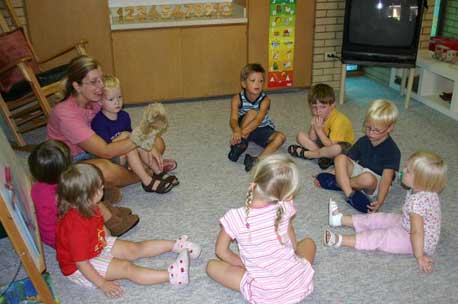
Students in the Stariņš preschool and kindergarten in Chicago gather in a circle to hear a story. The school is the only full-time Latvian program in the United States. (Photo courtesy of Vanda Dauksta)
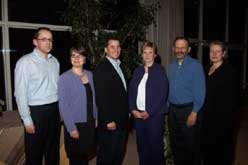
Leading the Toronto Latvian School Valodiņa this year are board members and committee chairpersons (from left to right) James Black, Ilze Matīss, Principal Norm Lee, Deborah Grietiņš, Viesturs Zariņš and Gundega Hladun. (Photo courtesy of Viesturs Zariņš)
Andris Straumanis is a special correspondent for and a co-founder of Latvians Online. From 2000–2012 he was editor of the website.