Bulte loses seat as Conservatives win in Canada

Sarmīte “Sam” Bulte, a Latvian-Canadian member of parliament from the Parkdale-High Park riding of Toronto, has lost her seat in the House of Commons in Canada’s general election.

Bulte, a member of the Liberal Party, lost to Peggy Nash of the New Democratic Party in an election that ended 13 years of Liberal rule in the federal government. Nash earned 40.3 percent of the votes, according to preliminary results reported by Elections Canada, while Bulte got 36 percent.

Two years ago, Bulte easily led a pack of six candidates to retain her seat in the House of Commons. Nash came in second in the 2004 vote in Parkdale-High Park.

Liberal Prime Minister Paul Martin’s minority government, plagued by scandal, fell on Nov. 29 after a no-confidence vote in Parliament. Now Conservative Party leader Stephen Harper will lead a new minority government.

As the Canadian campaign began in late autumn, Martin’s Liberals seemed assured of a victory. But the Conservative Party, according to media reports, benefitted in part from Canadians simply being tired with Liberal rule. The Conservative Party, according to Elections Canada, received 36.35 percent of the national vote and captured a total of 124 seats in the 308-seat House of Commons.

Bulte was first elected in 1997 and re-elected in 2000 and 2004. Among her other political and cultural activities, Bulte has served as a member of the board of the Latvian National Federation in Canada (Latviešu Nacionālā apvienība Kanādā).

Sarmīte Bulte

Sarmīte “Sam” Bulte, a member of the Liberal Party, has lost her seat in the Canadian House of Commons.
Andris Straumanis is a special correspondent for and a co-founder of Latvians Online. From 2000–2012 he was editor of the website.

Latvian association formed in Switzerland

A new Latvian association has been formed in Switzerland, home to at least 500 Latvians, and will be based in Zürich.

The Latvian Association of Switzerland (Lettische Gemeinschaft in der Schweiz) was founded on Jan. 18, Secretary Axel C. Scherrer told Latvians Online in an e-mail. The association will be officially chartered when Latvian Ambassador Aivars Groza, who is based in Austria and serves in five countries, visits Switzerland.

About 550 Latvians live in Switzerland, according to 2004 data compiled by the Swiss government. About half as many again live in Switzerland but are not registered, Scherrer said.

Historically, Switzerland was a refuge for Latvians after the failed 1905 Revolution. Among famous Latvians who once lived in Switzerland were the writers Jānis Rainis and Aspazija, who resided in Lugano from 1905 until their return to Latvia in 1920.

The aims of the new association are to maintain contact amongs Latvian of all ages in Switzerland, to promote Latvian culture in Switzerland, to organize regular guest speakers from Latvia, and to help Latvians in need in Switzerland.

The group will be creating a Web site, Scherrer said.

Latvia has an honorary consul, Ragnar Granelli, who is based in Zürich.

For further information about the association, contact Scherrer by e-mail at a.e@scherrer-mst.ch.

Andris Straumanis is a special correspondent for and a co-founder of Latvians Online. From 2000–2012 he was editor of the website.

Album offers a taste of Latvian post-folklore

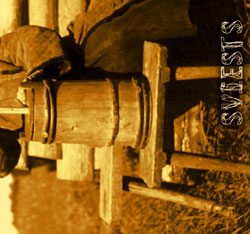
Sviests

Sviests (Butter) is a compact disc sampler of Latvian folklore-inspired music, also known as “post-folklore.” The CD does not have an overriding theme or style or time frame. Its only goal is to show the diversity of music that has been inspired by folk music, and therefore there’s a little bit of everything on it.

The CD begins with the groups Laiksne and Auri, both of which sing and play in a fairly traditional style. Next is Lidojošais paklājs with its mild, contemporary sound and elaborate arrangements, followed by Vilkači, the members of which focus on ancient Latvian culture and history.

Then the CD takes us to the world of ethno-jazz and the group Patina. Delve comes after that: a newer group from the Limbaži area with somewhat hypnotizing, ritual-like songs. Kristīne Kārkle and friends sing and play a first-rate rendition of “Ai, zaļā birztaliņa.” Kokle is a youth group, followed on the CD by the drums-and-bagpipes specialists, Auļi. Next is the most public face of Latvian traditional music—Skandinieki—followed by its antithesis, the pagan metal group Skyforger. If Latvian folk has made it this far, then there’s no fear that it will be lost any time soon, is there?

The next two groups on the CD are Trejasmens, a group that focuses on ancient warrior culture, and Dūdinieks, a project that creates modern musical arrangements for folk dance clubs. Kārkle then sings again, but this time with her original group, Ceiruleits. Next is the group Lāns and its delicate, ephemeral sound, followed by the Liv group Kala Jeng headed by Julgī Stalte. We hear Laiksne once more towards the end of the CD, and then Zane Šmite’s folk-avant-garde group Rīsa zvejnieki. The CD concludes with Visi vēji, a short-lived but popular and influential post-folklore group.

All in all, the variety included on Sviests shows an honest cross-section of the constantly changing post-folklore scene in Latvia. Some well-known groups have been left out, but some lesser-known groups have been brought to light. The liner notes offer a short description (in Latvian) of each group and a list of its participants. 

But why is the CD named “butter,” of all things? Especially when you take into account that in Latvian slang sviests means something that hasn’t turned out.

Maybe that’s what the CD sounds like to some: just a mess of unrelated music. But the name Sviests was chosen for other reasons. First of all, butter is a quintessentially Latvian product. Secondly, butter isn’t really a pure product, because in order to make butter, you need to take cream and churn and beat it until you finally get butter. But the result tastes just as good as the original product. The same goes for post-folklore: it’s highly processed folk music, but the result sounds just as good as the original. Thirdly, Latvians nowadays buy more margarine than butter—an analogy to the small part of the population who actually listen to and work with folk music.

In any case, this CD has definitely turned out and offers something for everybody who appreciates musical innovation.

Details

Sviests

Various artists

Lauska,  2005

LAUSKA CD05