Although they aren’t in abundance, more resources are becoming available, in Latvian and English, in Latvia and abroad, that can provide one with a substantial overview of Latvian art. Most are recent publications, having appeared only in the last 15 years or so. In Latvia the three main institutions responsible with providing the public with these publications are the Latvian National Museum of Art, the Latvian Center for Contemporary Art and the Latvian Artist’s Union. Most of these are exhibition catalogues, or catalogue raisonnés published in conjunction with an artist’s solo exhibition, but nevertheless they fill a negligible gap in the literature of European art.
The following is a summary of the most useful survey and reference books recently published on Latvian art.
One of the main sources for information on Latvian art in English in the United States is Rutgers University’s Zimmerli Art Museum, which houses the Norton and Nancy Dodge Collection of Soviet Nonconformist Art—the largest collection of its kind in the world. The collection contains a large number of works by not only Latvian artists but also artists from the other Baltic countries, Estonia and Lithuania. In 2001-2002 the museum mounted the first comprehensive survey of Cold War period art from the Baltics. Entitled “The Baltics: Nonconformist and Modern Art During the Soviet Era,” the exhibition was accompanied by the publication of one of the first English-language surveys of Baltic art, Art of the Baltics: The Struggle for Freedom of Artistic Expression Under the Soviets, 1945-1991. The book contains three chapters devoted to Latvian art written by Mark Allen Svede. The Zimmerli Art Museum also published a survey book of its collection, entitled From Gulag to Glasnost: Nonconformist Art from the Soviet Union, which also contains one chapter on Latvian art by Svede. Both of the books are an excellent source of information, in addition to being a resource for color reproductions of work by 20th century Latvian painters and sculptors.
As of yet there is no coffee-table history of Latvian art that will provide the reader with a thorough overview of the art and artists of the country. Perhaps the closest one can find are the chapters on Latvia in Art of the Baltics. Steven Mansbach’s Modern Art in Eastern Europe: From the Baltic to the Balkans, ca. 1890-1939 includes an informative chapter on Latvian and Estonian art. This is a concise introduction to the beginnings of the phenomenon of a Latvian national art, which only came about at the end of the 19th century.
In 2002 the Artists Union of Latvia published a catalogue on its collection. Entitled Paintings: Witnesses of an Age—The 1960s, 1970s and 1980s, the book is divided into three sections, which correspond with the aforementioned decades, and each essay is printed in both Latvian and English. The book is not only a resource for its overview of Latvian post-World War II art, but also as a source for color reproductions of previously unpublished art works. There are also a number of nostalgic spreads and collages of photographs of the artists from these years, which one would otherwise not have the opportunity to see.
Several valuable titles are available only in Latvian.
Another important book for understanding the history of Latvian art is Daba. Vide. Cilvēks. (Nature. Environment. Man.), which was published by the Artists Union of Latvia in 2004 in conjunction with an exhibition of the same name commemorating the 20th anniversary since the original exhibition held in St. Peter’s Church in 1984. The catalogue itself is a work of art, and was nominated for best book design in 2004. The essays in the book are written by leading art historians and art critics in Latvia and are crucial for understanding the exhibition, which was a turning point in the history of Latvian art.
For those seeking a handy reference book, there is an encyclopedia of Latvian art in four volumes, the fourth of which has yet to be published. Entitled Māksla un arhitektura biografijas (Art and Architecture Biographies), the first two volumes (A-Kal and Kal-Rum) were published by Latvijas karte in 1995 and 1996, respectively, and the third volume, R-V was published in 2000 by A/S Preses Nams. While the third volume is readily available in bookstores, the first two are difficult to find. The volumes contain short biographic entries on Latvia’s artists and architects, with some photographs of them and their work.
A one-volume reference is Latvijas Mākslas vēsture (Latvia’s Art History), also published by A/S Preses Nams.
Latvijas Kultūras vēsture (Latvia’s Cultural History) (Zvaigzne ABC, 2003) is a general reference book on the culture of Latvia from ancient Latvia (9000 B.C.) to the present. It contains entries not only on art and architecture, but also music, philosophy, theater, film and the press.
The Neputns publishing house has produced a series of books that contain essays on art and architecture by specialists in their field. The series is titled Materials for Latvian Art History and the essays contained in it are actually collections of published conference papers from the “Readings in Memory of Boriss Vipers” art conferences. Each anthology is organized around a theme, such as Latvijas māksla starptautisko sakaru kontekstā (Latvian Art in the Context of International Contacts, published in 2000), Latvijas mākslas un mākslas vēstures likteņgaitas (The Destiny of Latvian Art and Art History, published by Neputns in 2001), Latvijas māksla tuvplānos (Latvian Art Close Up, published in 2003), and Arhitektūra un māksla Rīgā: Idejas un objekti (Architecture and Art in Riga: Ideas and Objects, published in 2004). The books in this series are all in Latvian, with short summaries of each essay in English.
Another source for information on contemporary Latvian art are exhibition catalogues and the catalogue raisonné, which is a comprehensive overview of an artist’s life and work. These publications not only immortalize the exhibitions that have taken place over the past 15 years, but also fill a still negligible gap in the scholarship on the artists. Recently, in conjunction with their one-man exhibitions at the Latvian National Museum of Art, hardcover catalogue raisonnés have been published on Boriss Bērziņš (Neputns, 2003), Maija Tabaka (Rīgas galerija, 2004) and Bruno Vasiļevskis (Neputns, 2005), as well as one commemorating the Skulmes (Neptuns, 2000), a family of artists whose contribution to Latvian art history is vast and spans the entire 20th century. Two survey exhibitions of Latvian art have also been immortalized in print. Both of the catalogues are readily available: Latvijas māksla. 20. gadsimts, (Art of Latvia: The 20th Century, published by Neptuns in 2002), and Latvijas glezniecība. Kronētā ikona. 100 (published by SIA Nacionālais apgāds in 2005). The former is in Latvian with summaries in English, and the latter was published in Latvian, but a second version of the book in English, Painting of Latvia: The Crowned Icon. 100, is also available.
In 2005 the Latvian National Art Museum celebrated its 100th anniversary. In addition to the conferences and exhibitions that took place in Rīga in conjunction with the jubilee, the museum also published a thick, glossy catalogue. Entitled simply Valsts Mākslas muzejs (The State Art Museum, published by Jumava in 2005), it contains essays in Latvian and English about the history of the museum and the progression of Latvian art since the museum’s opening. At LVL 30 LVL (approximately USD 50), the book is somewhat pricey, but considering the 312 full-page color prints of art works from the museum’s vast collection, the cost is understandable.
The history of Latvian art is still being written, but more high quality publications have been put on the market during the last 15 years than ever before. While many of the books are only available in Rīga bookstores, it is possible more of the publications will become available for purchase online.
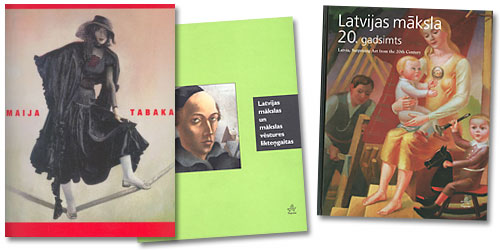
A catalog of the work of Maija Tabaka (left), the book Latvijas Mākslas un mākslas vēstures likteņgaitas (center) and a history of Latvian art in the 20th century are among recent publications.


