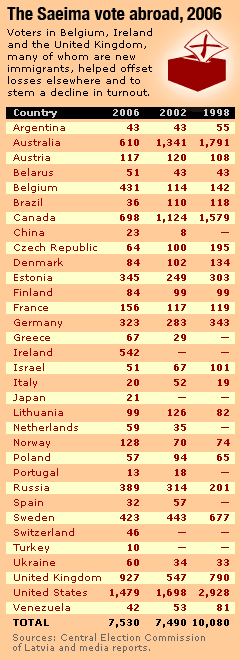
Voters in Belgium, Ireland and the United Kingdom—many of whom are recent immigrants—offset losses elsewhere and helped stem a decline in activity abroad during the Oct. 7 election for the Latvian parliament, according to data collected by the Central Election Commission in Rīga.
A total of 7,530 ballots were cast abroad in person or by mail, a 0.5 percent nudge over balloting four years ago, provisional results show. The 2002 turnout was almost 26 percent less than in 1998.
Voters in Australia got first crack at the ballot box as polling stations in the homeland and abroad opened at 7 a.m. local time for the election of the 9th Saeima—Latvia’s parliament. Election day dawned overcast and at times rainy in Rīga and other parts of Latvia, but in many other spots around the world voters were greeted with clear skies.
Polls were open until 10 p.m. (22:00 hours) local time as voters selected from among 19 political parties and their 1,024 candidates for the 100-seat parliament.
Voters should remember to bring their Latvian passports with them to the polling station, Arnis Cimdars, head of the Central Election Commission in Rīga, said during an Oct. 6 press conference. He also suggested voters who need eyeglasses should remember them.
Across Latvia by 10 p.m. on election day, 62.25 percent of eligible voters had cast ballots, according to the Central Election Commission. That was about 10 percentage points less than during the last parliamentary election in 2002. Observers of Latvian politics had noted that pre-election surveys showed a high percentage of undecided and nonvoters, although the numbers decreased as election day neared. A survey by Latvijas Fakti and the newspaper Diena just days before the election found that 8.7 percent of respondents would not vote and another 13.7 were undecided for whom to cast their ballot.
In all, 53 polling stations operated outside of Latvia for this year’s election, almost twice as many as in 2002 when a total of 7,490 votes were cast abroad in person or by mail. In addition to those who voted in person, a total of 557 Latvian citizens abroad requested absentee ballots that would be returned by mail, according to the Central Election Commission in Rīga.
Australia
Australia, seven hours ahead of Latvia, had three polling stations in Adelaide, Melbourne and Sydney.
About 200 voters, fewer than in the last parliamentary election in 2002, cast ballots at the Latvian House in Melbourne. The first voters came at 7 a.m., Honorary Consul Jānis Roberts Dēliņš said by telephone from his home in East Ivanhoe. Election day in Melbourne was aided by warm weather, with the temperature reaching 29 degrees Celsius, and by the fact that Saturday morning also was time for Latvian school, Dēliņš said.
Dēliņš said 199 voters were reported in Sydney. The polling station in Adelaide could not be reached.
Provisional final tallies reported to the Central Election Commission showed 610 votes cast in Australia, a drop of almost 55 percent from the 2002 turnout.
Asia and the Near East
Next in line were Latvian citizens who arrived at the polling stations in the Latvian embassies in Tokyo and Beijing. In Tokyo, 19 voters had cast ballots by about 8 p.m. local time, said Guna Reimandova, head of the local election commission and a diplomat in the Embassy of Latvia. Although a typhoon had threatened Japan the day before, Reimandova said, the weather on election day was sunny and clear.
This was the first Latvian election to take place in Japan, Reimandova said. The new embassy opened in April.
Two hours before the polling station was due to close in Beijing, the number of voters had reached 21, said Dana Rudāka, third secretary in the Embassy of Latvia. She expected a few more voters might still show up before the end of the day. Voters, the first of whom arrived at about 8 a.m., included students, travelers and workers. Rudāka described the weather in Beijing as “excellent.”
By about 2:30 p.m. in sunny and warm Tel Aviv, Israel, a total of 29 Latvian citizens had voted at the polling station in the Embassy of Latvia, said Einārs Miķelsons, head of the local election commission. Activity was expected to pick up again in the evening after public transport would again be running, he said, noting that during Shabbat (from sunset Friday until sunset Saturday) buses and other services do not operate. First to vote in Israel were some of the adults leading the Rīga Choreography School’s performance of the children’s ballet “Snow White and the Seven Dwarves,” Miķelsons said.
The weather also was warm and sunny in Ankara, Turkey, where by about 5 p.m. local time a total of eight voters had cast ballots in the Embassy of Latvia, said Jurijs Pogrebņaks, a embassy counselor and member of the local election commission. It is unclear how many Latvian citizens might be in Turkey, he said, but several no doubt were vacationing in seaside resorts.
Europe
Latvian citizens in Russia had three pollling stations available in Moscow, Pskov and St. Petersburg. The first voters to show up at the Consulate of Latvia in St. Petersburg appeared at about 9 a.m., said Agnese Saliņa, head of the local election commission. By 6 p.m., a total of 102 had cast ballots and Saliņa predicted the number might increase to about 140 by the end of the day. In Pskov, where the weather was štruntīgs (worthless), Consul Gints Serafinovičs reported 30 voters had cast ballots. That was 10 more than in the 2002 election. The first voter appeared at 8 a.m., he said. The Embassy of Latvia in Moscow could not be reached for comment.
Among the first voters at the Embassy of Latvia in Berlin, Germany, were some who had enjoyed that city’s night life before coming to cast their ballots, said Uldis Simsons of the local election commission. “But I can vouch that they were clear-headed,” he said. By about 6 p.m. local time under partly cloudy skies, the polling station had recorded 103 votes, Simsons said, plus had received 76 of the absentee ballots that had been requested in advance.
Voters at the Latvian consulate in Bonn, Germany, were mostly from the post-World War II exile generation, said local election commission Chairperson Inga Graudiņa. The day began with rain, she said, but the afternoon was sunny. By about 6 p.m. local time, 104 Latvian citizens had voted there.
Final tallies for Germany showed a 14 percent increase in turnout compared to 2002.
Voting in Brussels, Belgium, was strong. With three hours to go before the polling station closed, a total of 334 ballots had been cast. “It was not unexpected,” said Uldis Mikuts, chair of the local election commission. Many Latvian citizens now live and work in the Brussels area thanks to Latvia’s membership in the NATO defense alliance and the European Union. Also, some of the voters who cast ballots in the Embassy of Latvia in Brussels came from Luxembourg, Mikuts noted. The first voter did not arrive until about 8:15 a.m., he said, but then it was raining in Brussels from about 7-8 a.m., after which the weather became wonderful.
Belgium, according to final talllies, registered one of the most dramatic increases over 2002—278 percent—of all voting districts abroad.
In the United Kingdom, polling places were set up in the Embassy of Latvia in London; in the Daugavas Vanagi House in Bradford; in the Straumēni rest home in Catthorpe, and on the island of Guernsey.
“I see we have three more voters coming,” Jekaterina Tuļina, head of the election commission in Guernsey, told a reporter at about 3:30 p.m. local time. That would bring the total voters to 34 by that point. The first to vote, she said, was a Latvian citizen who works in the Les Cotils Christian Retreat & Conference Centre, where the polling station was based. The number of Latvian citizens in the Channel Islands, which includes Guernsey, may be anywhere from 2,000 to 6,000, Tuļina said, although official figures recorded by Guernsey administrators put the total at 800-900.
As 5 p.m. was approaching in Bradford, the number of voters was nearing 100, said Valdis Avotiņš, secretary of the local election commission. At least a third of the voters who came to the polling station in the Daugavas Vanagi club were recent immigrants from Latvia, he said, and more were expected in the evening as they got off work. The voters who traveled the longest distance came from Carlisle in northern England, Avotiņš said, about 150 kilometers from Bradford.
At the Straumēni rest home in Catthorpe, about 100 voters had been observed by the afternoon. The Embassy of Latvia in London could not be reached, but it was expected that some who voted there had come into the capital city to vote and then to shop or seek out entertainment.
Final tallies for the United Kingdom revealed a nearly 70 percent increase in turnout over the 2002 election.
With just over three hours left for balloting, a total of 338 voters had appeared at the Embassy of Latvia in Dublin, said First Secretary Ivars Lasis, who also served as chairman of the local election commission. The number was lower than expected, but Lasis held out hope that more voters would appear yet in the evening. During the past several days, the embassy received many telephone calls and e-mails seeking information about the election, and that interest continued throughout the day Oct. 7.
If nothing else, media interest in the vote was high, given that at least 20,000 Latvian citizens are believed now to be living and working in Ireland. Among media outlets from Latvia reporting from Dublin were Latvian State Television, Latvian Independent Television, the Baltic News Service, Latvian State Radio and the newspaper Vakara Ziņas. Several of the journalists were among the first to vote at the embassy, Lasis said.
Another polling station operated in the southern Irish city of Cork. By 7 p.m., just 57 ballots had been cast, said Ginta Dailīdenaite, chair of the local election commission. The first voter arrived about 11 a.m. and the greatest activity was during the lunch hour, she said.
The final tally for Ireland reported to the Central Election Commission was 542 votes.
Polling stations also were open in Vienna, Austria; Minsk and Vitebsk, Belarus; Prague, Czech Republic; Copenhagen, Denmark; Tallinn, Estonia; Helsinki, Finland; Paris, France; Athens, Greece; Rome, Italy; Vilnius, Lithuania; The Hague, Netherlands; Oslo, Norway; Lisbon, Portugal; Madrid, Spain; Warsaw, Poland; Göteborg and Stockholm, Sweden; Geneva, Switzerland, and Kiev, Ukraine.
North America
Just under 600 voters had cast ballots in the Latvian Canadian Cultural Centre in Toronto, said local election commission Chair Solvita Rakitko, reached 20 minutes before the polling station was to close. The greatest amount of activity had been in the morning, she said, adding that many voters no doubt were trying to take care of their civic duty before heading off for the three-day Thanksgiving Day weekend.
Meanwhile, at the Embassy of Latvia in Ottawa, just 80 voters had cast ballots by 9:30 p.m.—about half the number who voted in 2002, according to election commission member Mārtiņš Sausiņš. Latvians from Montreal, however, kept up tradition established in previous elections, chartering a bus that brought about 30 voters to Ottawa.
The final count for Canada was 698 votes, nearly 38 percent lower than in 2002.
In the United States, nine polling station were open in Boston; Chicago; Cleveland, Ohio; Los Angeles; Minneapolis; New York; St. Petersburg, Fla.; Seattle, Wash., and Washington, D.C. In many of those communities, members of the American Latvian Youth Association will offer senior citizens rides to the polling stations.
Across the United States, about 1,200 votes had been cast by 8 p.m. Eastern time, said Sanita Pēkale of the Embassy of Latvia in Washington, D.C. In Washington alone, a total of 176 voters had come to cast ballots on election day, she said.
A nice autumn day greeted voters who headed to the Latvia’s Permanent Mission to the United Nations in New York. The first voter showed up at 7:08 a.m., said Krista Raupa, a member of the local election commission. With just 45 minutes to go in the balloting, a total of 217 voters had been recorded at the polling station, she said.
Just before 3 p.m. on a warm and windy Minnesota day, a burst of voters moved to 85 the total ballots cast in the Latvian Ev.-Lutheran Church of Minneapolis-St. Paul, and still more were expected into the evening. The site was one of the new polling stations approved for this year’s election. Previously, voters had to travel to Chicago—about a seven-hour trip by automobile—or send their ballot by mail.
The last Latvian citizens to vote were those visiting polling stations late in the day in Los Angeles or Seattle.
The final count for the United States was 1,479 votes, a nearly 13 percent slip from the 2002 turnout, according to Central Election Commission data. Chicago, New York and Washington, D.C., were the most active polling stations, Pēkale said in a press release issued early Oct. 8. Voting ran smoothly with no incidents except in Boston, where illegal campaigning was observed but quickly stopped by the local election commission.
South America
In the Buenos Aires suburb of San Miguel, where Honorary Consul Mirdza Zalts is based, a total of 43 Latvian citizens cast ballots—the same number as four years ago. The first voter in Argentina showed up at about 9:30 a.m., Zalts said, and voting was done by nightfall.
Only a fourth as many voters cast ballots in Brazil this year as did in 2002, according to Honorary Consul Jānis Grimbergs, reached by telephone an hour before the polling station was due to close. Most of the 27 voters came from Sao Paulo, he said. A group from Nova Odessa, a old Latvian colony, could not make it to the polling station. But Grimbergs also attributed the low count to the fact that several of those who voted in 2002 have since died, while a number of potential young voters had failed to renew their Latvian passports.
Reached about two hours before the polling station was set to close in Caracas, election commission Chairman Andris Bērziņš reported that 42 people had voted in Venezuela. The number was about half of what had been hoped. One possible factor in the lower-than-expected turnout, Bērziņš said, was that some potential voters may have instead gone to a mass demonstration in Caracas in support of opposition Venezuelan presidential candidate Manuel Rosales. He hopes to unseat incumbent President Hugo Chávez come Dec. 3.
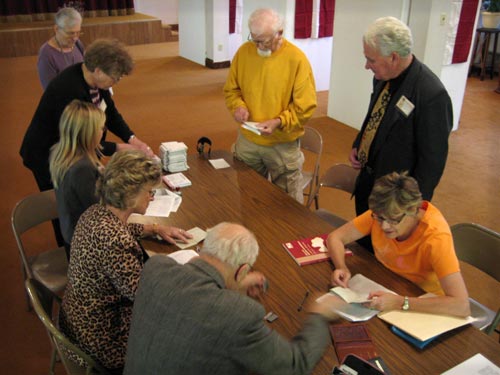
Members of the local election commission brief voters on the balloting process in Minneapolis. (Photo by Andris Straumanis)