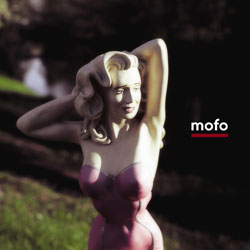
The Latvian britrock group Mofo has released its first album, simply entitled Mofo. Apart from what amounts to be a rather silly name for a band, Mofo offers something unique to the listener. One can only be thankful Platforma Records was wise enough to release this alternative music group’s album. It has a lot of good songs, is well produced and packaged.
The album contains 14 songs with an average song duration of about three minutes each, which gives just enough time for the standard intro, verse, chorus-verse, chorus, bridge, chorus and ending type of song. All songs are in Latvian.
The album starts off nicely with a little unfinished 45-second track, “Dienas atklājums” (Discovery of the Day), which ends quite suddenly and goes straight into the next song, “Daudz par daudz” (Too much). It is a real britrock song with straight beat and some interesting chord modulations and slow bridge ending.
Mild guitar rock follows on “Diena neparasta” (Strange Day), a simple little song with a nice guitar riff. But it is back to fast-paced rock with choppy guitar chords on “Kārtējais gals” (The Ever-Recurring Ending).This song has some cool lyrics about the end of the world being just around the corner again. The middle of the song settles down with some smooth, jazzy chords, but then returns to the hectic fast-paced beat. The end comes all too soon, unexpectedly of course.
“Meitene no filmām” is about a girl from a cheap Swedish film. The track has a nice melodic guitar-picking verse and heavier giutar chord chorus. Drummer Pēteris Linde goes all out thrashing his drums and riding the cymbal. The song reminds the listener of earlier work by Ingus Baušenieks. Nice sound effects are heard at the beginning and end of the song. “Es tevi nopirkšu” (I’ll Buy You)—and take you to the city where it’s always raining—has some simple choppy piano accompaniment, “la la la” background vocals and melodic chorus. Things slow down on “Es zinu man sacīs” (I Know I’ll Be Told) where singer Arnis Račinskis shows his entire vocal range. It’s a bit of a boring song and it seems that ballads are not Mofo’s forte.
Changing beats to waltz tempo, “Sākums kad viss ir beidzies” (The Beginng When Everything Has Ended) spins psychedelicly around with strumming acoustic guitar, drums and bass, ending of with echo guitar.
Thump-thump guitars are heard again on “Vienmēr vēlies vairāk” (Always Wanting More) co-wrtten by the group’s former guitarist Mārtiņš Elerts, who recently was replaced by Edgars Rubenis. This is really indy pop, with lots of guitar bar chords and cymbal ride. The group’s first single, “Nekas nav beidzies” (Nothing Has Ended), is next.
Another single follows. “Mans lielais rakstamgalds” (My Big Desk) is composed by Latvian alternative music guru Māris Šverns. This is actually one of the best songs on the album, with a rythmic verse, great melodic chorus and modulating bridge. The intriquing bass line is played byToms Ostrovskis.
“Uz manas ielas” (On My Street) is a slow little song that takes a while to take off, but doesn’t really seem to go anywhere. Between this song and the next, where normally a couple of seconds of silence is embedded, Mofo has chosen to put in a 48-second jazzy intro to its hit song “Tavs radio melo” (Your Radio Lies). Depending on your CD player, in shuffle mode this intro part is treated as a separate song (in my car stereo it counts down the time to the main part of the song). “Tavs radio melo” really rocks. However, the ending is a bit abrupt for my taste. The album is rounded off by another lazy song called “Rīta autobuss” (Morning Bus). The song and the album end with city traffic noises.
I get a feeling that song writer Arnis Račinskis gets a lot of his lyrical inspiration just by walking around the city. He is also the driving force behind the group and this album. He has composed nearly all the songs alone and is producer on the album. Even though the album is recorded in Rīga at Wolk Recording Studios by Sergei Amsterdam, Mofo had the album mastered at Optimum Mastering in England. This may be to guarantee the britrock feel.
Mofo makes music like no other group I’ve heard from Latvia.
Details
Mofo
Mofo
Platforma Records, 2006
PRCD 193