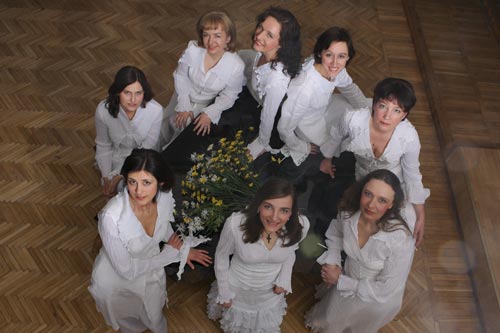
Vocal ensemble Putni flies across America

The women’s vocal ensemble Putni, which has received accolades both in Latvia and abroad, is scheduled to tour the United States with a series of 14 concerts in late October into mid-November.

Sponsored by the cultural organization TILTS, the tour will take the eight women from Massachusetts and Washington, D.C., to Ohio, Minnesota and Wisconsin, and then to New York. Five of the concerts, said ensemble leader Antra Dreģe, will be in Latvian and American schools.

Formed in 1993, Putni has earned several international awards. The ensemble also has released four compact discs, the most recent of which is last year’s Hildegardes dziesmas, a recording of songs composed by Georgs Pelēcis.

The concert program is to include mostly Latvian music by composers such as Pēteris Vasks, Maija Enfelde, Valts Puce, Anita Mieze, Juris Vaivods and others.

The ensemble’s first apperance, Dreģe said, will be a live broadcast with the women’s vocal ensemble Tapestry on WGBH-FM in Boston. The two ensembles will perform the debut of a new composition by Robert Kyr and Pēteris Aldiņš, founder of the Latvian-American ensemble Kolibri. The broadcast is scheduled 3 p.m. Eastern time Oct. 26 on Richard Knisley’s “Classical Performances” program. The concert also will be available online.

The ensemble’s nine public concerts are scheduled:

  • In Massachusetts at 8 p.m. Oct. 27 in the First Church Congregational of Cambridge, 11 Garden St. (by Harvard Square), Cambridge. The concert is organized by the women’s ensemble Tapestry.
  • In Massachusetts at 1 p.m. Oct. 29 in the “Trimda” Latvian Ev.-Lutheran Church, 58 Irving St., Brookline.
  • In the Washington, D.C., area at 7:30 p.m. Nov. 4 in the Latvian Ev.-Lutheran Church of Washington, 400 Hurley Ave., Rockville, Md. The concert is organized by the Latvian Organizations of Washington.
  • In Ohio at 7 p.m. Nov. 10 in the United Latvian Ev.-Lutheran Church, 1385 Andrews Ave., Lakewood. The concert is organized by the Latvian Concert Association of Cleveland.
  • In Minnesota at 4 p.m. Nov. 12 in the Latvian Ev.-Lutheran Church of Minneapolis-St. Paul, 3152 17th Ave. S., Minneapolis. The concert is organized by the Latvian Organization Association of Minnesota.
  • In Minnesota at 7 p.m. Nov. 13 at 625 N. 5th St., Stillwater. The concert is organized by the Latvian Organization Association of Minnesota.
  • In Wisconsin at 7 p.m. Nov. 14 in Davies Center, University of Wisconsin-Eau Claire, Eau Claire. The concert is organized by the Baltic Student Organization.
  • In New York at 8 p.m. Nov. 17 in St. Joseph’s Church Yorkville, 404 E. 87th St., New York. The concert is organized by the New Amsterdam Singers and TILTS.
  • In New York at 2 p.m. Nov. 18 during an Independence Day celebration in the Yonkers branch of the Latvian Ev.-Lutheran Church of New York, 254 Valentine Lane, Yonkers. The concert is organized by the Council of Latvian Organizations in New York.

For further information about Putni, visit www.music.lv/putni.
 

Description of image

The women’s vocal ensemble Putni tours the United States in late October through mid-November.
Andris Straumanis is a special correspondent for and a co-founder of Latvians Online. From 2000–2012 he was editor of the website.

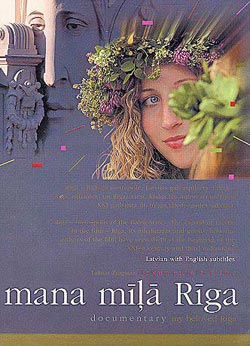
Documentary tells stories of love for Rīga

The standard tourist film about a country or city often seems to inform but at the same time lull the viewer into a gentle slumber. It’s often hard to remember the main points—and main attractions—the film has tried to bring to our attention. The problem is usually too much information in too short a time span. The documentary Mana mīļa Rīga (My Beloved Rīga) certainly does not fall into this category.

Director Laima Žurgina’s film was first released in 2004 and now is available on DVD.

The film is two hours long, so it has plenty of time to elaborate on specific themes. These give the viewer a good insight into various aspects of Rīga. There’s “Art Nouveau Rīga” and “Historical Rīga”, both with commentaries by experts; “Rīga’s Beautiful Cemeteries,” with commentary provided by a gravedigger; and the nation’s symbol , the Freedom Monument. The unhurried flow and sincerity of these commentaries, coupled with background music that blends in perfectly with each theme, make the title of the DVD seem fitting. One more added bonus is good-quality English subtitles, a detail that can often make or break a product.

Other clips show Rīga’s unique and memorable celebrations such as the seasonal Zāļu tirgus (herb and grass market) in the Dome Square the day before Midsummer Night and the annual arts and crafts fair at the Open-air Ethnographic Museum just outside Rīga during the first weekend in June. These two occasions show the nation’s love for tradition, both in terms of celebrating specific festivities as well as the continuation of centuries’ old traditions of embroidery, knitting, weaving, ceramics and other local handicrafts.The hope is that these folkloric legacies will remain with the Latvians for decades to come and cosmopolitanism will not take over.

Interviews with the architects of the new Hansabanka building, Saules akmens, as well as the architect responsible for the total revamp of Rīga Airport show Rīga’s contemporary new face and the direction that Rīga is heading in the 21st century. A fairly lengthy section devoted to a street festival may seem to drag, but it does show Rīgans relaxing and is a welcome break from the more serious parts of this documentary.

Scenes depict famous Rīga-born celebrities such as Gidon Kremer and the Kremerata Baltica, Olympic javelin-thrower Jānis Lūsis and his son Voldemārs, and artist Kristaps Zariņš—all in some way expressing their pride in their hometown and the emotional ties that bind them to the place. A Russian Orthodox Easter Mass, the opening ceremony of the Jewish Ghettos Memorial in Rumbula, the Latvian Song Festival and enthusiastic hockey fans celebrating Latvia’s win in a game all effectively depict the multicultural microcosm that is Rīga.

You catch the feeling that Rīga is in a state of flux. The film has no pompous attempt to exaggerate Rīga’s attractions nor an undertone of apologising for its shabbiness and neglect as a result of Latvia’s Soviet legacy. Emphasis is on the future, on Rīga’s dynamic changing nature and the possibilities that lie ahead.

After seeing this documentary you feel intrigued by Rīga and its diversity. The fim provides just enough information to raise a potential tourist’s interest level. For those who have just been to Rīga the film will give a bit more of an insight into what makes this city tick. The cinematography also helps shape the film. Subtle changes to the standard format—architecture, history, nature shots—couple with unusual angles, the use of narrative by local experts and a general feeling that the film has not been merely commissioned but created by professionals with a strong sense of pride in their city, make Mana mīļa Rīga stand out from other films of this genre. Rīga, and Latvia in general, would benefit if more people would use their creative skills with this positive aim in mind.

Details

Mana mīļā Rīga

Laima Žurgina

VISIO Ltd.,  2004

Notes: In Latvian with English subtitles. Documentary, 116 minutes. Script: Laima Žurgina; camer: Edgars Bite, Gvīdo Skulte and Uģis Egle; sound director: Aivars Znotiņš; producers: Laima Žurgina and Dzintars Belogrudovs.

Where to buy

Purchase Mana mīļā Rīga from BalticShop.

Note: Latvians Online receives a commission on purchases.

Daina Gross is editor of Latvians Online. An Australian-Latvian she is also a migration researcher at the University of Latvia, PhD from the University of Sussex, formerly a member of the board of the World Federation of Free Latvians, author and translator/ editor/ proofreader from Latvian into English of an eclectic mix of publications of different genres.

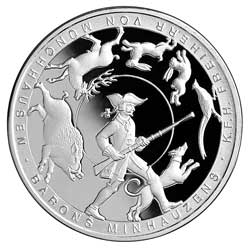
Baron Münchhausen coin wins top honor

A 100-santīm (1 lat) commemorative silver coin honoring the legendary Baron Münchhausen has won top honors at this year’s Vicenza Numismatica coin show in Italy, the Bank of Latvia announced Oct. 13.

The coin, released by the Bank of Latvia in 2005 and minted in the Netherlands, was designed by Arvīds Priedīte and Jānis Strupulis. It honors the 285th anniversary of the birth of Karl Friedrich von Münchhausen (1720-1797), a real-life retired military man who came to be known for his storytelling of fantastic adventures. Münchhausen lived in Vidzeme, part of modern-day Latvia, from 1744-1750.

Baron Münchhausen’s stories, with further embellishments, were published by several authors beginning, some believe, with the German writer Rudolf Erich Raspe (1737-1794).

The coin also was a favorite of the Latvian public, winning the award “Latvijas gada monēta 2005,” receiving the greatest number of ballots in the contest, according to the Bank of Latvia.

Baron Münchhausen coin

The reverse of the Baron Münchhausen coin features images from his stories. (Photo courtesy of Bank of Latvia)

Andris Straumanis is a special correspondent for and a co-founder of Latvians Online. From 2000–2012 he was editor of the website.