PBLA urges Saeima not to hurry border treaty

As the Latvian parliament prepares to debate a border treaty with Russia, the World Federation of Free Latvians is asking lawmakers not to rush their deliberations and to ask for international experts to evaluate the document.

The Saeima is prepared to begin discussion Feb. 1 on the Latvia-Russia Border Treaty, which was initialed by both sides in 1997.

A bill prepared by Prime Minister Aigars Kalvītis and introduced by the Foreign Affairs Commission pushes for quick approval of the treaty without any additional declarations or demands on Russia.

Among reasons for finalizing the treaty, according to the bill, are Latvian officials’ promises to both the European Union and the NATO defense alliance to clear up questions over the country’s eastern border.

“The WFFL does not see any new conditions why right now, 10 years after the 1997 initialing of the Republic of Latvia’s and the Russian Federation’s border treaty, there is such haste to accept the border treaty with Russia without any attached declarations or objections,” the World Federation of Free Latvians (Pasaules brīvo latviešu apvienība, or PBLA) said in a Jan. 31 press release.

In previous negotiations, the two countries have not been able to come to final terms, particularly over the issue of compensation for loss of territory and the 50-year Soviet occupation of Latvia.

The two countries were scheduled to finalize the treaty in 2005, but then Latvia added a declaration that demanded Russia acknowledge the “legal continuity” of Latvia from the time of its original independence in 1918.

At the time, Russian President Vladimir Putin had strong words for Latvia, saying his country would never give into the demands of its neighbor.

Particularly troublesome has been Latvia’s demand for compensation over the loss of the Abrene region.

Latvia declared independence from Russia in 1918. The two countries signed a peace treaty in 1920 that also fixed Latvia’s border with Russia. At the time, that meant the eastern territory known as Abrene was part of Latvia. The area is known as Pytalovo District to Russia. It was annexed by the Soviet Union in 1944 and made part of Russia.

When Latvia regained its independence, it legally renewed the 1918 republic, which at least in theory included Abrene.

The World Federation of Free Latvians said that if the border treaty is approved without any additional declaration about Latvia’s legal continuity, then the country will have a priori given in to Russia’s wishes and interests.

The border treaty has led to sharp words between Latvian politicians.

Tēvzemei un Brīvibai/LNNK (For Fatherland and Freedom/LNNK), a member of the ruling coalition, has announced it will oppose the treaty. Among other objections, the party says the proposed approval of the border treaty would amount to partial legalization of the Soviet occupation and could lead to further Russian demands on Latvia.

Some suggestion has been made that if the treaty is approved, the party might quit the government.

Sandra Kalniete, a member of the opposition party Jaunais laiks (New Era), has said she could not vote for a treaty that would violate Latvia’s constitution. Instead, she said in a Jan. 25 speech, the treaty should be offered to Latvian citizens to consider in a national referendum.

Māris Kučinskis, a member of Tautas partija (one of the members of the ruling coalition), said the question of the border agreement is important to Latvia and the European Union, and that he would like to see it resolved within in the next month.
Andris Straumanis is a special correspondent for and a co-founder of Latvians Online. From 2000–2012 he was editor of the website.

Īrijas latviešu skola grasās paaugties

Dublinas latviešu skola “Saulgriezīte” šogad varētu piedzīvot lielas pārmaiņas, piesaistot vēl skolotājus, uzņemot vēl skolēnus un varbūt pat atvērot jaunu nodāļu, ziņo Latviešu Biedrības Īrijā interneta lapa.

Pateicoties Latvijas Republikas vēstniecības Dublinā iniciatīvam, skola atvērta 2005.g. maijā. Tā kalpo Dublinas latviešu kopienai. Oficiāli dati liecina, ka visā Īrijā tagad dzīvo un strādā ap 20 000 latviešu, lai gan ir skaidrs, ka tur atrodas daudz vairāk tautiešu.

Kā ziņo biedribas mājas lapa www.lbi.ie, skola arī šogad saņēma finansiālu atbalstu no Latvijas Republikas Īpašu uzdevumu ministra sabiedrības integrācijas lietās sekretariāta.

Skola tagad meklē pasniedzēju darbam ar mazākajiem bērniem, kas piedalītos programmā “Mazā Saulgriezīte”. Tiek meklēti arī pasniedzēji vecākiem bērniem. Vēl pastāv iespēja, ka atsevišķu skolas grupu varētu nodibināt Swords pilsētā, ziemeļos no Dublinas, kur dzīvo daudz latviešu.

Interesenti lūgti sazināties ar Latviešu Biedrības Īrijā Izglītības jomas vadītāju Viju Vīganti, vijucha@inbox.lv.

Andris Straumanis is a special correspondent for and a co-founder of Latvians Online. From 2000–2012 he was editor of the website.

Re-release showcases Līvi after death of Ķiģelis

Kurzemei - saules ceļš

Tragically losing an important member might cause a band to break up, or, at the very least, cause the band’s work to decrease in quality. Just look at Queen, which after the death of Freddie Mercury in 1991 went on a nearly 15-year hiatus. On the other hand, there is AC/DC, which after the death of lead singer Bon Scott in 1980 hired a new lead singer and released one of the biggest albums of all time, Back in Black. And of course there are cases like The Doors after the death of Jim Morrison or Lynyrd Skynyrd after the death of a number of its members, both of which pressed on, though never equaling their earlier critical and commercial success.

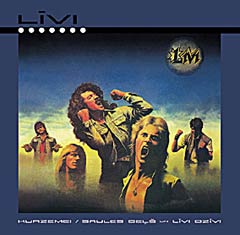
A similar story come from Latvia. Rock band Līvi had just tragically lost Ēriks Ķiģelis—guitarist, vocalist and songwriter—after recording its album Iedomu pilsēta. Other groups might have called it a day, but Līvi made a few significant lineup changes and, partly as a tribute to Ķiģelis, recorded his final major composition and released the self-titled album Līvi in 1988.  At the end of 2006, MICREC, as part of its “Latviešu populārās mūzikas klasika” series, re-released this album as well selections from the 1994 live album Līvi dzīvi, titling it Kurzemei – saules cēļš un Līvi dzīvi. Having this great album on compact disc is a joy as it contains some of the greatest Latvian rock music ever recorded.

After Ķiģelis’ death, the lineup of the band changed to include Guntars Mucenieks (keyboards, vocals), Jānis Grodums (vocals, bass), Aivars Brīze (vocals), Ainars Virga (guitars, vocals) and Dainis Virga (drums, vocals). Though they lost Ķiģelis, a talented guitarist, his replacement Ainars Virga was a young guitar prodigy. These lineup changes also led to a dramatic change in the sound of the band. Though always a rock band, Līvi now brought the guitar to the forefront of the music, to the point where one might call this the first Latvian heavy metal album.

The highlight of the album is the suite of five songs called “Kurzemei – saules ceļš,” with lyrics by O. Gūtmanis. I cannot imagine a better epitaph for Ķiģelis than this work. Starting with the driving “Pavasara iestāšanās” and finishing with the triumphant “Saules ceļš,” it is a monument of Latvian rock. It even leads one to wonder what other great work Ķiģelis might have composed had he lived. “Saules ceļš” ends with what may be just about the most epic guitar solo in Latvian rock music, performed by Ainars Virga.

This album also features not just one but two of the most memorable guitar riffs in Latvian rock, from “Deviņvīru spēks” (part of the “Kurzemei” suite) as well as from “Dzelzgriezējs” (music by Ainars Virga, words by V. Grēviņš), one of the most recognizable songs in the Līvi repertoire and still a major part of the band’s concert repertoire.

Another reason I like this album is that keyboards and synthesizers (as played by Mucenieks) are an integral part of many of the songs, as opposed to being little more than background music. A Mucenieks composition, “Zvani” (lyrics by Gūtmanis) closes out the album.

In 1987 and 1989, Līvi performed at the yearly festival “Liepājas dzintars.” Parts of the performances were released on the cassette Līvi dzīvi in 1994. At this point, the group was augmented by second guitarist Tomass Kleins (though the cassette release does not list him as a member, the CD does) and second drummer Valdis Štarks.

The CD contains most of the songs found on the original cassette, but for those few who might have the cassette, it should be noted that due to time contraints the CD leaves out the live versions of “Dzejnieks,” “Straume,” “Dzelzsgriezējs,” “Melu mēle” and “Zvani.”

The sound recording is a bit rough and unpolished, and perhaps for a rock band like Līvi it is best to have the sound as raw as possible.

The album does skip over a number of Līvi hits that one might have expected to be here—no “Dzimtā valoda,” “Zīlīte” or “Bailes par ziņģi,” for example. However, it is nice to have some lesser-known Līvi tracks, including a few that to my knowledge have not been released in studio format, such as “Pārāk maz,” “Metāla sirds,” “Man vienalga,” and “Sabrukusi pils.”

To be honest, I rarely listened to Līvi dzīvi, perhaps mainly due to its rough nature and lesser-known songs, but it does make a nice bonus to the Kurzemei album.

Once again, no lyrics are included in liner notes, but included are the original text from the 1988 album (written by Klāss Vāvere) and a few pictures from the original releases of Kurzemei – saules ceļš and Līvi dzīvi.

To have the Kurzemei album on CD for the first time itself makes this an essential disc to own. The album still resonates today. Cello group Melo M even recorded an instrumental version of the song “Dzejnieks” for its 2005 album. Featuring the last great work by Ķiģelis, as well as a number of other standout tracks, makes Kurzemei – saules ceļš un Līvi dzīvi a highly recommended purchase.

Details

Kurzemei – saules ceļš un Līvi dzīvi

Līvi

MICREC,  2006

MRCD 331

Where to buy

Purchase Kurzemei – saules ceļš un Līvi dzīvi from BalticShop.

Note: Latvians Online receives a commission on purchases.

Egils Kaljo is an American-born Latvian from the New York area . Kaljo began listening to Latvian music as soon as he was able to put a record on a record player, and still has old Bellacord 78 rpm records lying around somewhere.