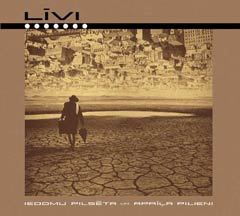
In its efforts to re-release most every important album on compact disc format, the recording house MICREC has finally come to the 1980s with the release of Iedomu pilsēta un Aprīļa pilieni . Approaching a total of 30 recordings in the series “Latviešu populārās mūzikas klasika,” the company has given its due to one of the most important and influential Latvian rock groups—Līvi.
This release contains the very first official full Līvi album from 1986, Iedomu pilsēta, and also Aprīļa pilieni, a song cycle from a presentation by Latvian State Television in 1985 (from which a few songs were released on a 7-inch record in 1985). Though the group did re-record many of these songs for the 1997 CD Bailes par ziņģēm, on this re-release you will hear these songs as they were originally recorded.
Līvi, which celebrated its 30th anniversary in 2006, was founded in Liepāja in 1976. Throughout the years, the band’s lineup has always changed, but the one member who has been constant is bass guitarist and vocalist Jānis Grodums.
The songs from Apriļa pilieni (with all texts by Māris Čaklais) were recorded in 1984. At that point, the leader of the group was guitarist, singer and composer Ēriks Ķiģelis. Along with he and Grodums, group members included vocalists Igo (Rodrigo Fomins) and Inga Pavītola, Modris Šterns on keyboards and vocals, and Vilnis Krieviņš on drums.
Apriļa pilieni, actually a children’s program, turned out to be rather controversial. The Soviet government did not approve of the songs’ ideologies, much less the noisy hard rock sound of some of tracks, and it came to pass that television director Lilita Eglīte was relieved of her duties. Eglīte even writes a few words about the whole event in the liner notes contained in the CD re-release.
The songs themselves are a rather eclectic. You do get the hard rock of songs like “Uzraksti uz sētas” and “Elektriskā zivs,” but you get other interesting songs like “Jānīts pīpē” (a lament about little Johnny who has begun smoking) and “Durvis” (in which the word „durvis” is repeated again and again in a low growling vocal). Also heard are songs with a poppier feel, like “Padeklītis.” And, of course, the album has the still popular hit “Apriļa pilieni” with its timeless refrain, „Aprīlim, aprīlim pilieni nav kā līdz šim” (In April, rain drops are like none before).
Even with the controversy of the television program, the group received the ultimate honor at that time—a request to record a full album (very, very few groups ever got this chance). In 1985, the group began work on its first album, Iedomu pilsēta, which was released in 1986.
Tragically, Ķiģelis died in an auto accident on Oct. 3, 1985, before the release of the record. This was a particularly severe loss for the group, as well as for Latvian rock music in general. Ķiģelis, besides being a talented guitarist and songwriter, had assertively taken over leadership of the group and was influencing its musical direction. Even though this was the band’s first full album, there were already many classics with music by Ķiģelis.
One of the most notable compositions on Iedomu pilsēta is “Saldus saule” (music by Ķiģelis, words by Māris Čaklais), a tribute to the town of Saldus in the Latvian region of Kurzeme. The song was even performed at the youth choir concert during the 2003 Latvian Song Festival. Also on the album is “Zušu dziesmiņa” (music by Ķiģelis, words by J. Plotnieks), a song about what to do if an eel is approaching you.
Not to be outdone, Grodums was also proving himself an adept songwriter. Though not on this album, one of Grodums’ most popular works was the song “Ziņģe par bailēm,” originally performed by the rock group Credo, and included on the Mikrofons 80 record. Grodums continued his composition work on this album, including the almost reggae-like “Līviskā ziņģe” and the song “Rožu laukums” (with words for both by A. Neibarts).
The packaging for this release, as with many of the other CDs in this series, is minimal. It does have the notes from Eglīte, as well as a facsimile of the back of the original vinyl release of Iedomu pilsēta, which contained an essay on the band by Klāss Vāvere. It would have been nice to have song texts, not to mention a bit more information about the group. Because Grodums has been there all along, it would be particularly fascinating to hear his thoughts on recording these songs.
These records show the origins of one of the cornerstones of Latvian rock music. From the intentional naïveté of Apriļa pilieni to the budding hard rock of Iedomu pilsēta, Līvi in the 1980s was a group that would shape the sound of Latvian rock. Līvi had already been in existence for almost a decade at this point, and even in this period of time the group had managed to leave its indelible mark. As always, great thanks to MICREC for releasing these gems on CD.
Details
Iedomu pilsēta un Aprīļa pilieni
Līvi
MICREC, 2006
MRCD 330
On the Web
Learn more about the band at its official Web site. LV
Where to buy
Purchase Iedomu pilsēta un Aprīļa pilieni from BalticShop.
Note: Latvians Online receives a commission on purchases.
Egils Kaljo is an American-born Latvian from the New York area . Kaljo began listening to Latvian music as soon as he was able to put a record on a record player, and still has old Bellacord 78 rpm records lying around somewhere.