Projects collect Latvian life stories

Each of us has a life story, each with a different color and texture, with moments of joy and moments of despair or sadness. Older Latvians’ lives in particular are full of trauma and often tragedy as the Latvian people have been subjugated by neighboring forces in the first decades of the 20th century as a result of two world wars. This was followed by even more tragedy as families were torn apart again in the 1950s by mass deportations from Latvia and at the same time emigration of thousands of families to the United States, Canada, Australia and various countries in Europe.

One way of documenting these biographies is by recording the oral histories of individuals. This way a physical recording or written transcription of a person’s life story can be passed on to future generations. Just as Krišjānis Barons recorded Latvian folksongs in the 19th century, there are many researchers continuing his job and adding much more to the documentation of people’s lives.

One project involved in this is Dzīvesstāsts (Lifestory), undertaken by the Institute of Philosophy and Sociology at the University of Latvia. Called the National Oral History project, its aim is to record the life stories of people with a connection to the nation of Latvia “regardless of the ethnicity or nationality of the interviewee who is an inhabitant of Latvia or where—even outside Latvia—this lifestory is recorded.” The material collected via these interviews provides resources to various fields of academic research: sociology, social and cultural anthropology, linguistics, individual and social history, ethnology, and folklore psychology. The Dzīvesstāsts project has a partner, “Dzīvesstāsts – trimdā” (Lifestory – Diaspora), with coordinator Maija Hinkle in the United States organising interviewers who, in contrast to the project in Latvia, work independently, thousands of miles away from one another, according to the Web site.

A similar project homes in on an even more specific group, the refugees from Latvia living in German Displaced Persons’ camps after World War II. The project, called DP Albums, invites people to send in testimonies as well as photographs of life in these camps. The team involved in this project is an eclectic group all too young to remember the events but keen to document them as they are part of their heritage. Funded by various foundations and associations with an interest in supporting Latvian cultural heritage projects, this is one project with a “use-by date,” as those who remember the DP camps age and pass away.

An interactive virtual encyclopedia project is Latvijas ļaudis uz 21. gadsimta sliekšņa (Latvia’s People at the Turn of the 21st Century), where individuals are invited to add biographical data about people who have “contributed to promoting Latvia’s freedom and growth. The people, who are the real wealth of our country, will write a book about themselves, thus creating a collective portrait of the country.” Collating Latvian biographies since 2002, the project is partially funded by the Soros Foundation. The biographies that can be seen there so far are a real cross-section of the community, both those Latvians living in Latvia as well as those who have lived outside Latvia for the past six decades. Many are people with a recognizable name, outstanding each in their particular field, while others have been “quiet achievers” who have made a significant contribution nonetheless.

All these projects have helped to document the personalities, both big and small, that have helped to create the mosaic of Latvia and its people. Each person and family has their own thread to add to the complex tapestry of Latvian history.
Details

Daina Gross is editor of Latvians Online. An Australian-Latvian she is also a migration researcher at the University of Latvia, PhD from the University of Sussex, formerly a member of the board of the World Federation of Free Latvians, author and translator/ editor/ proofreader from Latvian into English of an eclectic mix of publications of different genres.

Higinsoni covers folk songs with punk, metal

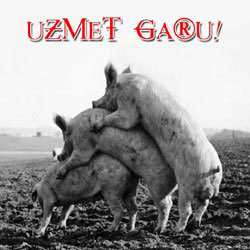
Uzmet garu!

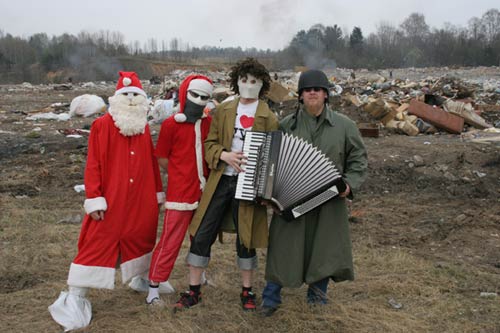
A promotional photo of the band Higinsoni shows two masked Santas, one military man and a wig-wearing “I ‘heart’ NY” T-shirt-sporting mystery man. Whatever first impressions this may suggest, it turns out the band’s debut compact disc Uzmet garu! is just another modern take on traditional Latvian folk songs. It actually doesn’t get more normal than this.

Higinsoni (Zoltāns, E Minor, Blokis and Tēvocis) are a self-proclaimed four-man ethno-punk-metal band from Latvia—or Sweden. The album insert (as well as Web site) says Higinsoni, the grandsons of Latvian emigrants, arrived in Rīga toward the end of 2005 and, after a few month’s hardships and a side job of stealing light bulbs only to resell them at the market, wound up in the music business. One can guess the information is largely fictional—the band’s Web site updates happenings and events that seem too outlandish to be true—but the “information” is entertaining enough. Unfortunately, their music doesn’t match the animation of their write-up.

The album started out well enough, with a peppy ska-goes-death-metal rendition of “Mīlu mazo Lulu.” This song will doubtless bring up memories for people other than myself, as “Lulu” was a song often sung at the weekly Gaŗezers vasaras vidusskola campfires in Michigan. The opening is played by an accordion, which sets up that intimate campfire feel. Then the ska-punk beats kick in, followed by some heavy metal guitar and screaming, gravely vocals. For a first track it’s not spectacular, but so far it had my attention, which is what counts.

The album’s second track, “Kur gaismiņa,” flat out did not impress me. Unlike “Mīlu mazo Lulu,” this is a traditional folk song.  However, the track was a disappointment. It sounds like the band is trying too hard to achieve…whatever it is the band is trying to achieve.

That being said, the beginning of the third track, “Div’ dūjiņas,” made me very nervous. It’s happened before. Bands will lull you into a false sense of “this CD is good, we promise!” with track one, and then it’s all the same the rest of the way through. “Div’ dūjiņas” redeems itself quickly and becomes a less depressing version of the popular folk song. The track is overall well executed and the instrumental break is even catchy.

Track four keeps up appearances with “Līgo.” A bit of a tribal-sounding intro and nicely harmonized vocals balance out the heavy metal break in the middle of the song. “Līgo” shows Higinsoni at its highest point in the album. The song is not only the best track on the album, but it is the most originally done out of all of the covers. It even has a hint of Korn toward the end, accompanied by a very James Bondesque bass guitar line.

From this track on most of the songs are a monotony of synthesizer, heavy guitar and vocals.  It’s one of those albums that starts to drone on after a while. The attention span of a person can last only so long, and once the rhythm and sound patterns are exhausted, it’s over. 

Two more tracks should be noted: “Tur es biju tur man tika” and “Mērkaķītis.”

“Tur es biju tur man tika” is worth mentioning because it strikes me as one of those songs that are heard anywhere Latvians and beer can be found. The track starts off calmly and sweetly enough, then rails into the good old “Šur tur, it nekur, krodziņā zem galda!” Another point of interest in the song is toward the end, where a musical break closely resembling George Michael’s “Faith” is heard. If anything else, Higinsoni isn’t oblivious to catching the attention of listeners familiar with classic riffs.

“Mērkaķītis” is another one of those songs sung at Latvian children’s camps. What surprised me is that Higinsoni decided to go with the “clean” version of the song:

Manu mazo mērkaķīti, ū-ū-ū,
nepaliec par vientulīti, tu tu tu,
noglaudīšu tavu galvu
sasukāšu tavu spalvu
došu tevīm mazu bučiņu.

If you don’t know the “unclean” version, then you probably didn’t go to a Latvian kids camp.

I can think of a handful of my friends who would get a kick out of this album for a party scene, but I don’t think that it would make a reoccurring appearance. It doesn’t offer anything that permanently catches one’s attention, that stays on the mind days or even hours after listening to it. I would hope that if the band puts out another album, Higinsoni will explore its abilities and try to shake things up a bit more. The band comes across as a highly creative group of guys, and it would be nice to see that creativity applied to the music.

Higinsoni

Higinsoni, a band said to be made up of the grandsons of Latvian emigrants to Sweden, plays in an ethno-punk-metal style on its debut album. (Promotional photo)

Details

Uzmet garu!

Higinsoni

MICREC,  2006

MRCD 318

Where to buy

Purchase Uzmet garu! from BalticShop.

Note: Latvians Online receives a commission on purchases.

Latvia’s hockey juniors make their mark in Canada

Last summer a record number of six hockey players from Latvia were drafted by Canadian Hockey League major junior teams in the European Entry draft. Approaching the end of the season, five of the six are still playing in Canada and continue to draw the support of Latvian-Canadian fans.

Forward Kaspars Daugaviņš, who had celebrated his 18th birthday in his debut with Latvia’s senior men’s team at the World Championships in Rīga and had earlier been drafted by the Ottawa Senators in the third round of the National Hockey League’s entry draft, was picked up by the Ontario Hockey League’s Toronto St. Michael’s Majors. He was joined on the Majors by then 17-year-old defenseman Krišs Grundmanis.

Seventh-round Atlanta Thrashers draft pick defenseman Arturs Kulda joined the OHL’s Peterborough Petes. Forward Kaspars Saulietis went to the Kelowna Rockets of the Western Hockey League. Incumbent defenseman Oskars Bārtulis, a Philadelphia Flyers draft pick, was traded from the Quebec Major Junior Hockey League’s Moncton Wildcats to the Cape Breton Screaming Eagles, who play out of Sydney, Nova Scotia.

Arturs Ozoliņš was picked up by the OHL’s Guelph Storm, but was released in October. Although he is a good skater and has “light” hands, he struggled to adapt to the North American game and failed to register a single point during exhibition and regular season play. He returned to Latvia and now plays with Rīga 20, his old team in the Latvian Samsung league.

Daugaviņš has impressed observers, playing with both flair and grittiness. A skilled play-maker, he is one of the Majors’ top forwards. His determined play along the boards is second to none. Early in the season Daugaviņš was among the Top 20 point getters in the OHL but he has now dropped further down the pack. Part of the issue has been a weak supporting cast. The Majors are last in their division and will not make the playoffs.

Six-foot-four (1.93 metres) Grundmanis has steadily improved his game and is now playing with confidence on a regular shift as well as going out on the power play and penalty kill. His rock solid hits have brought Majors fans to their feet on more than one occasion. No one expected Grundmanis to be drafted by the CHL and he could be a sleeper and go far.

In Peterborough, Kulda is evolving into a solid defenseman. He fought Daugaviņš in a game on Feb. 11. After the game the two embraced and jokingly compared the damage each had done.

Out west Saulietis had a slow start with the Rockets and his position was shaky until he picked up his game and started scoring to become one of the team’s top scorers. He was traded Dec. 8 as part of a blockbuster deal with the WHL’s Regina Pats. Meanwhile, Bārtulis is one of the Quebec league’s top defensemen and was voted October player of the month. Bārtulis will likely graduate to the pros next year while Saulietis, Daugaviņš and Kulda will have at least another year in the juniors. Grundmanis, the youngest of the group, will be back for two.

A fan club is born

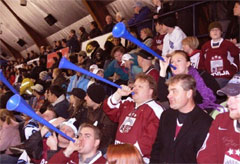
The arrival of Daugaviņš and Grundmanis in Toronto triggered the founding of the Latvian Hockey Fan Club in Canada by Viesturs Zariņš (author of this article) and Vilnis Blūms. A hard core group of up to a dozen fans nicknamed the “Latvian Embassy” has been going to most Majors games. Others, often in Latvian hockey jerseys, have joined them. With their chants, horns and waves, they have kept games lively even on nights when the Majors have been outplayed. The Latvian presence has not gone unnoticed by the Majors, who have been stocking Aldaris Zelta beer in their lounge since the start of the season.

On Oct. 17 the fan club organized an event at the Latvian Canadian Cultural Centre in Toronto featuring Colorado Avalanche defenseman Kārlis Skrastiņš, as well as juniors Daugaviņš, Grundmanis and Ozoliņš. The evening was attended by about 100 Latvian fans of all ages and featured door prizes, a hockey trivia quiz and Latvian food. The players answered questions from the public and were kept busy all night signing autographs and posing for photographs. A few months later on Feb. 8, Skrastiņš broke the all-time record for NHL defensemen with 487 consecutive games, eclipsing Canada’s iconic Tim Horton in a run set 40 years earlier.

The next outing was on Dec. 3 when more than 75 Latvian fans descended on a Majors game against the rival Barrie Colts in a fundraiser for Latvian youth with the Majors selling tickets at a discount for resale by the Latvian National Youth Association of Canada (LNJAK) and the Toronto Latvian School Valodiņa. Following the game the fans assembled in the rink’s lounge to give Daugaviņš and Grundmanis a rousing send-off to the World Junior Under-20 (U-20) Division I championships held in Odense, Denmark, from Dec. 11-17. The two players were presented with a huge best wishes card with player caricatures that was signed by those in attendance.

(Latvia’s U-20 juniors were attempting to get promoted back to the elite level after being relegated in their debut last winter in British Columbia. They beat Estonia 6-0, Poland 7-2 and Slovenia 7:2, only to stumble and lose to Ukraine 4-5 in an undisciplined game. It came down to a final game on Dec. 17 against Denmark. Even though Latvia beat Denmark 5-4 with late game goals by Saulietis and Ozoliņš, it was not enough. Denmark, Latvia and Ukraine were tied with 12 points and Denmark went ahead on goals differential. Latvia missed getting promoted by one goal. Daugaviņš was the leading point getter at the tournament followed by teammates Gatis Gricirskis and Andris Dzēriņš. Bārtulis was the top defenseman. The U-20 juniors will have another shot next winter. Meanwhile Latvia’s U-18 team will be making its elite level debut in Sweden in April. Grundmanis is the only junior playing in Canada young enough to qualify. Daugaviņš will likely be heading back to the senior men’s team at this year’s World Championship in Moscow.)

In recognition of the support provided by Latvians fans this season, the Majors hosted Latvia Day on Jan. 28. The event was attended by more than boisterous 100 Latvians in a sellout crowd of 1,400. Young Latvian women served pīrāgi and apple bread while the newly formed LNJAK men’s choir sang the Canadian and American national anthems for the game against the Plymouth Whalers from Michigan. The game sheet included facts on Latvia and Latvian hockey. Raffle tickets to a Maple Leafs Game were provided by Latvia’s honorary consul in Toronto. After the game Daugaviņš and Grundmanis signed autographs.

More Latvians could head to NHL

Despite inroads made by colleges in the United States and European imports, the three leagues that comprise the CHL still produce about half of the NHL’s players. It is probable that within a few years, at least one or two of the Latvian juniors now playing in Canada will make it to the “Big Show.” Daugaviņš and Bārtulis are the favourites but one or two of the others could surprise observers.

Oskars Bārtulis

Defenseman Oskars Bārtulis of the Cape Breton Screaming Eagles looks for an opening during a Nov. 15 game against the Moncton Wildcats. (Photo courtesy of Mike Sullivan, Quality Cameras & Computers)

Hockey fans at Toronto Majors game

Latvian fans make some noise during a Toronto St. Michael’s Majors hockey game. (Photo by Raimonds Sultmanis)