Court freezes Parex’s U.S. trading account

Rīga-based Parex Bank’s USD 3 million trading account in the United States has been frozen under a federal court order in the District of Columbia, the Securities and Exchange Commission announced March 7.

The decision by U.S. District Court Judge Ricardo M. Urbina involves a case filed March 6 by the SEC against Parex and an unknown number of stock traders who are being accused of a “pump and dump” scheme using the Internet to defraud investors of more than USD 732,000.

The SEC claims in court documents that from at least December 2005 to December 2006, one or more stock traders based abroad purchased shares in 15 companies listed on the Nasdaq exchange. The purchases allegedly were made through sub-accounts of the trading account controlled by Parex.

“These unknown traders then hacked into unsuspecting investors’ online brokerage accounts at seven major online broker-dealers and sold off investors’ existing securities holdings,” the SEC said in a press release. “They then used the proceeds to buy shares on the open market of the thinly-traded issuers the unknown traders had previously purchased in their own sub-accounts.”

The broker-dealers whose customers’ accounts were hacked into suffered about USD 2 million in losses, according to court documents.

Parex’s trading account is held by Pinnacle Capital Markets, a North Carolina-based broker-dealer, the SEC said in court documents. Opened in 2002, the account has 75 sub-accounts. The trading account has 20 beneficiaries living in Latvia, Lithuania, Russia and the British Virgin Islands, the SEC said, but it is unclear who owns the sub-accounts.

The investors whose accounts were hacked into traded through some of the best-known online stock brokers: E*Trade Securities, Scottrade Inc., TD Ameritrade Inc., Vanguard Brokerage Services, Fidelity Investments, Merrill Lynch & Co. Inc. and Charles Schwab & Co. Inc., the SEC said.

No immediate response to the court decision was available from Parex. Founded in 1992, Parex is one of Latvia’s largest banks.
Andris Straumanis is a special correspondent for and a co-founder of Latvians Online. From 2000–2012 he was editor of the website.

Saulīte’s ex-husband held in murder probe

Police in Ireland have now arrested Baiba Saulīte’s ex-husband and another man as the investigation into the Latvian woman’s apparent murder-for-hire continues.

The press office of the Garda, or Irish police, announced March 8 that a 38-year-old man was being held at the station in Swords while a 24-year-old man was being held at the Malahide police station. Radio Telefís Éireann and other Irish media identified the 38-year-old as Hassan Hassan, Saulīte’s former husband.

The two men are the ninth and 10th suspects to be arrested in the investigation.

Saulīte was gunned down Nov. 19 at her home in Swords, north of Dublin. She was chatting with friends that evening when a man approached and shot her twice. Saulīte’s two sons, subjects of a 2004 custody battle between her and Hassan, were asleep in the house at the time.

Hassan has been serving prison terms for his involvement in an automobile theft scheme and for abducting his sons in 2004 and taking them to the Middle East. Hassan is Lebanese and was in prison at the time of the murder.

The 24-year-old man is described by RTÉ as a member of a gang from Limerick.

Andris Straumanis is a special correspondent for and a co-founder of Latvians Online. From 2000–2012 he was editor of the website.

Funeral music CD isn’t all that somber

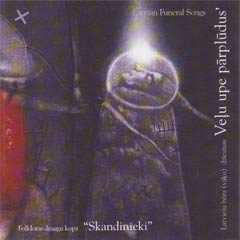
Veļu upe pārplūdus'

I recently spoke with a friend whose father had just passed away. She told me about returning to her hometown and about her struggles to convince her own mother that it would not be “improper” to include one Latvian folk song as a part of the memorial service. All of this took place right here in Latvia, among normal Latvians, and goes to show how far removed from their own traditional culture many have become.

And so I am very glad that Skandinieki—the best-known Latvian folklore ensemble—has released a recording of wake and funeral songs. The compact disc, called Veļu upe pārplūdus’ (The River of Spirits is Overflowing), contains 24 songs and dances from all parts of Latvia. The collection is a good representation of the hundreds of songs devoted to death and funerals. Please don’t dismiss this CD just because it’s funeral music. This is very important listening material! Plus, it’s not as somber as you might expect.

The texts may be sad, but they are also profound and comfortingly clear-sighted. Interestingly, many Latvian dainas (folk verses) describe death, wakes and funerals from the perspective of the deceased. The deceased may tell those who have remained behind how to prepare for the burial, how to decorate the cemetery, or how to sing and dance at the funeral feast. Yes, dance! An essential part of a Latvian funeral is ritual dance. One of these rituals is the stamping out of the deceased’s footsteps (pēdu izmīšana), so that their spirit may rest easily and not return to the land of the living. An example of this practice is included on the CD, “Nominu, nodeju māmiņas pēdas.” Another funeral dance or game is “Sieviņ brauca mežās,” in which a blindfolded participant must guess who his fellow dancers are.

Other songs of note on the CD are “Dedzan man skalu” about the death of a fisherman and “Vakar māti glabājām” and “Kas tevi šaukie,” both sung in rarely heard dialects. “Zin, Dieviņi, kālabati,” “Jūdzat bēŗus, jūdzat raudus,” “Divejādi saule tek” and “Dzīvoš’ ilgi, nedzīvoš’” are fairly familiar melodies and texts, but the rest of the CD will probably be completely new material for many listeners. The melodies alone of “Viena pati balta puķe” and “Te ganiņi ganījuši” are beautiful enough to make your heart break. “Eim’ pašas māsiņas” is another dance. “Visi ciema kukainīši” is not only upbeat and in a major key, but it even pokes gentle fun at the legions of insects that are awaiting the singer’s death. Talk about a healthy attitude towards death! Near the end of the CD is a Liv wailing song, which does not at all fit in with the reserved manner of Latvian funeral songs. It’s sung so convincingly, though, that it’s fascinating to listen to—almost to the point of being uncomfortable.

Some of the songs on Veļu upe pārplūdus’ have kokle, ģīga or violin accompaniment, but the arrangements are all very simple and the main focus of the CD is definitely on the voices, melodies and texts. Skandinieki is a large group and consequently tends to have a pleasant choral sound. Ten different singers are featured on the CD, with the voices of the directors Helmī and Julgī Stalte being particularly powerful and full of character. Again, don’t be frightened off by the seriousness of these songs. If you allow them, they will give you great comfort and strength, even if you are not in mourning.

By the way, my friend’s mother later grudgingly admitted to her that the inclusion of the folk song in her father’s memorial service had been appropriate…and even very beautiful and moving.

Details

Veļu upe pārplūdus’

Skandinieki

Rīgas skaņu ierakstu studija,  2006

RS058