PBLA slams Saeima over inaction on Estonia’s troubles

In a sharply worded open letter to Latvia’s parliament, the World Federation of Free Latvians has criticized legislators for not acting quickly to support Estonia in the face of verbal attacks from Russia over the controversial removal of a downtown Tallinn monument to World War II-era Soviet soldiers.

The federation is “deeply disappointed” in the Saeima’s “reluctance, delay and fear” in supporting Estonia, the letter states. The May 8 letter is signed by the board of the federation (known in Latvian as the Pasaules brīvo latviešu apvienība, or PBLA).

To save face, the Saeima should adopt a resolution of support for Estonia, the PBLA said.

The PBLA’s concern stems from Russia’s reaction to Estonia’s removal of the Bronze Soldier from Tallinn’s Freedom Square, as well as plans to relocate the remains of 14 Red Army soldiers from an area near the monument. Estonia’s Russian-speaking minority viewed the statue’s removal as an affront, leading to two days of unrest April 26-27 during which hundreds were arrested, dozens were injured and one man—a Russian citizen and permanent resident of Estonia—died. The Latvian embassy in Tallinn also was attacked.

Estonia has blamed Russia for fomenting the unrest, for cyberattacks on Estonian government Web sites that followed the unrest, for a siege by a youth organization of the Estonian embassy in Moscow and for what it says are distorted Russian media reports on the situation in Tallinn.

Estonia’s foreign minister, Urmas Paet, in a May 1 statement called on the European Union to defend Estonia’s interests.

“The issue of the Bronze Soldier and vandalism in Tallinn are Estonia’s internal matters but the coordinated activities undertaken against Estonia by Russia are a matter of the entire European Union,” Paet said in the statement.

Russia has had strong words of its own.

“We are all outraged by this sacrilege, blasphemy and the methods used to disperse the demonstrators who tried to defend the sacred object, put up in memory of Europe’s liberation,” Sergey Lavrov, Russia’s foreign minister, said during an April 27 press conference in Norway, according to ministry’s Information and Press Department.

The PBLA criticized ruling Latvian coalition parties for failing to bring a resolution to the floor during the Saeima’s first meeting after the Tallinn riot. Opposition parties did propose a resolution, but it was defeated.

The PBLA wants the Saeima to adopt a resolution supporting the Estonian government and its sovereign decisions, condemning the vandalism and theft that occurred in the streets of Tallinn, condemning high Russian officials and members of parliament who have attempted to meddle in Estonia’s internal affairs, and condemning Russian authorities for their unwillingness to end the blockade of the Estonian embassy in Moscow and to guarantee the safety of embassy personnel in accordance with the Vienna Convention on Diplomatic Relations.

Andris Straumanis is a special correspondent for and a co-founder of Latvians Online. From 2000–2012 he was editor of the website.

Referendum scheduled for July 7

A referendum on changes to two national security laws will take place July 7 in Latvia and at polling stations abroad, the Central Election Commission announced May 8 in Rīga. The announcement came after the commission certified that more than 214,900 citizens signed petitions demanding the referendum.

The referendum will consist of two questions about whether to revoke amendments approved March 1 by the Saeima, Latvia’s parliament, to the National Security Law and the State Law on Security Institutions.

Although the parliament already has rescinded the amendments, the referendum must still go forward. Some observers and politicians see the vote as a test of confidence in the parliament and the coalition government led by Prime Minister Aigars Kalvītis.

The amendments initially were pushed through in January by the Cabinet of Ministers while the Saeima was in recess. Government officials said the amendments allowed for greater oversight of state security operations, but opponents—including President Vaira Vīķe-Freiberga—said the changes allowed politicians access to potentially sensitive information and caused concerns among NATO defense allies.

Ironically, the referendum is scheduled on Vīķe-Freiberga’s last day as president. She concludes her second term July 7.

The Saeima approved the amendments on Feb. 1, but Vīķe-Freiberga vetoed them. After the parliament overrode the veto on March 1, the president suspended implementation of the amended laws, which put in motion a petition drive for a referendum on the amendments.

At least 10 percent of the number of voters in the last parliamentary election, or 149,064 citizens, had to sign the petitions to call the referendum. According to the Central Election Commission, a total of 214,966 citizens signed the petition for a referendum on changes to the National Security Law, while 214,906 signed the petition for a referendum on changes to the State Law on Security Institutions. The final numbers reported May 8 were nearly 3,000 more than initially reported May 3, when the commission announced provisional results.

Thirty-two stations were set up to gather signatures in embassies and consulates abroad, in addition to more than 600 stations in Latvia.

For the referendum to count, at least half the number of voters in the last Saeima election, 453,730 citizens, must cast ballots July 7. For the amendments to be revoked, more than 50 percent of votes cast must be in favor of the referendum questions, the Central Election Commission explained in a press release.

The commission has not yet announced where polling stations will be established abroad.

Andris Straumanis is a special correspondent for and a co-founder of Latvians Online. From 2000–2012 he was editor of the website.

Lordi, save us from Ukraine in Eurovision

The more I listen to Latvia’s entry in this year’s Eurovision Song Contest, the more I have come around to believing Bonaparti.lv and the song “Questa Notte” (This Night) have a good chance of not disappointing fans.

The concept, which involved assembling six well-known Latvian male singers and having them croon a song in Italian, seemed a bit strange at first. But strange has a way of standing out at Eurovision. Finland’s lizard-monster-clad, hard rocking Lordi—which won last year’s contest—certainly attests to that.

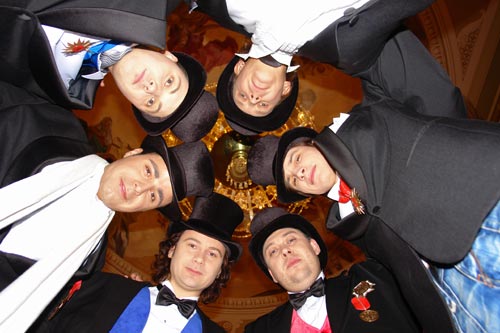
Bonaparti.lv includes six tenors: Andris Ābelīte, Andris Ērglis, Normunds Jakušonoks, Roberto Meloni, Zigfrīds Muktupāvels and Kaspars Tīmanis.

The group’s first appearance in Eurovision will be May 10 during the semi-final in Helsinki. Bonaparti.lv will perform last in the field of 28 contestants. In the telephone voting at the conclusion of the performances, the tenors will have to land in the top 10 to advance to the May 12 final. The top 10 semi-finalists will join 14 other countries in the final. The 14 others include the top 10 winners from last year’s contest plus France, Germany, Spain and the United Kingdom, which automatically get into the final because of their size.

Latvia should make it through to the final, but probably has little hope of winning outright. Some of the online oddsmakers, such as those at betdirect in Liverpool, England, give Latvia a 20/1 chance of winning the final. Online bookmaker Stan James is less optimistic, suggesting a 50/1 chance. Both betdirect and Stan James also posit that Ukraine—horrors!—has a 6/1 chance of an outright victory.

Because of uninspired performances or poor songs, sure losers in the semi-final are going to be the entries from Belarus (Koldun, “Work Your Magic”); Iceland (Eiríkur Hauksson, “Valentine Love”);  Malta (Olivia Lewis, “Vertigo”); Montenegro (Stevan Faddy, “Ajde Kroči”); Norway (Guri Schanke, “Ven a bailar conmigo); Portugal (Sabrina, “Dança Comigo); Switzerland (DJ BoBo, “Vampires are Alive”), and Turkey (Kenan Dogulu, “Shake It Up Shekerim”). Of course, that’s just my opinion. Some oddsmakers, for example, give Belarus more than a fighting chance to advance out of the semi-final and even win the contest.

One of my favorites of a few Eurovisions ago is Macedonia’s Karolina Gočeva. She returns to represent her country this time with “Mojot Svet” (My World), a tune about music and the Balkan soul. I hope she makes it into the top 10 semifinalists.

My other candidates for the top 10 semi-finalists:

  • Bulgaria’s Elitsa Todorova and Stoyan Yankoulov, who try the drum-driven and ethnic song “Water,” singing it in Bulgarian.
  • Israel’s Teapacks with the song “Push the Button,” which is either a clever political commentary or a badly done joke. The song begins with the lyrics, “The world is full of terror, If someone makes an error, He’s gonna blow us up to biddy biddy kingdom come.”
  • The island nation of Cyprus, which puts forward Evridiki and her performance of “Comme Ci, Comme Ça.”
  • Georgia and its entry, “Visionary Dream” performed by 20-year-old Sopho, which might stand a chance in part because of the singer’s strong voice.
  • The rock band Kabát from the Czech Republic, which performs “Mála Dáma” with a restrained energy that might appeal to viewers who want their music without visual gimmicks.
  • Andorra’s punk rockers Anonymous, performing “Salvem el Món,” which could do well especially among younger Eurovision voters. The band, which also gets the song-writing credits, has a nice energy.
  • Slovenia and singer Alenka Gotar, whose years of voice training may pay off. The song “Cvet z Juga” comes alive with her range and operatic talent.
  • Hungary’s Magdi Rúzsa, who will sing “Unsubstantial Blues,” a tune penned by Imre Mozsik. The composer was born in the United States, but moved permanently to Hungary in 1989.

Of those countries already in the final, my greatest fear is of Ukraine. Representing the nation of the Orange Revolution is Verka Serduchka with the song “Dancing Lasha Tumbai.” Serduchka is the stage persona of Andrii Danylko, who performs in a costume that brings to mind an overgrown Teletubby clad in aluminum foil. The song is equally ridiculous. (Ukraine’s Ruslana Lyzhicko won Eurovision in 2004 with her song “Wild Dances.”)

On the Eurovision scale of the ridiculous to the sublime, Bosnia & Herzegovina’s Maria Šestić‘s performance of “Rijeka bez imena” (River of Sorrow) scores toward the latter. It is a powerful entry. Bosnia & Herzegovina also already is in the final based on the nation’s success in last year’s Eurovision contest.

Lithuania also is in the final, thanks to last year’s sixth place showing by LT United, which performed the in-your-face song, “We Are the Winners.” This year’s entry is 4FUN, a five-member band fronted by lead singer Julija Ritčik, which will perform the mellow song, “Love or Leave.”

Of the entries already in the final, my vote would go to Ireland. For once, the nation has a decent entry, “They Can’t Stop the Spring,” performed by the well-known folk band Dervish. And you can’t beat the opening lyrics: “The curtain has been raised, The wall no longer stands, And from Lisadell to Latvia, We’re singing as one clan.”

Bonaparti.lv

Latvia’s entry in this year’s Eurovision Song Contest is the Italian-language song “Questa notte,” performed by six well-known singers teamed as Bonaparti.lv.

Dervish

During the Eurovision Song Contest, Irish folk band Dervish will perform “They Can’t Stop the Spring,” a song that makes reference to Latvia.

Andris Straumanis is a special correspondent for and a co-founder of Latvians Online. From 2000–2012 he was editor of the website.