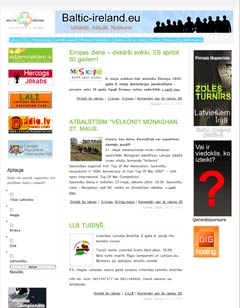
The newest Web site for Latvians living on the Emerald Isle is called Baltic Ireland.
Thousands of Latvians (according to latest Irish census statistics, officially around 14,000) have voted with their feet since Latvia joined the European Union in 2004 and have moved to Ireland, a prosperous nation with numerous opportunities. Many have moved with the intent to only stay for a short while and earn enough for a specific purpose, others are fed up with their life in Latvia and do not plan to return.
The Latvians who have moved to the “Emerald Isle” are scattered throughout the whole of Ireland, with a large proportion now living in Dublin and its surrounds. With such a large number of Latvians living in Ireland it comes as no surprise that they have started to form Latvian organisations and various interest groups—and even have several Web sites. Even though the percentage of Latvians interested in such organised activities is quite minimal, the hope is that the Latvian saying “kur ir, tur rodas” (loosely translated: the more the merrier) will apply in future.
The first Web site worth mentioning is that of the Embassy of Latvia. This would seem the first logical port of call for Latvians in Ireland. But the embassy’s role is purely to represent Latvia in Ireland, so the Web site doesn’t have any further information about Latvian activities in Ireland or offer any further information for those who are planning to relocate there.
Three Latvian societies have been founded in Ireland in the past few years. The first one, founded in 2005, is Latviešu Biedrība Īrijā (Latvian Society in Ireland). LBI’s statutes state that among it’s main aims are maintaining the culture, language and ethnic identity of Latvians living in Ireland. The society’s Web site also acts as an information source for those who need help with relocation to Ireland with a list of links to Irish government information brochures and sites. This is not all the site is concerned with. Visitors also can find out what the newly formed Latvian organisations are up to. Among these are the Latvian mixed choir, the Latvian folk-dance group “Jampadracis,” the Latvian School “Saulgriezīte,” Latvian church services and hockey team Latvian Hawks .
Latvians, as is their nature, are not content to stop with one society. In 2006 another society, Latviešu Apvienība Latviešiem Īrijā (Latvian Society for Latvians in Ireland), was founded in Dublin. Its aims are very similar to those of LBI. According to LALI’s Web site, the society “acts in the interests of Latvians in Ireland and deals with issues that are of interest to Latvians who are living in Ireland for a shorter or longer length of time.”
As Latvian organised activities gain momentum, the Latvians living on the western coast of Ireland (numbering around 2,000) can now also proudly say they have an organisation to represent them—the Limerick Latvian Society, founded in April. The society does not have a Web site yet but news of the organisation’s aims and future plans can be found on the new Baltic Ireland site.
Baltic Ireland, just launched at the beginning of May, wants to incorporate all Latvian activities, not discriminating among those hosted by one society or another. In its introductory comments the Web site states that it is created for “…Latvians in Ireland and their relatives, friends and acquaintances in Latvia. The main aim of the portal is to provide information on what is happening in Ireland…We hope, with your assistance, to create a portal that ‘rocks’ and dispel the myth that all Latvians in Ireland are ‘mushroom-pickers.’”
Latvians in Ireland also have a paper-based source of news and information. The weekly newspaper Sveiks can be purchased in Russian and Polish grocery stores in Dublin, Cork, Galway, Sligo and other towns. The paper is edited in Rīga but printed and distributed by the Russian-language newspaper Nasha Gazeta in Dublin.
Details
Daina Gross is editor of Latvians Online. An Australian-Latvian she is also a migration researcher at the University of Latvia, PhD from the University of Sussex, formerly a member of the board of the World Federation of Free Latvians, author and translator/ editor/ proofreader from Latvian into English of an eclectic mix of publications of different genres.


