Communing with nature in Latvia

Cūkmens sticker

Stickers urging people to clean up after themselves when visiting state forests are part of the Cūkmens campaign.

If you are planning a trip to Latvia—or are already in Latvia—do you have an interest to be at one with nature? Where can you turn to find out the best picnic and fishing spots, childrens’  nature activity parks and other outdoor recreation areas? Mammadaba.lv, a literal translation of the term Mother Nature, is an initiative created by Latvijas valsts meži (Latvian State Forests, www.lvm.lv) that encourages travel to the countryside.

By countryside this state institution means the forests, the rivers, the lakes—not just the towns. The hope here is that locals as well as tourists will find these trips to the countryside enjoyable and will return and pass this information on to others. The Web site is great for ideas for the best spots for all kinds of activities, from the local Latvian favorites of berry picking, mushrooming, fishing, bird-watching and hunting to cycling routes, orienteering and nordic walking routes. So far there are around 300 areas of state-owned forest territory under the stewardship of Latvijas valsts meži that have been cleared for recreational public use.

If you’ve headed out to the woods but want to stay longer than just one day your best bet for accommodation options is Atputa laukos. The Web site is created by the country tourism association Lauku ceļotājs, which also publishes brochures that can be purchased in most bookstores. For more sites on the environment and various options for outdoor recreation have a look at the links page.

Latvijas valsts meži has also for the past two years been involved in a campaign to increase public awareness of the dumping of rubbish in Latvian forests. Cūkmens is the public face of this campaign, a litterer-turned-pig in a superman-style pink pig costume actively urging the public to clean up its act: “Nemēslo mežā! Par cuku pārvērtīsies!” (Don’t dump your rubbish in the forest! You’ll turn into a pig!). This year the campaign has focused on coastal rubbish dumping. Cūkmens has visited local school in coastal regions, educating the children as well as getting the public involved in cleaning up the coastline. Jāņi was another perfect target for a Cūkmens intervention; with so many people heading to the woods to celebrate, there has always been a tendency to leave the post-Jāņi waste behind. Learn more about the Cūkmens campaign and see video and listen to audio from the campaign at www.cukmens.lv.

School-aged children can learn more about the forests of Latvia by taking part in a program, Izzini mezu, a joint initiative of Latvian State Forests, the Foundation for Environmental Education and the Forest Development Fund. The patron of this program is Latvian writer and poet Imants Ziedonis. The aim is to teach kids the importance of the forest habitat from an ecological and cultural perspective in the early years to more complex concepts in the later years of their school life.
Details

Daina Gross is editor of Latvians Online. An Australian-Latvian she is also a migration researcher at the University of Latvia, PhD from the University of Sussex, formerly a member of the board of the World Federation of Free Latvians, author and translator/ editor/ proofreader from Latvian into English of an eclectic mix of publications of different genres.

Indianapolis tops referendum activity abroad

Citizens voting during the 12th National Latvian Song and Dance Festival in Indianapolis made theirs the most active polling station abroad in the July 7 referendum and helped push the United States to the No. 1 spot in terms of ballots cast outside the homeland.

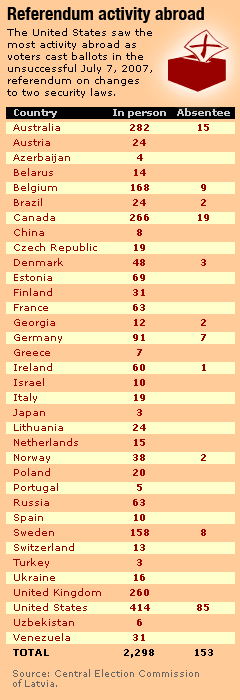
Provisional results from the Central Election Commission in Rīga show 414 citizens cast ballots at polling stations in Indianapolis, New York and Washington, D.C. With an additional 85 absentee ballots, the United States accounted for 499 votes.

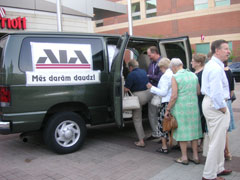
In Indianapolis, a total of 308 citizens voted. Many were brought to the polling station from downtown Indianapolis by a minibus provided by the American Latvian Association.

In all, 2,298 ballots were cast abroad on July 7. With an additional 153 absentee ballots, the total number of voters abroad was 2,451. Voters in the United States accounted for 20.3 percent of the total.

The referendum, on whether to annul changes to two national security laws, failed. While 338,765 voters in Latvia and abroad cast ballots, the total fell short of the 453,730 required to make the referendum count. At least half the number of voters in the last parliamentary election had to cast ballots.

The vast majority of those who did vote, however, were in favor of striking the amendments to the National Security Law and the State Law on Security Institutions. In all, 95.95 percent were in favor of striking amendments to the National Security Law, while 96.03 percent were in favor of doing the same for the State Law on Security Institutions.

The amendments, pushed through by the Cabinet of Ministers in an emergency decree in January, would have allowed for greater oversight of security operations in Latvia. Critics of the amendments—including the NATO defense alliance—said the changes allowed politicians access to potentially sensitive information.

The Saeima, Latvia’s parliament, approved the amendments in March, but the action was vetoed by President Vaira Vīķe-Freiberga. The Saeima overrode her veto, so the president took the unusual step of freezing implementation of the amendments. That gave time to gather signatures in favor of a referendum. Just days before the petition drive was to start on April 3, the parliament rescinded the amendments, but the referendum process moved on.

The July 7 referendum was seen by critics as a symbolic test in the confidence voters have in the parliament and in the coalition government led by Prime Minister Aigars Kalvītis. Its failure has bolstered coalition parties.

In addition to the United States, the greatest voting activity abroad was in Australia (a total of 297 in-person and absentee ballots cast), Canada (285) and the United Kingdom (260).

The election commission originally announced 48 polling stations would be open abroad, but closed those in Argentina and Kazakhstan because their operation could not be guaranteed. The polling station in Indianapolis was added because it was expected many Latvian citizens would be attending the song festival, which ran from July 4-8.

On July 7, several polling stations abroad reported voter activity only in the single digits. The station in Kaliningrad reported no voters.

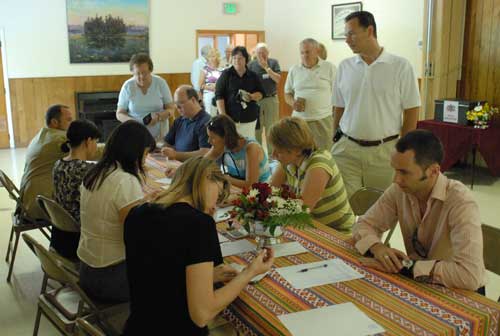
Voters in Indianapolis

In the Latvian Community Center in Indianapolis, the four-member local election commission processes a group of July 7 voters just arrived by minibus from the song festival. (Photo by Andris Straumanis)

Referendum activity
ALA busiņš

Voters in Indianapolis climb into the minibus provided by the American Latvian Association for the first run of the day to the polling station. (Photo courtesy of American Latvian Association)

Andris Straumanis is a special correspondent for and a co-founder of Latvians Online. From 2000–2012 he was editor of the website.

Referendum fails to garner voter interest

A national referendum to strike controversial amendments to two of Latvia’s national security laws has failed to gather enough voters, but otherwise results show resounding opposition to the government.

A total of 337,897 citizens voted in Latvia and abroad in the July 7 referendum, which was more than 115,000 short of the number required to make it count. At least 50 percent of the number of voters in the 2006 Saeima election—a total of 453,730—had to participate.

That enough interest in the vote could not be generated is being viewed by some politicians as a sign that the government opposition is weak.

Those who did vote, however, cast strong votes in favor of annulling the amendments first approved by the Cabinet of Ministers in January. On both of two referendum questions, more than 95 percent of those voting said they were for striking the amendments, according to results tallied by the Central Election Commission in Rīga.

At the Latvian community center in Indianapolis, voters came in spurts. Some drove themselves to the polling station, while others took advantage of a minibus provided by the American Latvian Association that ferried voters from the 12th National Latvian Song and Dance Festival taking place downtown. By the end of the day, said election judge Sanita Pēkale, a total of 308 Latvian citizens had voted in Indianapolis.

Andris Straumanis is a special correspondent for and a co-founder of Latvians Online. From 2000–2012 he was editor of the website.