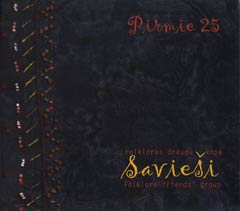
When you find a compact disc with your favorite song on it—particularly when it’s a less-often heard Latvian folksong—you buy it. This is precisely what happened when I saw the CD Pirmie 25 by Latvia’s folk ensemble Savieši. Fortunately, the CD contains a number of treasures and is worth buying for more than just one song.
Although Savieši has been in existence for a number of years, it only recently released its first CD. The recording’s 25 songs offer a wide variety musically, geographically and historically. Savieši was formed in 1980 by the now well-known ethnomusicologist Valdis Muktupāvels. The group’s mentors were Skandenieki, widely known as the grandparents of the Latvian folk movement.
Most of the songs on the CD are sung a cappella, but a few are accompanied by instruments such as kokle, trejdeksnis or a drum, and there is one instrumental dance tune, “Augškojenieku dancis.”
The first six songs are from the group’s early years. They have the simple yet pleasant sound of Latvian folk music recorded in the 1980s.
The song for which I bought the CD is “Dziedātaju māsu devu.” I knew only three verses, but on the CD the song is five verses long. The lyrics are about the power of song—how very Latvian!
One song I have grown to love thanks to this CD is “Saule rāja mānestiņu,” which has beautiful lyrics about the sun, moon and stars, as well as a lovely harmony.
The songs that I enjoyed most were the ones which showcased the pure strength and energy of Latvian music. One example is “Es piedzimu māmiņai,” another song about the importance of song. In this tune the men drone while the women sing the lyrics, an effective method that Savieši employs more than once for those that are considered women’s songs.
“Zīdit, zīdit, uora pļovas” is a powerful song that makes me want to quickly learn the Latgallian lyrics so that I can sing along from the depths of my lungs. The Savieši version makes it sound like there are several dozen people singing, although in reality I imagine that no more than a dozen did.
The CD contains several rather uncommon songs. One is “Kur tu teci miega pele,” a peaceful children’s lullaby. It has a “pai pai” refrain that I’d never heard and, like so many Latvian folk songs, a great little story. Two songs, “Pa vējame es dziedāju” and “Suni reja, vilki kauca,” were first collected by a member of Savieši in Lithuania in 1988. Both of these songs have melodies unlike anything one would hear among other Latvian folk songs. Another interesting song is “Gotiņ, gotiņ, lelo,” which follows few of the conventions we are used to when it comes to traditional Latvian songs.
Of course, not all Latvian songs are about happy events such as weddings or about the beauty of nature. “Svātdin agri buoryneite” is about an orphan girl visiting her deceased mother’s grave and crying about the treatment she receives from her new stepmother. Even if one were unable to understand the lyrics, one would sense from the heartbreakingly beautiful melody that the song is not about a joyful topic.
The liner notes contain a short history of Savieši both in Latvian and Eglish. The notes also contain lyrics for each song, but unfortunately no English-language synopsis. My favorite thing is that the listings for many songs also indicate from which area of Latvia they come, and often in what year the songs were first collected. Additionally, several list the name of the person from whom the song was collected. Many Latvians are familiar with Krišjānis Barons, who collected folk songs in the late 1800s and early 1900s, yet few people know that enterprising individuals continued to collect Latvian folk songs for many years after that. This CD includes songs collected in surprising years such as 1940 and 1945, and as recently as 1988 and 1991, when members of Savieši undertook expeditions to collect folksongs in areas such as Lubāna (in Latgale, Latvia’s eastern region) and Lithuania’s Butinges Sventaja.
The CD also contains a couple dozen photographs of Savieīi through the years. These can only be looked at by using a computer.
Overall Pirmie 25 is an excellent CD that will be enjoyed by anyone who appreciates Latvian folk music.
Details
Pirmie 25
Savieši
Savieši, 2007