With the turn of the New Year, North American hockey is at mid-season. This year 10 players from Latvia are playing professional hockey and another four are playing with top tier junior teams in either Canada or the United States.
Even though hockey is Latvia’s No. 1 sport, the Latvian émigré community in North America has been slow to embrace the game. A few Latvians in Canada and the United States do attend games and cheer their players. Being far from home, players appreciate the attention and are happy to sign autographs and engage in post-game talk.
Perhaps the biggest story this season the so-far successful comeback of former National Hockey League (NHL) all-star defenseman and Stanley Cup winner, 35-year-old Sandis Ozoliņš. He signed a one-year deal with his first NHL team, the San Jose Sharks. Ozoliņš struggled with leg injuries and alcoholism following the 2003-2004 season. He entered the NHL’s substance abuse and behavioural health program for the second time in 2006. Over the past year Ozoliņš has turned himself around, stayed sober and put himself into shape by training for triathlons. He credits his wife Sandra and their two sons, ages 11 and 13, for much of the comeback.
Defenseman Kārlis Skrastiņš returned for his eighth NHL season, his fourth with the Colorado Avalanche. Last season Skrastiņš become the NHL’s all-time ironman defenseman, playing 487 consecutive games since February 2000 without injury. He shattered the record previously held by Canada’s iconic defenseman Tim Horton, founder of the successful Canadian coffee and doughnut restaurant chain. Shortly afterwards Skrastiņš was sidelined by a knee injury.
Raitis Ivanāns, a hulking 6-foot 4-inch, 250-pound forward from Rīga, is in his second season in the NHL with the Los Angeles Kings. Ivanāns came to play junior hockey in Canada back in 1996. On his way to the NHL, he played in every North American minor pro league with teams ranging from Baton Rouge, La., and Pensacola, Fla., in the south to Rockford, N.Y., and Hamilton in Ontario in the north. Ivanāns made his mark as an enforcer who regularly scraps with the opposing team’s tough guys. He had his NHL debut in 2005-2006 when he played four games with the Montreal Canadiens. In today’s NHL it’s not enough to be an enforcer and Ivanāns has shown he’s a solid fourth-line player, has a long reach and good checking skills, and is a surprisingly strong skater for a big player.
Poised one level below the NHL in the American Hockey League (AHL) is talented forward Mārtiņš Karsums, who is playing his second season for the Boston Bruins farm team in Providence, R.I. The Hockey News recently characterized Karsums as a “speedy, hounding forechecker who is a scoring threat and can play every role from the power play to the penalty kill” and someone who should expect to be called up to the NHL.
Karsums is joined in the AHL by Oskars Bārtulis. A skilled defenseman, Bārtulis has been drafted by the Philadelphia Flyers and is in his first year with the Philadelphia Phantoms farm team after graduating from Canada’s junior leagues, where he played together with Karsums on the Moncton Wildcats.
Latvian hockey fans had hoped that this season forward Jānis Sprukts would stick in the NHL. Last year he played with the Rochester Americans of the AHL and had the second highest number of points. Sprukts was called up to the Florida Panthers in the NHL for 13 games. This year he turned down a two-way contract from the Panthers to start in the AHL and instead returned to Finland to play with Rukko Rauma. Under two-way contracts players are paid much less when they play in the AHL rather than the NHL. The money was much better in Finland, a major consideration for a player with a young family.
Things looked promising for Jēkabs Rēdlihs, a defenseman in his second pro season after graduating from Boston University. Rēdlihs was drafted by the NHL’s Columbus Blue Jackets and last season was one of the better defencemen on their AHL farm team in Syracuse, N.Y. This year, rather than getting a shot at the big team, Redlihs was sent down to the Elmira (N.Y.) Jackals of the East Coast Hockey League (ECHL) after 13 games with the Syracuse Crunch. At this point he is likely considering options to play in Europe, joining his brothers Miķelis, who plays in Belarus, and Krišjānis, who now plays in Germany after four years in the AHL.
Further down in the minors, 30-year-old Kārlis Zirnis, a University of Alabama in Huntsville graduate from Rīga, returned for his fourth year with the Central Hockey League on the roster of the Bossier-Shreveport Mudbugs in Louisiana.
Two defensemen from Latvia play in Indiana with the Fort Wayne Komets of the International Hockey League (IHL). Formerly the United Hockey League (UHL), the IHL is centered around the Great Lakes and is down from 12 to six teams and has ongoing financial difficulties. Maksim Sirokov is in North America for the first time while Sergei Durdin is a four-year veteran of the IHL.
Ervīns Muštukovs has had a disappointing season. The goaltender who played junior hockey in Quebec back in 2003-2004, decided to give North America a try in 2006-2007. He landed in the Southern Professional Hockey League (SPHL), a seven-team loop based in the southeastern United States. The league is the lowest minor pro hockey league in North America, one level below the East Coast, International and Central Hockey Leagues. Muštukovs impressive play saw him called up to the ECHL where he finished last season. There was even interest in him from at least one AHL team. This year Muštukovs started the season in the ECHL but he was bounced from two teams. As a free agent, Muštukovs became expendable as AHL and NHL teams moved their goaltenders up and down in the minors. He is now back in the SPHL with the Knoxville Ice Bears in Tennessee, where he is a fan favourite and nicknamed “Moose.”
Latvian juniors in Canada
Latvia’s top junior players continue to make their presence felt in Canada, too. Four players started the season with the Canadian Hockey League (CHL), which in turn consists of the Western Hockey League (WHL), Ontario Hockey League (OHL) and Quebec Major Junior Hockey League (QMJHL). Each team can carry only two Europeans. Some teams in all three leagues are based in U.S. cities.
Kaspars Saulietis returned to the Regina Pats of the WHL, but a serious injury on his first shift in the first game saw him dropped and he returned home.
Kaspars Daugaviņš, a third-round Ottawa Senators draft pick, is back with the OHL’s Mississauga St. Michael’s Majors. The talented forward was called up to the Binghampton Senators of the AHL at the end of last season and participated in the Ottawa Senators training camp at the start of this season before being sent back to the juniors. Daugaviņš is the Majors’ top scorer and will turn pro at the end of the season and likely play in the AHL. Back in 2006, Daugaviņš, who at the time was only 17, was the youngest player ever to crack Latvia’s senior men’s national team.
Artūrs Kulda, a seventh-round Atlanta Thrashers draft pick, is back for his second season with the OHL’s Peterborough Petes. A tough and strong defenseman, Kulda is getting a lot of ice time with the Petes. He participated in the Thrashers’ rookie camp in Traverse City, Mich., prior to the season and has said he hopes his play will lead to a contract with the Thrashers and their farm system.
Andris Džeriņš had played junior in Sweden and Finland before being picked up by the Kingston Frontenacs of the OHL. Džeriņš is a smooth skater and passer. In his first year overseas, he is adapting to North American hockey and has recently been scoring goals. As a 19-year-old player, this is his final year of junior eligibility unless he comes back as overage junior. Each CHL team can carry three overage juniors who are 20 at the start of the season.
Eighteen-year-old Krišs Grundmanis, a tall, lanky defenseman who played with the Majors last season, is now in Wisconsin with the Green Bay Gamblers of the U.S. Hockey League, the top junior league in the United States. He got a try-out with the Johnstown Chiefs of the ECHL before heading to Green Bay.
Hockey Canada, the country’s national governing body of ice hockey, limits European players to the three Major Junior leagues. Europeans cannot play at lower levels (for example, Junior A or Junior B). USA Hockey also restricts junior teams to two Europeans, but unlike Canada, they can play junior hockey at any level. A number of Latvian players are toiling in various lower-level junior leagues in the United States hoping that they will be noticed and called up or land a National Collegiate Athletic Association scholarship.
The juniors in Latvia
The biggest event in Latvian hockey this season was the Division 1 Group B Under-20 World Junior Championships held in December in Rīga. Latvia was pooled with Belarus, Slovenia, Hungary, France and the United Kingdom. The winner of the group would be promoted to the top tier and play against hockey’s superpowers like Canada and Russia. Latvia had been there once before playing in British Columbia two years ago before being demoted after finishing ninth in the group of 10. At this year’s championship, Latvia handily beat Hungary, France and the United Kingdom. A loss against Slovenia set up a Dec. 18 showdown with Belarus in a packed Arēna Rīga. Latvia won 3-1 and the North American juniors were a big part of the gold medal victory.
Unfortunately, Latvia’s U-20 squad will be weaker next year when it plays in Ottawa. A number of talented juniors including the three currently playing in the OHL will no longer be eligible.
The next Division 1 Group B Under-18 World Junior Championships are also being held this April in Rīga. Latvia will compete with Austria, Norway, Italy and Japan for the right to move up to the top tier.
Big hockey, as it is called in Latvia, is set to return in May. Latvia’s senior men’s team, currently ranked 10th in the world, will compete at this year’s International Ice Hockey Federation (IIHF) Championships in Quebec City and Halifax, Canada. Sixteen countries will participate and Latvia is in a tough pool drawing Canada, the United States and Slovenia. Latvia’s games will be played in Halifax. Qualification round dates are set for May 2, 4 and 6. The core of the national team plays in Europe where post-season play ends before the World Championships. Typically Latvia relies on North America-based players to bolster the national team. At mid-season it looks like a number of the North American teams are poised for playoff runs and so the availability of players like Skrastiņš, Ozoliņš (who has said he has retired from the national side), Karsums, Bārtulis and Daugaviņš will not be known until April.
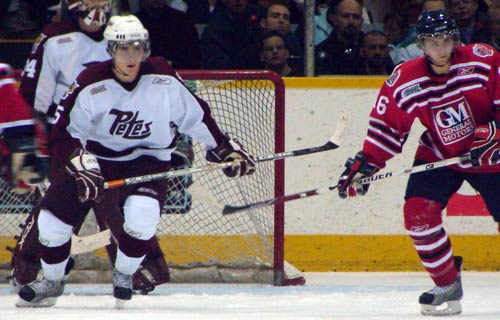
Artūrs Kulda, in his second season with the Peterborough Petes, follows the action during a game. (Photo by Viesturs Zariņš)
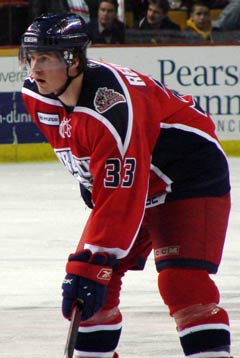
Jēkabs Rēdlihs, while still with the Syracuse Crunch, lines up for a face-off. He has since been sent down to the Elmira (N.Y.) Jackals. (Photo by Viesturs Zariņš)


