Compilation captures musical spirit of the Reawakening

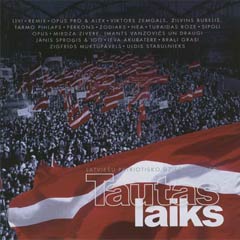
Tautas laiks

It is about time someone released a compilation album of the songs that were most significant and popular during the “Singing Revolution.” These songs of the late 1980s and early 1990s inspired and awoke long dormant thoughts in many listeners, both in and beyond Latvia. As a teenager in the United States who had never been to Latvia, when I heard the song “…pie laika” by Remix and its final exhortation “Brīvību tēvzemei – pieprasām!” (Freedom for the fatherland – we demand it!) I realized something big was happening.

And it wasn’t just in that one song. So very many songs of the period dealt with the Reawakening and a yearning for independence. Most all of the songs on the compilation records Mikrofons 88 and Mikrofons 89 dealt with this very theme. Though multiple factors led to the return of Latvia’s independence, one cannot deny the power of song in these events and their effect on what transpired.

In 2007, MICREC released the compact disc Latviešu patriotisko dziesmu izlase: Tautas laiks, a collection of the songs of the era (plus a few older songs) that played a part in the “Singing Revolution.” Most all of the hits of that time are here: the aforementioned “…pie laika” by Remix; the Pērkons song dedicated to the nascent Latvian green movement, “Zaļā dziesma”; two songs, “Manai tautai” and “Lūgšana,” by Ieva Akurātere, who was the “voice” of the Reawakening; and “Taisnība” by Zodiaks. Older songs included are “Tik un tā” by Uldis Stabulnieks and “Vairogi” by Līvi. The Stabulnieks song, with lyrics by Māra Zālīte, dates from 1980 and is perhaps one of the first to express an unabashed patriotism and love for Latvia. The Līvi song was first recorded in 1972, but the version on this CD is the re-recorded 2002 version.

Most of these songs have been released and re-released a number of times, but what makes this particular collection a true treasure is a number of songs that, to my knowledge, have never been released on CD (and if they have, they are not readily available). These include songs like “Daugaviņa” by the group Sīpoli, “Senā kalpu dziesma” by Opus and “Veltijums LTF (Latvijas Tautas Frontei)” performed by NEA. A particularly pleasant surprise was the inclusion of “Zeme, zeme, kas tā zeme” by Brāļi Grāši of Germany. Rarely do these compilations include songs by diaspora Latvian groups. Interestingly, this song’s melody is based on the Jewish song “Dona dona” by Aaron Zeitlin and Shalom Secunda.

Some songs have not aged particularly well. For example, “Atmostas Baltija” is a song that repeats its verse and chorus in Latvian, Lithuanian and Estonian by, respectively, singers Viktors Zemgals, Žilvins Bubelis and Tarmo Pihlaps. Though certainly an admirable display of unity, the novelty of the song wears off quickly. There is also the less than subtle “Brīvību Baltijai!” from Opus Pro, which bludgeons the listener with its message. Or “Ai, māsa Lietuva” by Turaidas Roze, which repeats the title of the song way too many times. Contrast those with the song “Tautas laiks” (music by Jānis Lūsēns, lyrics by Imants Ziedonis), performed by Zigfrīds Muktupāvels. It still gives me the shivers whenever I hear it.

No collection of songs will ever satisfy everyone, but I would have dropped some of the previously mentioned songs and found a place for “Mēs pārtiekām viens no otra” by Pērkons (the most popular song in Latvia in 1989), as well as other songs that, to my knowledge, have not yet been released on CD, such as “Līdz palodai” by Zodiaks and Akacis or “Putnu ceļš” by Jumis, both from Mikrofons 89. And I would have added more diaspora songs, such as “Par mani, draudziņ, nebēdā” or “Pazudušais dēls” by Čikāgas piecīši.

Unfortunately, one particularly disappointing aspect of this collection is, as always, the packaging. There are a few pictures from that time, as well as an all-too-short essay by lyricist and musician Guntars Račs. Though certainly one could write a dissertation about the Reawakening (and plenty have been written), this is truly a missed opportunity to give newer listeners an understanding of what happened during that time and why these songs were so special. A younger listener, especially one not born before the Reawakening, will not get a full historical picture of what went on. So much more could have been written. Why not ask major figures of that era, such as Ieva Akurātere or Imants Kalniņš, to write a few thoughts and impressions? That would make for some fascinating reading for both young and old.

In any case, Tautas laiks is an essential collection of songs from the 1980s and early 1990s, particularly since it contains many songs not available elsewhere. Packaging deficiencies aside, I recommend this highly, not just as a collection of great songs, but as a historical musical overview of that period of time—a time of unprecedented unity in Latvia, and as a harbinger of what was soon to come.

Details

Latviešu patriotisko dziesmu izlase: Tautas laiks

Various artists

MICREC,  2007

MRCD 365

Where to buy

Purchase Latviešu patriotisko dziesmu izlase: Tautas laiks from BalticShop.

Note: Latvians Online receives a commission on purchases.

Egils Kaljo is an American-born Latvian from the New York area . Kaljo began listening to Latvian music as soon as he was able to put a record on a record player, and still has old Bellacord 78 rpm records lying around somewhere.

Muktupāvela’s novel about Ireland translated to German

Laima Muktupāvela’s novel about the experiences of Latvian guest workers in Ireland, Šampinjonu derība (Testament of Mushrooms), is now available in German, the Rīga-based Latvian Literature Centre has announced.

Translated by Berthold Forssman, the book is titled Das Champignonvermächtnis in German. The book was published by Weidle Verlag in Bonn, which in 2006 published a German version of the Anšlavs Eglītis novel Homo novus.

Translation and publication of the work was supported by a LVL 1,000 grant from the State Culture Capital Foundation (Valsts kultūrkapitāla fonds).

Šampinjonu derība was originally published in 2002 and the following year was translated into Lithuanian. A Swedish version is expected this autumn, according to the literature center.

The novel—Muktupāvela’s first—focuses on the character of Īva Baranovksa, a young Latvian woman who travels to Ireland to seek her fortune, and how she perseveres against various challenges.

Muktupāvela, Forssman and the publisher are expected to unveil the German translation during the Leipzig Book Fair, which is scheduled March 13-16. Latvian writers Nora Ikstena and Dace Rukšāne also are expected to participate in the fair.

Šampinjonu derība

Laima Muktupāvela’s novel Šampinjonu derība has been translated into German.

Andris Straumanis is a special correspondent for and a co-founder of Latvians Online. From 2000–2012 he was editor of the website.