Signature drive begins, aims at allowing recall of Saeima

In Latvia and abroad, a signature drive begins March 12 to demand the Latvian parliament accept proposed constitutional amendments that could allow a popular recall of the Saeima.

To succeed, the drive must gather at least 149,064 valid signatures of Latvian citizens, representing 10 percent of those who voted in the last parliamentary election, according to the Central Election Commission in Rīga.

Thanks to amendments to Latvia’s law on initiative and referendum that were adopted in February, citizens abroad will be able to add their signatures at Latvian embassies, general consulates or consulates in 33 countries. In addition, the Ministry of Foreign Affairs announced March 7, the honorary consulates in the Australian cities of Adelaide, Melbourne and Sydney will be available.

The signature drive closes April 10.

If enough citizens sign on, the initiative will compel the Saeima to accept proposed amendments to Articles 78 and 79 of the constitution to allow voters to submit a draft resolution calling for the dismissal of parliament. If parliament alters or rejects the proposed amendments, a national referendum will have to be called.

The constitutional amendments, proposed by the Free Trade Union Confederation of Latvia (Latvijas Brīvo arodbiedrību savienība), would allow for popular recall of the Saeima. Under current constitutional language, only the president can propose dissolving parliament. That leads to a popular referendum. If the referendum succeeds, parliament is dissolved and new elections are called. But if the referendum fails, the president must step down.

Opposition political party New Era (Jaunais laiks) is among supporters of the initiative and has started a month-long campaign titled “Tavas tiesības atlaist Saeimu” (Your Right to Dissolve Parliament).

The trade union proposed the constitutional amendment as part of a broader effort aimed at encouraging government reform.

A list of Latvian embassies, general consulates and consulates is available online from the Ministry of Foreign Affairs by visiting www.mfa.gov.lv. Information about all locations for the signature drive in Latvia and abroad is available online from the Central Election Commission by visiting www.cvk.lv.

In the United States, the Embassy of Latvia has announced that citizens also will be able to sign the initiative at the Latvian Ev.-Lutheran Church of Washington, D.C., 400 Hurley Ave., Rockville, Md. Signatures will be accepted in the church from 10 a.m. to 2 p.m. March 30 and April 6.

In Canada, the Embassy of Latvia in Ottawa has announced additional hours at the Latvian Canadian Cultural Centre, 4 Credit Union Drive, Toronto. Signatures will be accepted in the cultural center from 8-10 a.m. April 5 and from noon to 2 p.m. April 6.

To be eligible to sign the initiative, citizens must be at least 18 years old and must bring with them a valid Latvian passport. Signatures must be made in person.
Andris Straumanis is a special correspondent for and a co-founder of Latvians Online. From 2000–2012 he was editor of the website.

Rīga song festival tickets selling quickly

Just hours after going on sale, tickets all but sold out to the most popular concerts of the 2008 Song and Dance Festival in Latvia, the LETA news service reported March 10.

Late that night, fewer than 10 of the least expensive tickets remained for the July 12 closing concert at the Mežaparks open-air stage in Rīga, according to a check by Latvians Online of the Web site of the Biļešu Paradīze ticket agent.

The same was true for the grand folk dance performances scheduled July 10 and 11.

Tickets for less popular or well known events were more available. For example, the July 12 kokle concert still had a fair selection of tickets available at LVL 3 and LVL 5, but fewer than 10 tickets remained at LVL 7.

In an effort to keep ticket prices low, the Latvian government granted LVL 3.7 million to the festival, while organizers also have received support from three major businesses. Several free events also are scheduled.

The song festival is scheduled July 5-12 at various venues around Rīga. For further information about the festival, visit www.dziesmusvetki2008.lv.

Meanwhile, tickets also are being sold for the 15th West Coast Latvian Song Festival, scheduled Aug. 28-Sept. 1 in Ventura, Calif. While the West Coast festival’s Web site offers no indication that tickets are getting scarce, the festival hotel—the Crown Plaza Hotel in Ventura—is already sold out. For further information about the West Coast festival, visit www.westcoastlatviansongfest.org.

Andris Straumanis is a special correspondent for and a co-founder of Latvians Online. From 2000–2012 he was editor of the website.

Compilation captures musical spirit of the Reawakening

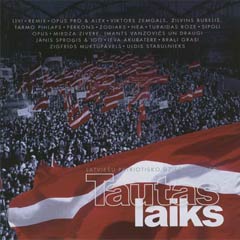
Tautas laiks

It is about time someone released a compilation album of the songs that were most significant and popular during the “Singing Revolution.” These songs of the late 1980s and early 1990s inspired and awoke long dormant thoughts in many listeners, both in and beyond Latvia. As a teenager in the United States who had never been to Latvia, when I heard the song “…pie laika” by Remix and its final exhortation “Brīvību tēvzemei – pieprasām!” (Freedom for the fatherland – we demand it!) I realized something big was happening.

And it wasn’t just in that one song. So very many songs of the period dealt with the Reawakening and a yearning for independence. Most all of the songs on the compilation records Mikrofons 88 and Mikrofons 89 dealt with this very theme. Though multiple factors led to the return of Latvia’s independence, one cannot deny the power of song in these events and their effect on what transpired.

In 2007, MICREC released the compact disc Latviešu patriotisko dziesmu izlase: Tautas laiks, a collection of the songs of the era (plus a few older songs) that played a part in the “Singing Revolution.” Most all of the hits of that time are here: the aforementioned “…pie laika” by Remix; the Pērkons song dedicated to the nascent Latvian green movement, “Zaļā dziesma”; two songs, “Manai tautai” and “Lūgšana,” by Ieva Akurātere, who was the “voice” of the Reawakening; and “Taisnība” by Zodiaks. Older songs included are “Tik un tā” by Uldis Stabulnieks and “Vairogi” by Līvi. The Stabulnieks song, with lyrics by Māra Zālīte, dates from 1980 and is perhaps one of the first to express an unabashed patriotism and love for Latvia. The Līvi song was first recorded in 1972, but the version on this CD is the re-recorded 2002 version.

Most of these songs have been released and re-released a number of times, but what makes this particular collection a true treasure is a number of songs that, to my knowledge, have never been released on CD (and if they have, they are not readily available). These include songs like “Daugaviņa” by the group Sīpoli, “Senā kalpu dziesma” by Opus and “Veltijums LTF (Latvijas Tautas Frontei)” performed by NEA. A particularly pleasant surprise was the inclusion of “Zeme, zeme, kas tā zeme” by Brāļi Grāši of Germany. Rarely do these compilations include songs by diaspora Latvian groups. Interestingly, this song’s melody is based on the Jewish song “Dona dona” by Aaron Zeitlin and Shalom Secunda.

Some songs have not aged particularly well. For example, “Atmostas Baltija” is a song that repeats its verse and chorus in Latvian, Lithuanian and Estonian by, respectively, singers Viktors Zemgals, Žilvins Bubelis and Tarmo Pihlaps. Though certainly an admirable display of unity, the novelty of the song wears off quickly. There is also the less than subtle “Brīvību Baltijai!” from Opus Pro, which bludgeons the listener with its message. Or “Ai, māsa Lietuva” by Turaidas Roze, which repeats the title of the song way too many times. Contrast those with the song “Tautas laiks” (music by Jānis Lūsēns, lyrics by Imants Ziedonis), performed by Zigfrīds Muktupāvels. It still gives me the shivers whenever I hear it.

No collection of songs will ever satisfy everyone, but I would have dropped some of the previously mentioned songs and found a place for “Mēs pārtiekām viens no otra” by Pērkons (the most popular song in Latvia in 1989), as well as other songs that, to my knowledge, have not yet been released on CD, such as “Līdz palodai” by Zodiaks and Akacis or “Putnu ceļš” by Jumis, both from Mikrofons 89. And I would have added more diaspora songs, such as “Par mani, draudziņ, nebēdā” or “Pazudušais dēls” by Čikāgas piecīši.

Unfortunately, one particularly disappointing aspect of this collection is, as always, the packaging. There are a few pictures from that time, as well as an all-too-short essay by lyricist and musician Guntars Račs. Though certainly one could write a dissertation about the Reawakening (and plenty have been written), this is truly a missed opportunity to give newer listeners an understanding of what happened during that time and why these songs were so special. A younger listener, especially one not born before the Reawakening, will not get a full historical picture of what went on. So much more could have been written. Why not ask major figures of that era, such as Ieva Akurātere or Imants Kalniņš, to write a few thoughts and impressions? That would make for some fascinating reading for both young and old.

In any case, Tautas laiks is an essential collection of songs from the 1980s and early 1990s, particularly since it contains many songs not available elsewhere. Packaging deficiencies aside, I recommend this highly, not just as a collection of great songs, but as a historical musical overview of that period of time—a time of unprecedented unity in Latvia, and as a harbinger of what was soon to come.

Details

Latviešu patriotisko dziesmu izlase: Tautas laiks

Various artists

MICREC,  2007

MRCD 365

Where to buy

Purchase Latviešu patriotisko dziesmu izlase: Tautas laiks from BalticShop.

Note: Latvians Online receives a commission on purchases.

Egils Kaljo is an American-born Latvian from the New York area . Kaljo began listening to Latvian music as soon as he was able to put a record on a record player, and still has old Bellacord 78 rpm records lying around somewhere.