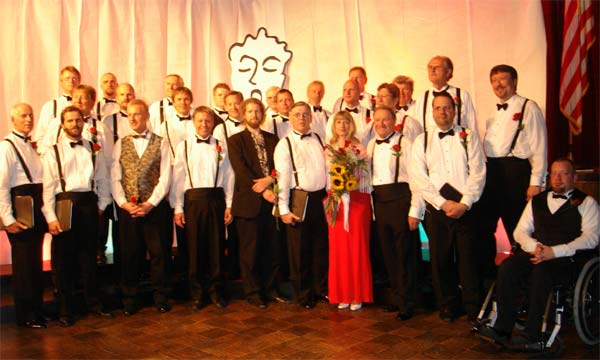
The men’s chorus Uzdziedāsim, brāļi! marks its 10th anniversary in 1997 by posing for a photograph with conductor Laura Rokpelne Mičule.
Very little information exists about the first Latvian settlers in Los Angeles, who arrived in the years following the founding of the Latvian social democratic group “Zemgalieši” in 1905. However, they did have a sizeable library, which was later moved to the Los Angeles Public Library and from there to the Latvian Association of Southern California’s library.
According to Latviešu kolōnijas, written by Vilberts Krasnais and published in 1938 by the Latvian National Youth Alliance, approximately 300 Latvians lived in Los Angeles in 1930. They worked as surveyors, painters, shoemakers, carpenters, fishermen, farmers, machinists, gardeners and shopkeepers. There were two radical Latvian organizations in the city at that time, one of which was called Draugu klubs (Society of Friends). The other was presumably called Strādnieku Klubs (Workers’ Club), based on post-World War II immigrants’ memories from the 1950s of a faded sign on Main Street not far from Sixth Street reading “Los Angeles Latviešu Strādnieku Kluba meet…” This was likely the meeting place for the other “radical” group mentioned by Krasnais in his book. The Latvians who arrived after World War II did not in general associate with the members of these two groups.
Krasnais also mentions that in the 1930s at least 20 Latvians were employed in the film industry in the Los Angeles suburb of Hollywood.
According to 2000 census data, 11,000 Latvians now make their home in California, about 5,500 of them in Southern California. Interestingly, there are currently also about 20 Latvians working in the film industry, just as in the 1930s.
The Latvian Association of Southern California
Margareta and Eduards Drumalds, Viktors Baltkājis and Helmuts Brauķis began to organize Latvians in the Los Angeles area in 1949, when the first refugees from World War II began to arrive from Germany and settle in southern California. At that time there were approximately 100 of these refugees in Los Angeles and another 300 exiles living (and working as orange pickers) in nearby Anaheim. However, most of the Latvian social activities took place in Los Angeles and thus the city eventually became the base for the Latvian Association of Southern California (Dienvidkalifornijas Latviesu biedrība, or DKLB).
E. Drumvalds chose journalist Felikss Krusa as the first president of this group of new immigrants. Krusa also became president of the subsequently formed DKLB. The group hosted monthly gatherings, including gatherings of a spiritual nature led by the Rev. Aleksandrs Grietēns.
By the end of the 1950s several hundred Latvian refugees from the war had arrived in Los Angeles, hosted by a variety of American organizations. They met on the fourth Friday of every month at a rented space owned by a German organization, Herman’s Sons.
Eventually the Latvians in southern California formed an association, which continued to organize monthly meetings. Members paid one dollar a year in dues. The congregation’s dues were two dollars a year (one dollar for senior citizens). Brauķis was elected president of the association on December 1, 1951. He in turn selected the members of the board. The DKLB quickly became more active and in December 1951 began to publish a monthly bulletin called the Dienvidkalifornijas latviešu biedrības Informācijas biļetens. At first the bulletin consisted of two or three mimeographed pages. Later another page was added for the congregation’s activities. The bulletin is still going strong; it has a circulation of 400 and is published nine times a year, using the best of current technology, of course. It can also be read online at www.biletens.com.
The Latvian Association of Southern California currently has approximately 350 members. Its largest events are the Nov. 18 and June 14 commemorative programs, as well as the New Year’s Eve dance. The DKLB also hosts a variety of lectures, concerts and meetings with authors, artists and representatives of civic organizations. When Latvia was still under Soviet rule, the association also organized political demonstrations. Separate organizations that often work together with the DKLB include the theater group, choir and folk dance group. The association is run by its board, which is elected yearly at the annual members’ meeting. A revision committee audits the DKLB’s books. All members of the board are volunteers, except for the editor of the bulletin, who receives a small salary. In addition to income from events and members’ dues, another considerable source of the DKLB’s income is a yearly calendar prepared by Rūdolfs and Helēna Hofmanis.
The DKLB informs local Latvians and others about events in the area. The association regularly awards scholarships to local youths to attend Latvian schools and summer camps. It also manages a library, and any extra copies of books are donated to libraries in Latvia. Among the organizations that the DKLB supports are the Association for the Advancement of Baltic Studies, the Baltic Association to the United Nations, the Baltic American Freedom League, the World Federation of Free Latvians (Pasaules brīvo latviešu apvienība, or PBLA), the American Latvian Association, the American Latvian Youth Association, Latviešu Fonds, the Occupation Museum of Latvia, Latvijas bērnu fonds and the summer high school Kursa. DKLB is also a member of all the above-mentioned organizations. Each year the DKLB sends two delegates to the American Latvian Association’s congress. Representatives (Alfons Reinis, Ivars Mičulis and Astra Moora) have also taken part in conferences organized by PBLA in Rīga. An information line run by the DKLB offers current information on events taking place at the Los Angeles Latvian Community Center.
The mission of the DKLB is to unite Latvians living across all of southern California, from Santa Barbara and Bakersfield in the north to the Mexican border in the south. Yearly dues are now USD 25, which includes a subscription to the association’s bulletin. Non-members pay USD 35 per year for the bulletin. The DKLB strives to contact people who have recently arrived from Latvia and invites them to participate in the local Latvian community.
In addition to its regular, annual events, the DKLB also organizes a number of special events. For example, in 2006 Los Angeles hosted the 55th congress of the American Latvian Association in April, a reception with former President of Latvia Vaira Vīķe-Freiberga and her husband in June, and was the site of a polling station for Latvian parliamentary elections in October. The association has also supported novuss tournaments, concerts by popular musicians such as the cello trio Melo-M, events organized by other Baltic organizations and a 100th anniversary commemoration of the popluar Latvian-Californian author Anšlavs Eglītis.
The current members of the DKLB board (as of March 2007) are: Jānis Daugavietis, Ilgvars Dižgalvis, Rūdolfs Hofmanis, Imants Leitis, Nora Mičule, Ivars Mičulis, Astra Moora (secretary), Nonita Priedīte (English language liaison), Jānis Rutmanis, Valdis Pavlovskis, Dace Taube (representative to the Latvian Community Center board), Jānis Taube (treasurer) and Vija Vīksne (events coordinator). Pārsla Blāķe, Inguna Galviņa and Helēna Hofmane are on the audit committee.
DKLB board meetings take place on the second Wednesday of each month at the Los Angeles Latvian Community Center. The meeting room is dedicated to long-time DKLB president Alfons Reinis and his wife Ināra.
Former presidents of the DKLB are Felikss Krusa (1949-1951); Helmuts Brauķis (1951-1955); Ludvigs Vīks (1955-1956); Eduards Duks (1956); Daniels Agrums (1957-1959); Helmuts Brauķis (1960-1964); Viktors Vaits (1964-1965); Edgars Gernatovskis (1965-1968); Imants Kaprālis (1968-1971); Nonita Priedīte (1971-1972); Māra Eglāja (1973); Silvija Tūbele (Kurmiņa) (1974); Guntis Kuškēvics (1974); Leo Veiss (1974); Juris Cilnis (1975-1977); Alfons Reinis (1978-1987); Inese Birzniece (1988-1990); Ģirts Budkēvics (1991-1995); and Arnis Tolks (1996-1998). Ivars Mičulis has been president since 1999.
Youth group
On August 4, 1952, Ilgvars Dižgalvis of the Southern California congregation, Klitija Pilmane of the Miera congregation and Helēna Nukša (independent host of the occasion) composed an invitation for young Latvians in the area to join together. Their first outing was to Canoga Park, where Ādolfs Kaktiņš had recently purchased a poultry farm. The youngsters helped Kaktiņš clear undergrowth from the property, and Mrs. Kaktiņš treated the bunch to fried eggs and lemonade. The newly formed youth group also took trips to the rose garden at Exposition Park and to various museums. Similar youth groups were also being established at that time in other Latvian centers throughout the United States.
The first West Coast youth gathering took place on July 4, 1952, in San Francisco. The Los Angeles youth group was officially founded on December 13, 1952, with a program that included songs, recitations of poetry, official greetings and the presention of a flag by the Miera congregation. A Latvian coat of arms could not be located, and so the sun from the coat of arms was made of white chrysanthemums instead.
Daugavas Vanagi
The Southern California chapter of the Latvian Welfare Association Daugavas Vanagi (DV) was founded on August 18, 1963. It has had four presidents: Pauls Pļavenieks, Edvīns Leimanis, Aivars Jerumanis and, currently, Teodors Lilienšteins. Inguna Galviņa is president of the women’s auxiliary. But the Riverside DV chapter—the very first chapter in Southern California and possibly on the whole West Coast—has been all but forgotten. Its founding (on November 11, 1950) was proposed by Valdis Grīnvalds, and its first and possibly only president was Andrejs Olte. Olte now lives in Michigan. The Riverside DV chapter became a group when its membership dwindled to 20, and eventually it closed completely.
Construction of the Latvian Community Center
By the late 1950s the Los Angeles Latvian community began to dream of buying or building a meeting place and event hall of their own. Professor Augusts Raisters, who had directed the civil engineering department at the University of Latvia’s College of Agriculture and had recently settled in Los Angeles, supported the idea. Former Latvis editor Felikss Krusa resolved to find out whether the local Latvian community was ready to donate money to the cause, and Helmuts Brauķis began advertising the idea.
After a while Krusa reported that he had already collected almost USD 2,000 in donations. But that was too little to begin construction, and therefore the community had to wait until more of their countrymen joined them in southern California and their financial position improved.
Raisters, Brauķis and Krusa, along with E. Drumvalds, M. Drumvalda and others, were elected to a newly formed hall acquisition committee. However, opinions varied as to whether a hall should be bought or constructed with donations alone, or whether the local Latvian organizations ought to provide the necessary funds. A year or so later a new hall acquisition committee was elected with Alfons Reinis as its chairman. This new committee discussed how to finance the project. Eventually, the new committee registered a joint-stock company named Latviešu nams with the state of California and bought a church with a small adjoining hall on Griffith Street in Lincoln Park, Los Angeles. Many Latvians lived in the surrounding neighborhood. Many of their programs were held at the church, but other halls had to be rented for larger events. Of these rented halls, the International Institute became a favorite, especially for the New Year’s Eve dances.
The community, though, had not forgotten the idea of building a hall of their own. In the meantime their numbers had noticeably grown, and the city was now home to two Latvian congregations, a Latvian association, an amateur theater company and the folk dance group Pērkonītis. Haralds Alksnis was elected chairman of the hall acquisition committee; H. Brauķis and others were also on the committee. They immediately decided to begin a campaign to collect donations. They also decided that the committee should work together with the congregation, so that the hall could be classified as a non-profit—and therefore tax-exempt—organization.
From then on the idea of acquiring a hall of their own was advertised at all of the DKLB’s and congregation’s events. Special fundraisers were organized. The hall committee chairman contacted all of the local Latvians and asked for donations of paintings to be given as prizes in raffles, which raised money for the cause. Almost every Latvian artist responded positively to the call.
The Los Angeles building committee planned to auction off several plots of land not used up by the construction of a new freeway. These unused plots together formed a considerable piece of land, but the original asking price was about USD 20,000 more than what the Latvians’ had donated. Imants Kapralis, a member of the hall committee and plastics factory owner, wrote out a personal check for the remainder of the sum, which was to be paid back with no interest whenever the community was able to do so.
Three architects handed in bids for the Latvian Community Center project: Staņislavs Borbals, Voldemārs Ozoliņš and Jānis Janavs. The committee chose Janavs’ design for the new building. Committee member Guntis Kuškēvics was authorized to secure a loan from the bank. Māris Andersons was the vice president of the Bank of America at that time, and with his help the Los Angeles Latvian community was able to secure a loan for USD 100,000.
Janavs supervised the construction of the building. Major work was done by professional builders, but much of the minor work was done by Latvian volunteers. The community also donated money to buy tables, chairs, dishes, etc. for the new center. Viktors Vaits and Helmuts Brauķis together with members of the Tālavija fraternity laid the parquet floor in the main hall. And so, little by little, the Latvians of Los Angeles acquired a community center of their own, where eventually all of their events and activities took place. In the meantime the church on Griffith Street had been sold. The Rev. Elmārs Caune led church services in the new building until a separate church—also designed by the architect Janavs—was built at the other end of the plot.
But the community’s financial worries did not end with the construction of the hall. The loans from the Bank of America and Imants Kapralis still had to be paid back. Beginning in 1974 members of the Southern California Latvian Credit Union donated money. The only sources of income for the community center were donations and a few events organized by the building’s management committee. The community center was officially described as the congregation’s meeting hall and was therefore exempt from taxes. The only way to earn some extra income was to form a Latvian Club with annual dues of USD 50. Once the club had at least 50 members, it was able to obtain a permit to sell drinks to its members. The club still exists today, annual dues are still USD 50, and a list of its members is on the wall in the front entry.
A Latvian Community Center board was established to replace the building management committee. The board consists of one representative from each organization and group that uses the hall, except the congregation, which has two representatives, one of whom is the congregation president. For extra income the Latvian Community Center board decided to occasionally rent the hall out to others—Latvians and non-Latvians, organizations and individuals. Other board decisions have included giving exclusive authority of the bar to the board, requiring the board to provide a person on duty at the bar, calling board meetings once a month, and hiring a custodian for the building.
Latvian School
The Los Angeles Latvian Sunday School was founded on November 23, 1950. Classes at first took place at the German Trinity church, but now the school meets at the Latvian Community Center. A total of 73 students have graduated from the school in the years between 1950 and 1999.
The grandchildren of Haralds Alksnis and Jānis Janavs now attend the school. Lolita Ritmane-Matsone conducts the school choir; Loma Kārkliņa directs the folk dance group Mazais pērkonītis. Every year the school participates in local Scandinavian festivals. Plays by Andrejs Zinbergs and Andra Berkholda – both involving a large number of students in their casts – have been performed at Latvian song festivals on the West Coast.
Former directors of the Los Angeles Latvian School are Daniels Agrums (1950-1954, 1955-1957, 1960-1964, 1969-1975); Ludvigs Vīks (1954-1955); L. Knauta-Daugaviete (1957-1960); Ludmila Raistere (1964-1966); I. Lūsis (1966-1969); Ilmars Bastjānis (1975-1980, 1982-1985); Andrejs Zinbergs (1980-1982); Nora Mičule (1985-1989), Maruta Dankere (1989-1990); Anita Puķīte (1993-1994); and Inguna Galviņa (1994-1995). The current director is Nora Mičule.
Congregations
The Latvian Ev. Lutheran Church of Southern California was founded on November 26, 1950, with the Rev. Aleksandrs Grietēns as its first minister. The congregation held services in a rented Lutheran church—the Trinity Church, which is now located under Harbor Freeway.
The second congregation, the Miera (Peace) congregation, was founded in 1951. Its minister, the Rev. Oskars Kleinbergs, also held services in a rented space. However, the Miera congregation ceased to exist after Kleinbergs’ death.
Latvians bought their first church in Los Angeles on Griffith Street in Lincoln Park. The church had previously belonged to a German congregation. Services were led by the Rev. Roberts Āboliņš, who traveled the long distance from Atascadero, where he worked for an American congregation. It was in this church where well-known couples such as Zaiga Ozoliņa and Ilgvars Dižgalvis, Daira Caune and Olafs Stumbrs, and Līga Brauķe and Viktors Vaits were wed. At present the church is known as the Templo Emanuel Asamblea Apostolica de la Fe en Christo Jesus.
Other ministers who have served the Southern Californian Latvian congregation are Elmārs Caune, Edgars Liepiņš and Mārtiņš Irbe. The congregation currently has approximately 300 members; its president is Jānis Lejnieks; and its minister is the Rev. Dāvis Kaņeps, dean of the Western District of the Latvian Ev. Lutheran Church in America.
Theater
Ilgvars Dižgalvis founded the Los Angeles Latvian Theater Group in 1950. Mudīte Šauriņa-Hovele directed the group’s first performance, a production of Rūdolfs Blaumanis’ play “Zelta kupris,” on May 26, 1951. The group’s next production was Mārtiņš Zīverts’ play “Divkauja,” directed by Daniels Agrums. Jānis Vācietis produced V. Richters’ “Nebēdnieks,” M. Zīverts’ “Tīreļpurvs” and J. Pētersons’ “Pieklīdušais kaķeņs” in 1952-1953. The group next performed Anna Brigadere’s “Ilga” (1954) and M. Zīverts’ “Minchauzena precības” (1955), directed by Ansis Tipāns and Vilis Lapenieks, respectively, both of whom had arrived in Los Angeles in 1953. Vitolds Riķis, Lidija Mitrēvica, Andrejs Zinbergs and Aleksis Lielausis directed plays for the group in subsequent years. Stage designers have included Andrejs Zinbergs, Jānis Rapa, Jānis Bērziņš and Jānis Krišjānis. Over the years about 100 Latvians from Los Angeles and the surrounding area have performed with the theater group. Many have been amateur actors, but some have been professionals, such as Stefanīda Jansone, Spodra Lejniece, Ādolfs Kaktiņš, Māris Ubāns, Lolita Lejiņa-Bola, Ilze Tauriņa-Barona and Lilita Kreišmane.
From 1951 to 1981 the Los Angeles Latvian Theater Group performed 34 plays. Most popular were M. Zīverts’ “Minchauzena precības,” which was produced three separate times, and R. Blaumanis’ “Skroderdienas Silmačos” and J. Rainis’ “Jāzeps un viņa brāļi,” both produced twice. Of particular note for its many dances, songs and lighting effects were V. Lapenieks’ productions of “Minchauzena precības,” “Jāzeps un viņa brāļi” and A. Brigadere’s “Princese Gundega un karalis Brusubārda.” The group also performed shorter theatrical works for various local events.
The theater group is run by a board of directors. Arvīds Pukinskis was the first chairman of the board; later Ilgvars Dižgalvis was chairman. Throughout the years the group has performed at several Latvian song festivals on the West Coast and has also toured Latvian communities in the United States and Canada with its plays. One play—“Trešais zvans”—was even written based on the group’s experiences during a tour with director A. Eglītis.
Ilgvars Dižgalvis and Ilga Jankovska currently run the theater group. A 1997 production of J. Kesselring’s “Arsenic and Old Lace” under the direction of Andrejs Zinbergs was its latest performance. Since then the group has mostly been involved in the organization of tours by actors from Latvia.
Music and dance
Loma Sprūde (later Kārkliņa), Matīss Kārkliņš, Zigis Teteris, Dace Kārkliņa, Anita Rubene, Mārīte Rozentāle, Maija Caune, Juris Cilnis, Sallija Šmite, Mārtiņš Šmits, Lolita Ritmane and Daila Mičule formed the ensemble Solaris, which existed from 1977 to 1984. Daira Cilne directed the vocal group, which performed in Los Angeles, San Francisco, Portland, Seattle and even Münster, Germany.
Timothy Fetler, a music professor at the Santa Barbara City College, was the first conductor of the Los Angeles Mixed Choir, which began singing in 1956. Then the Lithuanian composer and organist Bronius Budriūnas directed the choir for a short time. Olafs Stumbrs and Andrejs Kurmiņš later conducted the choir, and Daira Cilne was conductor from 1972 to 2002. Currently the choir’s conductor is Pauls Berkolds.
The folk dance group Pērkonītis was founded in 1950. Its first teacher of dances was Arturs Šmits, later Zelma Ābele. Mirdza Lapeniece developed and directed thematic programs for the group that included not only dances, but also singers, choirs, musicians and recitations of folk verses. One of her more memorable programs depicted a traditional Latvian wedding. Other programs were dedicated to the family, the homeland and Latvian virtues. The group performed Lapeniece’s “Balta nāca tautu meita” at the 1965 song festival in Portland, Oregon. The current director, Loma Kārkliņa, helps the group prepare dances for local Latvian events and Sacandinavian festivals.
Laura Rokpelne-Mičule conducts Uzdziedāsim, brāļi!, a men’s chorus founded in 1997. In its first decade the choir has more than doubled in size with several young men joining after graduation from Latvian school, as well as the addition of new arrivals from Latvia, a few American singers with ties to Latvians, and also a couple of Latvian-Americans who began to take interest in their heritage later in life. Among the singers one can find engineers, airport employees, a camp counselor, television program editor, minister, lawyer, computer programmer, movie lighting technician, television producer, sports referee, fire fighter, high school student, teacher, construction worker, artist, computer consultant, financial manager, retail purveyor and inventor. The youngest singer is 16 years old; the oldest is 70. Uzdziedāsim, brāļi! has performed for Latvian, Baltic and American audiences across the United States and Toronto. It celebrated its 10th anniversary on May 19, 2007, at the Latvian Community Center in Los Angeles.
Sports
The Los Angeles Latvian community once had a sports group with Viktors Veiss as its director. The group organized volleyball, basketball and tennis practices and competitions. Now there is a novuss group, organized by Jānis Daugavietis. Three tournaments of men’s and women’s singles and doubles take place each year. The first of these tournaments always includes the ten best players of the previous year. For more information on the novuss group visit its Web site at www.novussusa.com.
Song festivals in Los Angeles
The Latvians of Los Angeles have hosted four song festivals. In 1970 Helmuts Brauķis and Vilis Lapenieks headed the steering committee of the 4th West Coast Song Festival in Los Angeles. The 7th West Coast Song Festival took place in 1977 in Pasadena with Jānis Taube Sr. as chairman. Arnis Tūbelis was the main organizer of the 9th West Coast Song Festival in 1989 in Long Beach. Ten years later the 13th West Coast Song Festival took place in Thousand Oaks, headed by Valdis Pavlovskis. The 15th West Coast Song Festival is planned for Aug. 28-Sept. 2, 2008, in Ventura. The chairman of this year’s song festival steering committee is Pauls Berkolds.
(Editor’s note: This article was translated from Latvian by Amanda Jātniece.)
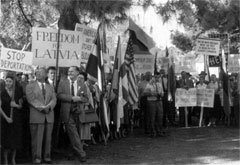
Members of many nationalities, including Latvians, participate in a 1956 demonstration in Los Angeles supporting the Hungarian revolution against the Communist regime. Edgars Gernatovskis, president of the Latvian Association of Southern California from 1965-1968, stands with a “Freedom for Latvia” poster.


