


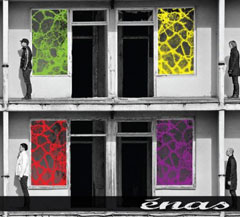
People always say the pace of life in Europe is more relaxed or simply slower than elsewhere. This review, for example, could (or should) have been finished weeks ago, but I like to think on my words before I commit them to “.doc”. Rock-pop group Ēnas has been together since 2005 (and averaging three concerts a month since 2006), but its self-titled debut just came out back in April of this year. The band took its time as well. My reactions to the album were also delayed, as well as fickle. And although I can’t say I’m 100 percent swept away, I can at least recommend Ēnas further.
The four-man band is a smorgasbord of total talent, consisting of Lauris Valters (vocals), Jānis Ķergalvis (solo guitar, acoustic guitar), Dāvis Ābrams (keyboard, piano) and Mārtiņš Miļevskis (drums). Though the group is relatively new, its style of music rings more familiar than not, a rock-pop sound that tends to easily remind people of bands like Latvia’s Lādezers or U.S. band The Calling.
The album starts with a very steady orchestral and piano introduction that sounds like something you might hear during a transition scene on some American television series. I can only understand about seven words total, but I’m not bothered. Valters’ voice soars through the latter half of the first one minute and 34 seconds of the album and leaves you with a good feeling about what is hopefully to follow.
On that note, not only does Ēnas start its album out in English, but more than half of the album is in English. A somewhat risky move for a debut? Maybe, but Ēnas lucks out in that it doesn’t affect the quality of the album as a whole.
Track 2, “Beautiful Morning,” follows the same musical principles of the intro but trades the strings for guitar. The lyrics are very positive and fairly well developed, though there is the questionable use of the word “funny,” which sticks out painfully. The most notable and positive aspect of the song is the vocals, which are well-rounded and don’t disappoint.
“Viss savādāk” (Everything’s Changed) takes a darker turn from the previous track. A slightly blast-from-the-past synth intro and background beat accompany lyrics that build a picture of a brownish haze of desparation. Even the lyrics portray the narrator as having a sense of being lost, knowing but at the same time not knowing where he stands in the implied relationship. But I feel the song lacks originality. The sound is nothing new, the title of the song is nothing new—it’s a weak link in the album.
The next track, “Par šo un to” (About This and That), is simple in nature. A very strong guitar and snare beat demands your attention and is good at getting you physically involved in the listening process. However, the lyrics are not impressive—the song is about juxtaposition and contrast, but nothing original. The music is good, though, and pleasantly passive-aggressive. If you can look past or just ignore the ho-huminess of the words, the track is decent.
“SirC” (Heart) is probably the first and best known song by Ēnas. I had actually forgotten about the song until I listened to the entire album for the first time and, very fittingly, my heart jumped with joy at hearing something I had heard before. The guitars dominate this track, giving you the first good listen at what these guys can do. Once again, the vocals let loose and the whole thing just comes together. It’s a catchy song that radiates positivity and, though I wasn’t moved by it way back when, it’s now one of my favorite songs of the year.
My second favorite, Track 6, “Ar skaistām frāzēm” (With Beautiful Words) is a meloncholy song, but has a truly wonderful sound to it. I could listen to the intro over and over again, even with the synth, which actually works this time. A combination of guitar, drums and excellent bass line melt together in a smooth beat that leads you into the vocals almost without noticing what’s happened. The lyrics leave you with an achy feeling and, even though it’s a sad song, I appreciate the lack of beating around the bush. It’s no-nonsense, a “No, something’s up and this is what it feels like” tune:
Kāds no mums nav patiess.
Vai savādāk var būt?
Daudz sapņu prāts noliedz,
Tos zaudējot, sirds lūst.
Tad pēkšņi viens var pateikt
viss beidzies, kā būs – tā būs.
Tā zvaigzne kādreiz izdziest,
tai mirklī pagaist it viss.
And let me say once more just how big a fan I am of the bass line. Thumbs. Up.
Skipping ahead a bit, track 8, “Neprātīgais” (Reckless) starts out slow, then unexpectedly picks up. There’s an interesting ambiguity here in subject matter and I like the image the lyrics create. This song is also one of two (the other being track 7, “Somehow”) that made me start thinking that Ēnas might be borderline Christian rock. The subject matter and potential references to religion are more apparent in these two tracks, but looking back over the preceding material, the rest of the album could also easily be associated with belief in a higher power.
Tracks 7 (“Somehow”), 9 (“Double Coffee”), 10 (“Rainbow”) and 11 (“Mr. Evil”) are all decidedly my least favorite parts of the album. While technically strong, they form a line of English tracks with randomized styles and approaches with which I apparently have some kind of problem.
“Somehow,” which isn’t saved by the wonderful musical talent of the group, features less than perfect English grammar and the one and only profanity on the entire album. Is the song a huge reference to the Rapture or something? The second coming of Christ? Then there’s “Double Coffee,” which I thought would be a clever reference to the café and restaurant chain (it’s not). These two tracks form a pair of grammatical anti-wonders that I can’t bring myself to get over. It doesn’t make a difference that the written lyrics are mostly correct, because it’s what you hear that matters.
“Rainbow” and “Mr. Evil” also left me less than enthused. Maybe the problem with these tracks is that Ēnas, being a relatively new group, has already involved so many other people. If the band members had less outside help and more of themselves on their first album, there would be a better chance for them to establish themselves as themselves. Let us hear who you are before you let us hear what you can do with everyone else.
Track 12 is back in the more consistent style of the band. The second verse is a little too cliché, but the refrain is outstanding. Right away it’s apparent that the English is much more advanced. As a result, I’m inclined to think that this song may have meant more to Valters than the other English tracks. In any case, the sound here is more refined. The vocals run through a wider range and the individual instruments can be heard much better than in the other.
“Acīm ciet” (With Eyes Closed) is the “cool” song of the album. Astro’n’out vocalist Māra Upmane joins Valters in a duet that basically summarizes a lot of what has been already “discussed” in the lyrics of the rest of the album. One of the nuances of the song is that Upmane and Valters seem to have a similar vocal range, which they take complete advantage of. They take turns in singing the high and low notes. Their voices mesh well and the track slows the album down, nicely preparing it for the close.
The final track of the album has two parts to it: the actual song, “Player”, and a bonus track, which is a rather unconvincing English version of “SirC.” “Player” is another track with some good imagery and, looking past some grammatical speedbumps, is probably one of the best songs on the album. Once again all members of the band are given the chance to clearly show what they can do. Piano and vocals run for a little over three minutes without drums and guitar, then the group has four more minutes to prove that it is adept at different instrumental-voice combinations and that it can take it down a notch without a hitch.
I have to say that if for the most part it sounds like I don’t like the album, it’s not all true. My opinion of the band changed completely after I saw Ēnas perform live. I felt cheated that the album didn’t have the same vibe as the live show. It wasn’t just the that it was a surround-sound, live gig. On stage the band members sounded so much more “there” with their music. It was like I was watching a completely different band play the same Ēnas songs. They might benefit from recording a live album: the electricity they emit and receive is something else. Ēnas, when you break it down, is a group of very talented individuals who work together like they were born to do so.
Details
Ēnas
Ēnas
Antena, 2008
On the Web
Grupa Ēnas
The band’s official Web site includes news about the band, samples of its music and other features. LV
Where to buy
Purchase Ēnas from BalticShop.
Note: Latvians Online receives a commission on purchases.
