


The European Latvian Association (ELA), the umbrella organisation for Latvian organisations in Europe outside of Latvia, held its annual general meeting in Brussels on Sept. 20, and closed its proceedings by holding a discussion on the future of Latvian diaspora organisations in Europe.
The discussion, organised by the Belgian Latvian Association, took place on the premises of the Latvian Permanent Representation to the European Union, and brought together eight speakers and around 20 other participants.
There was a general perception that Latvian diaspora organisations, as they currently stand and have existed throughout the postwar period, are faced with a number of new challenges which require a review of their mission and their relationships both with the members of the communities they claim to represent (whether these be descendants of postwar refugees or people who have emigrated from Latvia over the last few years) and with institutions in Latvia. Globalisation and Latvia’s accession to the European Union has led to unprecedented labour-force mobility throughout much of Europe. The diaspora in Europe is rapidly changing, and its organisations sense a need to change with it.
Bricks-and-mortar or virtual playgrounds?
Some participants in the discussion questioned whether formal associations were at all relevant to today’s circumstances, in an age where Latvians can form social networks on Facebook or draugiem.lv and mingle virtually and, especially in the European context, jump on a plane and gorge themselves on Latvianness in Latvia to their hearts’ content in a matter of hours.
Ivars Ījabs, lecturer in political science at the University of Latvia, mentioned that there is a general worldwide trend away from organisational membership, as noted by Robert D. Putnam in his book Bowling Alone: The Collapse and Revival of American Community (2000). Public relations specialist Žaneta Vegnere concurred with this assessment and highlighted the usefulness and increasing importance of informal networks, of groups of citizens as “ideas generators” and “political lobbyists,” linked by communications technologies and able to mobilize rapidly for specific purposes. One has only to remember the success of the campaign to get Rīga featured in the Monopoly World Edition board game to confirm this. No need for membership dues or convening meetings in a Latvian House! Indulis Bērziņš, editor of the Web site latviesi.com and representative of the Daugavas Vanagi Organisation in Germany, also questioned the need for national-level organisations, but did highlight the need for more regional bodies.
ELA Chairperson Dace Luters-Thuemmel, meanwhile, stressed that the established structures could still be transformed and develop. Latvia’s Special Ambassador to the Diaspora Juris Audariņš also did not dismiss them lightly, highlighting the benefits of formal organisations as representative bodies and a readily identifiable cooperation partners for Latvia.
New communities, new needs
It seems, however, that established organisations are failing to capitalise on the opportunities for expanding their membership that the recent wave of migration from Latvia present. Ījabs suggested that the underlying problem might be a legacy of totalitarian rule: clubs and associations in Latvia in Soviet times could only exist with the consent of the ruling Communist Party, and membership in them was often a requirement for a reasonable career. The lack of interest shown by recent emigrants in Latvian diaspora organisations, Ījabs contended, could be due to an ingrained mistrust of such institutions per se, rather than to any stereotypical “Latvian individualism” or preference for isolation over communal living. The Soviet legacy may go some way to explaining why an inhabitant of Latvia is likely to be a member of only 0.9 associations on average, whereas the corresponding values for Europeans as a whole and for Americans are 2 and 3.4, respectively.
Perhaps class is also an issue? Most post-war refugees and their descendants have established themselves within the middle class, whereas the majority of new migrants could be classified as working class. Or perhaps the issue is rather one of supply and demand, with the older organisations perceived as too set in their ways, providing premises in which to perpetuate rituals of national belonging for ageing societies, but not offering an outlet for the dynamism of younger generations? Too much in the way of bricks-and-mortar and well-invested inheritances, going through the motions of conducting tired, worn-out rituals, when in fact people actually “want to party,” as Bērziņš suggested?
At any rate, a lack of understanding and communication, if not a wary hostility between the old and new diasporas was apparent. Mārtiņš Sausiņš, chairman of the World Federation of Free Latvians (Pasaules brīvo latviešu apvienība, or PBLA), acknowledged the difficulties, putting forward the view that recent emigrants did not take enough time to get to know the older diaspora well enough and make use of all the opportunities that the older organisations make readily available. “Why don’t you come to us?” Sausiņš rhetorically asked the newer migrants. But there seemed to be no clear strategy for outreach to the new constituencies.
New directions?
Nevertheless outreach does seem to be occurring within some postwar diaspora communities. In the United Kingdom, activities are being organised for the descendants of postwar migrants who do not speak Latvian and for people from other nationalities with an interest in Latvian culture. And it would seem that the Latvian government is in favour of the net being cast yet wider, by harnessing the energy and knowledge of persons of Latvian ancestry to promote Latvia abroad in a similar way to the Globalscot Programme that brings together the expertise of all sorts of specialists of Scottish ancestry to provide strategic advice to Scottish industry. A few audience members did wonder aloud why the Latvian government was not doing more to forge such links.
One area in which the interests of members of both old and new diasporas converged was the fostering of business links with Latvia. Sausiņš cited the example of the Latvia Canada Business Council as an organisation that could embrace both old and new émigré streams. Journalist Ģirts Salmgriezis emphasized the benefits to Latvia of business ideas generated in diaspora communities and realised in Latvia, while Audariņš said that such economically beneficial assistance might act to counterbalance the influx of Russian capital into Latvia.
New political agendas?
There was also broad agreement that diaspora organisations could still play a political role, as they had done in Europe throughout the Cold War and, more recently, as Latvia sought membership of the European Union and the NATO defence alliance. Details of the road ahead, however, were very sketchy.
Audariņš affirmed that although the Latvian government considers diaspora organisations to be nongovernment organisations, they could serve as a political “weapon” in certain circumstances. For example, they could help forge public opinion in their host-country societies and counter negative publicity directed against Latvia, such as erupts around commemorations of the Latvian Legion on March 16 each year. Or they could express solidarity with the Latvian position on international issues, such as the situation in Georgia, in cooperation with other national diasporas, such as those of the other Baltic states, Ukraine, Belarus and Jewish communities.
Salmgriezis wondered what the Latvian government could ask of diaspora organisations if it itself was not doing enough to utilise other available political opportunities, such as those presented by the European Parliament. He questioned the usefulness of some approaches already used, such as organising exhibitions in the European Parliament building, which ended up mainly attracting a Latvian audience. There was a need to “go out onto the streets” and popularise Latvia with a much greater vigour to produce a broader impact.
Other members of the audience questioned how much diaspora organisations can be seen as an extension of the foreign policy arm of the Latvian government, especially since diaspora voters have traditionally supported opposition parties in Latvia. The funds that the government sets aside for the diaspora are also primarily aimed at supporting Latvian cultural and linguistic rather than political activities abroad (and of these, some 50 percent are earmarked for Latvian communities in the Russian Federation). And what happens in cases where Latvian associations bring together people from widely divergent political orientation, much broader than that common in postwar communities? All of this could constrain partisan political activism in favour of a Latvian government position.
The particular difficulties for Latvians living in Brussels to implement a political agenda were also highlighted. Most work as civil servants in various administrations (many are on short-term assignments from Latvian ministries and intend to return in Latvia once their tour of duty is over) and so feel reticent to get involved in political issues. But even here, it was suggested, there could be scope for developing broader informal networks that deal with political themes. German, Swedish and even Estonian EU officials have established networks within their national groups to inform each other about issues related to their countries of origin and to raise awareness of their countries within the EU institutions. And perhaps there are some fundamental issues on which Latvians of every stripe could unite—for example, issues which threaten the very survival of Latvia as an independent state?
Influencing Latvia or expanding Latvia’s influence?
In the meantime, the political activities of the older diaspora organisations (such as the PBLA) continue to be directed at Latvia itself, seeking to influence the Latvian domestic situation, whether through political activism (for example, by advocating the revision of the electoral law) or humanitarian actions.
One has to wonder how far this influence actually reaches. It would appear to be conducted rather discreetly. Lāsma Vaice, a representative of the Secretariat of the Special Assignment Minister for Social Integration, strongly emphasised that information about the diaspora barely reaches the average Latvian in Latvia. The computer literate are well-resourced in this regard, able to consult Latvians Online or latviesi.com, but Vaice stressed the need for a more “aggressive marketing” approach, an active awareness-raising campaign to inform the inhabitants of Latvia about the achievements of their compatriots abroad, possibly through a television programme, such as Lithuanian TV broadcasts about its diaspora. Vaice suggested that such a programme might focus more on Latvian organisations and movements rather than individuals and in so doing encourage more active citizenship in Latvia itself.
For many and varied reasons, Latvian diaspora organisations are not making the mark that they could. I left the discussion with a certain sense of déjà vu. I have attended at least one other public discussion in which Latvian community organisations had engaged in similarly intensive navel-gazing about their future. That was in a distant continent and not long after the restoration of independence in the early 1990s. Although many and varied opinions were expressed on that occasion, no concrete action ever materialised. I have similar concerns about this meeting, though, to be fair, producing a plan of action was not its stated aim.
For change to occur, there need to be people willing and able to implement it, and to reach out to groups that are not being catered for. Identifying opportunities is one thing, seizing them is something else entirely. To paraphrase a Latvian poem, change won’t come if people don’t make it happen. Will there be change in Europe? Can new wine be poured into old wineskins, or do we need new vessels entirely?
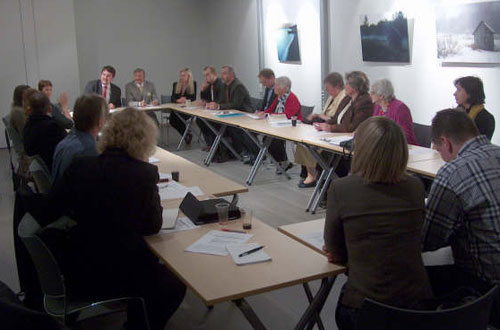
Latvians representing the diaspora in Europe, as well as experts and government officials from Latvia, gather Sept. 20 in Brussels to discuss the future role of émigré organizations. (Submitted photo)
