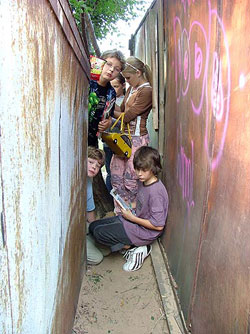
When their classmate goes missing, a group of Latvian schoolchildren takes up the search in the new film Kur pazudis Elvis?, which is directed by Una Celma.
The new Latvian children’s film released Oct. 25, Kur pazudis Elvis?, is a cause for celebration. Una Celma, director of various feature films over the past few decades (Olu kundze, Augstuma robeža and others), has taken on the task of depicting the kids of today in a realistic adventure film.
Since Latvia regained independence in 1991, the film industry has seen better times. Producers have not had a guarantee of government funding, which was the case during the Soviet era. New film production companies have emerged, but they have all had the same financial worries as the state-run film industry. The release of Latvian childrens’ films, in particular, is a rare event. And as the country is inundated with foreign films—the main cinema in Rīga, Coca Cola Plaza, mainly screens U.S. titles and Russian films are also not hard to track down— movies showing everyday issues in Latvia are few and far between, but always welcome.
Kur pazudis Elvis? provides a glimpse into the daily lives of five 5th grade children. Central to the plot is a 5th grade pupil, Elvis, a good student who doesn’t turn up for classes. The teacher seems disinterested in tracking him down (“I’ve tried calling his mother on various phones and can’t get through on any of them—what am I to do?” is the only attempt she makes), dumping the task onto one of her pupils. The boy takes it on himself to tackle this problem head on. With the help of a few classmates he begins the sleuthing job, trying to piece together the puzzle of where their classmate has disappeared to.
The adults in the film, even the powers-that-be don’t seem to appear sympathetic or helpful in any way, leaving the children to their own devices. One is left with the overwhelming feeling of the individual left to fend for themselves at an early age, always a shock to the system in Western countries.
Although this is an adventure film, the most memorable parts are the seemingly mundane, everyday ones: the latch-key kid who comes home to an empty house and ends up staring desolately at his pet tortoise; the heart-breaking phone conversation where a mother regrettably informs her daughter she won’t be able come back from Ireland for her daughter’s birthday; the overworked, disinterested father who has a phone permanently attached to his ear. It seems all the families in this film are dysfunctional, leading one to the question if there are any “average” families left anywhere in the world today? And what kind of a future can these children hope for? The situations are not confined to Latvia; they could be easily transferrable to any other country in the Western world.
Some of the characters are classic stereotypes. Villains are either bumbling clown types or of the Addams family type, complete with the mansion on “Zirnekļu iela 13.”
The kids are the stars here. They are very believable, complete with Russian-Latvian slang and an acute imagination. The insight into the behaviour in the Latvian classroom and the reality faced by teachers and kids is a real eye-opener. Sensitive pre-teens the world over face their own age-old issues: budding relationships, bullying, loneliness, finding themselves. Many of these are briefly touched on in Kur pazudis Elvis? Kudos to the director for combining all these elements and bringing them to the big screen.
Latvia is a like a big country town. The same actors from the Rīga theatres and TV soap operas appear sporadically on the big screen. So it was no surprise to see New Rīga Theatre (Jaunais Rīgas teātris) actors Baiba Broka and Guna Zariņa as well as Daile Theatre (Dailes teātris) actors Ģirts Ķesteris, Ieva Pļavniece, Harijs Spanovskis, Rēzija Kalniņa and Ilze Vazdika all cast in the “minor” adult roles in this movie.
It would be interesting to see how taking part in this movie will influence the 11- and 12-year-old child-actors and if their futures will evolve in this direction. They have certainly shown talent in the brief opportunity they have been given here.
Details
Kur pazudis Elvis?
Una Celma, director
Latsfilma, 2008
Notes: In Latvian. Feature, 78 minutes, in color. Cast: Emīls Desainis, Matīss Kaža, Mārtiņš Ivanovs, Gerda Grobiņa, Margareta Cilinska, Harijs Spanovskis, Ieva Pļavniece, Zane Daudziņa, Andris Bērziņš, Juris Gornovs, Ilze Vazdika; camera: Jānis Eglītis; screenplay: Ingrīda Elerte.