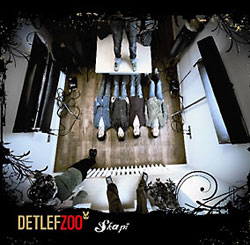
Detlef Zoo (formerly Detlef) has always been a band. However, there seemed to be a misconception that it was really just a solo act, singer Uldis Dirnēns doing all the work, especially after the release of the band’s first album, Tu izliecies par sevi (You’re Pretending to be Yourself), back in 2004.
Go to the band’s Web site and you immediately understand differently. After a brief and nonchalant mention of Dirnēns’ reality music show stint, it is made quite clear that although some of the members have since changed, the band now known as Detlef Zoo is a collective of four “equal and like-minded friends.”
The 2004 album had its success, but I can only recall one song from it and can sadly only pretend to remember the rest of the tracks. But two good things come with the band’s sophomore album Skapī (In the Closet), released in December 2007. First, it is an excellent and at times fairly bad-ass “chill out” album. Second, it is proof that there is strength in numbers because as a “recognized plural,” these guys just plain sound better.
Alt-rock band Detlef Zoo is Mareks Ameriks (drums), Kaspars Ansons (guitar and vocals), Dirnēns (vocals and guitar), and Martins Millers (bass and vocals).
The first and title track of the album is a straight forward mantra of “let us go where we want” with text that is not only mature, but a little ironic, as the band is more out in the open than locked away. There isn’t much to write home about for this one, but it’s conceptually good and paves the way for the rest of the album.
The second track, “Love Town,” is a Blur-meets-Queens-of-the-Stoneage track that is in English and confuses me. I’m not talking grammar (for once), but rather subject matter. It’s about love in all forms, yet the song is riddled with phrases like “I’m happy alone” and “It’s a perfect day to get away.” At least is has a strong beat.
The next two tracks, “Par nozīmītēm” (For Badges) and “Lēts triks” (Cheap Trick), are quite similar, though the former urges people to get over themselves and look at what’s going on in the world and the latter is, from what I gather, a slightly duty-bound look at relationships, as well as musically somewhat superior.
Track five, “Funny Girl” is another English tune with a nice drum groove. The text kind of pokes fun at all of the commercialized songs—specifically about love—that are out there.
At this point I could note that the album seems to be a fan of the percussion and rhythm aspects of music, which is also reflected in the sixth track, “Mana dārgā” (My Dearest). With its abundance of drum set, highlighting cymbals, the track is immediately heavier sounding than its predecessors and has an additional “far away” feel to it.
The pace of the album picks up drastically in the next track, “If It Makes Us Happy”, with a balance of aggressive music and soft vocals. The lyrics kind of connect back to the first track of the album, but in contrast express the mortality of a band as a concept. Its members are aware of how easily something can fall apart, but for now, it works and feels good, so it’s meant to be.
Track eight, “Labrīt, miesniek!” (Good morning, Butcher!), is my one of my favorites. What I like about it is the almost too-slow molasses movement of the lyrics. The line “Dievs, lūdzu izsit pienzobus man!” has a strong sense of immediacy without sounding like it. There’s no “I want to go through years of life to gain experience”. It’s “Give me experience! NOW!” Someone, anyone, please use this song for a slow-motion or reflective moment scene in a coming-of-age or action movie, where a young person has to learn to fight the bad guys to survive. Just make it good or you’ll ruin the song.
“Zaļais krekls” (The Green Shirt), the next track, makes you wonder if you’ve missed something. It may be because it’s a happier sounding song and very different from a good deal of the rest of the album. Or maybe it’s the Telletubbyesque “la-la-las” at the end of the song.
Track 10 is my absolute favorite. The breakdown of “Ar vienu savu silūetu” (With One of Silhouette) is as follows: guitars = love them; percussion = love it; vocals = love them; lyrics = love them. This song could be in that same action movie. Remember? The one that isn’t a flop.
The next three tracks make up what is the collectively strong close to the album. “So Sophisticated” is like “Funny Girl” but with different lyrics. “Ja vien…” (If only…) is melancholy in text and instrumentals, but a very beautiful song, though nothing more. “So Cold” is a heavy final track, but doesn’t offer any “Pow!” to the album.
Skapī ends up being another one of those albums where, though there aren’t many individually striking songs, the overall whole is where it’s at. With songs ranging from cynical outlooks on relationships to social topics and with a very high cool factor, this whole certainly leaves a good impression.
Details
Skapī
Detlef Zoo
MICREC, 2007
Track listing:
Skapī
Love Town
Par nozīmītēm
Lēts triks
Funny Girl
Mana dārgā
If It Makes Us Happy
Labrīt, miesniek!
Zaļais krekls
Ar vienu savu siluetu
So Sophisticated
Ja vien…
So Cold
Where to buy
Purchase Skapī from Amazon.com.
Note: Latvians Online receives a commission on purchases.