Deadlines near for Europarliament absentee ballots

Latvian citizens abroad who wish to vote in the June 6 election for the European Parliament have until April 25 to apply for an absentee ballot at embassies or consulates, according to the Central Election Commission in Rīga.

Those abroad may also submit absentee ballot applications to the Ministry of Foreign Affairs in Rīga until May 7.

No voting precincts will operate abroad on election day, said Kristīne Bērziņa, spokesperson for the Central Election Commission. Those citizens who are abroad may only vote by mail.

All 27 member states of the European Union will be voting for members of the European Parliament. Latvia will elect eight members.

In all, 17 political parties in Latvia are fielding a total of 186 candidates, according to the Central Election Commission. Parties include:

  • New Era (Jaunais laiks)
  • Civil Union (Pilsoniskā savienība)
  • For Fatherland and Freedom / LNNK (Tēvzemei un Brīvībai / LNNK)
  • Union of Greens and Farmers (Zaļo un Zemnieku savienība)
  • Latvian Social Democratic Workers Party (Latvijas Sociāldemokrātiskā strādnieku partija)
  • Society for Political Change (Sabiedrība citai politikai)
  • People’s Party (Tautas partija)
  • For the Homeland! (Par dzimteni!)
  • Latvian Revival Party (Latvijas Atdzimšanas partija)
  • First Party of Latvia / Latvia’s Way (Latvijas Pirmā partija / Latvijas ceļš)
  • Harmony Centre (Saskaņas Centrs)
  • The pan-European party Libertas.lv
  • Action Party (Rīcības partija)
  • For Human Rights in United Latvia (Par cilvēka tiesībām vienotā Latvijā)
  • Christian Democratic Union (Kristīgi demokrātiskā savienība)
  • The Liepāja-based Osipov Party (Osipova partija) led by Jevgēņijs Osipovs
  • All for Latvia (Visu Latvijai).

A complete list of the 45 embassies and consulates that will accept absentee ballot applications until April 25 is available online from the Central Election Commission.

In Australia, the applications will be accepted at the honorary consulates in Adelaide, Melbourne, Perth and Sydney, according to a March 30 ruling by the commission. In Canada, applications should be sent to the Latvian Embasssy in Ottawa. In the United States, applications go to the embassy in Washington, D.C. In Ireland, applications may be sent to the embassy in Dublin. In the United Kingdom, applications may be mailed to the embassy in London.

Absentee ballot applications also will be accepted until May 7 by mail at the following address: LR Ārlietu ministrijas Konsulārais departaments, Elizabetes iela 57, Rīga, LV 1050, Latvia.

Municipal elections also are scheduled across Latvia on June 6, but citizens living abroad are not allowed to participate in those. Latvian citizens living in other European Union member states may vote for European Parliament candidates from those countries, but by doing so they lose the right to vote for candidates from Latvia.

Andris Straumanis is a special correspondent for and a co-founder of Latvians Online. From 2000–2012 he was editor of the website.

Poems of Čaks reach Bulgarian audience

The work of poet and prosaist Aleksandrs Čaks (1901-1950) is now reaching a wider audience in Bulgaria, thanks to a new anthology focused on Latvian writers. Čaks’ collection of poems Iedomu spoguļi has been published by the Sofia-based Foundation for Bulgarian Literature, reports the Latvian Literature Centre.

Čaks, born Aleksandrs Čadarainis, is remembered in part for pushing Latvian poetry in new directions.

The Bulgarian translation by Aksinia Mihailova includes selections from Sirds uz trotuāra, Es un šis laiks, Apašs frakā, Mana paradīze and Iedomu spoguļi. The translation was supported by the literature center and the State Culture Capital Foundation (Valsts kultūrkapitāla fonds).

It is not the first time Čaks’ work has been translated into Bulgarian, according to the Latvian Literature Centre. Sirds uz trotuāra was translated in 1998.

The Foundation for Bulgarian Literature also has published a translated collection by Latvian poet Dagnija Dreika and is planning to release translations of novels by Zigmunds Skujiņš and Nora Ikstena.

Aleksandrs Čaks

The poetry of Aleksandrs Čaks is reaching a Bulgarian audience thanks to a new translation.

Andris Straumanis is a special correspondent for and a co-founder of Latvians Online. From 2000–2012 he was editor of the website.

‘Lielā diena’ heralds arrival of spring

Olas

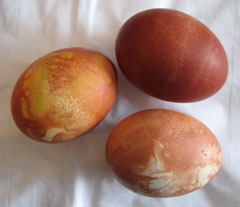
Latvians color Easter eggs using onion skins and other natural materials. (Photo by Andris Straumanis)

The ancient Latvians called the spring equinox Lielā diena, when the day gets longer or lielāka than the night. It is a cause for celebration, of course! As Easter or Lielā diena approaches and the preparations begin, you may be on the hunt for some Easter-related information.

We took the pain out of Googling and have come up with some sites you can quickly scan if you’re planning Latvian traditions in your festivities.

Without going into the Latvian Easter rites in depth, the world-view of the ancient Letts has been distilled down to a few traditions that are still holding strong. Here is a list of Web sites (all in Latvian) to get straight into them:

Egg coloring

Visitors to the agricultural products site www.zemnieks.info can download a a step-by-step guide to egg coloring and Easter basket weaving techniques. Click on the image of the hairy bunny in the right hand column and you will get a Microsoft PowerPoint presentation. It’s great for schools and other folklore activity leaders.

More tips on coloring eggs using natural materials is available on the holiday-themed site Svētki.lv.

For information on other egg-related traditions, visit the tourism site Vietas.lv for the article “Lieldienu olas un olu krāsošana folklorā.”

Pasha, kuličs and other recipes

Ever wondered how Grandma makes Easter delicacies like pasha (also spelled paska) and kuličs? Sixty readers of the Web site Receptes.lv have posted these and other recipes meant for Easter. Don’t even try to sneak them in any other season—you’ll be the laughing stock of the town!

Swinging

Taking a turn on a swing, or šūpošanās, is part of Latvian Lielā diena tradition. Suffice to say that you had better swing high if you want the crops to do well while at the same time avoiding mosquito bites. The folk culture site Māras loks offers information on this and other traditions.

Singing

It wouldn’t be a Latvian holiday without singing. The official Web site of the Latvian folk religion dievturība, www.dievturi.org, offers information on songs related to Lielā diena.

Lesser-known traditions

Among other traditions Latvians enjoy at Easter are olu ripināšana (egg rolling), olu kaujas (egg fights) and prognosticating the future based on weather conditions. You’ll learn about some of these at the aforementioned Svētki.lv, as well as in a section devoted to Easter in the Latvian folklore pages maintained by the Latvian Education Informatization System, and on the Web site of the nationalist political organization Latviešu nacionālistu klubs.

Still want to do your own searching? Don’t forget to check out Google Image Search if you’re still stumped on the nuances of egg rolling and spring swinging. A picture is worth a thousand words!

Details

Daina Gross is editor of Latvians Online. An Australian-Latvian she is also a migration researcher at the University of Latvia, PhD from the University of Sussex, formerly a member of the board of the World Federation of Free Latvians, author and translator/ editor/ proofreader from Latvian into English of an eclectic mix of publications of different genres.