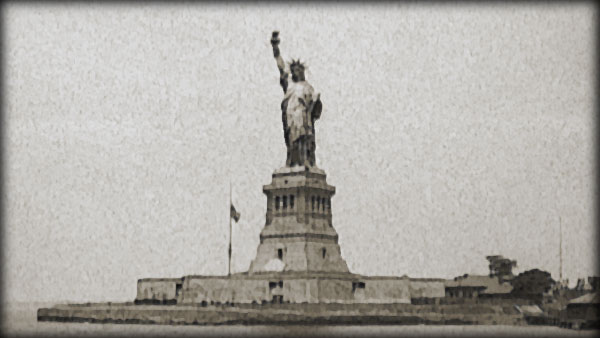
For a Latvian-American living in Rīga, the United States may bring feelings of nostalgia. (Library of Congress, Prints and Photographs Division, Detroit Publishing Company Collection)
One morning in early April I found myself on a shuttle bus bound for Brussels, that brave new center of 21st century Europe. Behind me sat a group of proud Baltic parents who had just flown in to visit their sons and daughters employed as translators and bureaucrats deep in the halls of the European Union.
As we pulled away from the airport, and the Belgian landscape streamed by outside the window, I noticed the changes in foliage—much different from scenes I had left behind that morning in perennially autumnal Rīga.
“Look,” I said to my wife, “the bird cherries are in bloom! Back home they won’t be flowering until at least May!”
My wife tossed back her head and laughed.
“You’re turning into a real Latvian!”
I cringed and sank into my seat, waiting out the rest of the trip in gloomy, mock-adolescent silence.
This was becoming something of an unpleasant trend. The previous fall, I had sat in a Manhattan bar with a friend who, emboldened by a couple glasses of red wine, hollered over the din of organ music: “Your voice, it has this strange accent. You sound almost like… like a Latvian!”
I winced, and struggled to swallow the giant lump that had formed in my throat. But later, when I got back to Rīga, I began to analyze my speech patterns (resulting in an uncanny sense of disembodiment) and did notice something amiss. When I spoke English, acquired and mastered in the gilded heartland of suburban American, my sentences would come out in a jumbled mess of syntax.
“I’m now this interesting book reading,” I would hear myself saying. “Author he grew up in Russia, but living he’s now in New York.” I was beginning to sound like those bad translations of Latvian texts that I often spent my days editing.
“That politician he’s a cretin, but that’s just normal, simply normal,” I would say when trying to explain local politics to friends from abroad. “It’s not anything concrete, actually, but it promotes his… um… his recognizability. Normal. At the same time, these processes are driving us into the swamp. And you definitely won’t find any berries there, my friend. Definitely not. Like running naked through the stinging nettles. No thank you, not in any case, no.”
I had never planned on this happening. But it was the logical outcome of a course set in motion seven years ago, when I moved to Rīga after college. Back then, I spent hours listening to Latvian public radio, trying to get the accent, inflections, emphases and intonations just right. (Misplaced intonations are always a dead giveaway: English-speakers end their questions with rising intonation; a Latvian question goes up a hill and ambles down the other side, like a lost little shepherd in a folksong.) I wanted to avoid becoming one of those clichéd Latvian-Americans who walk around Rīga in polo shirts, chinos, loafers and clunky jewelry, exuding a glaring sense of entitlement and sprinkling their speech with “OK” and “so” and “well” as if they were flashing diamond-encrusted amber rings. I knew all too well that this technique—an attitude masquerading as mere diction—earned you either fawning acolytes ready to follow your every command, or disdainful critics who snickered behind your back. I wanted to avoid both groups, and merely continue where I left off back home: a broke college graduate looking for a job, a Latvian-American more American than Latvian, content to enjoy the best of both worlds.
But when I moved to Rīga, I didn’t realize that a dual identity was difficult to hold on to when you were being canoodled on all sides by one of the pair. Even Hugh Heffner has to choose which of the twins to take to bed, because his weak heart, like my weak will, simply can’t deal with the efforts of pleasing a double. In public, I masqueraded with my two prized possessions—on the left, in the sequined blue dress, Miss America!, and right beside her, in the elegant red gown, Miss Latvia!—but at home I secretly mourned the loss of my American sensibilities and watched with astonishment as Latvian inclinations came to dominate the ménage.
This transition has snuck upon me with cunning stealth, barely discernible at first but then so readily apparent it is almost shocking. The first thing to vanish was my trusty American palate. Like most people of my generation, the cornerstones of my diet had always been frozen pizza, canned spaghetti sauce, boxed macaroni and cheese, and Ramen noodles. When I arrived in Latvia, I was surprised to see that frozen and canned foods were more expensive than fresh produce—contrary to the situation in U.S. supermarkets. People in Latvia ate things like pumpkins, beets, cabbage and summer squash. Soon I, too, grew accustomed to these earthy orbs, served, of course, with a generous dollop of sour cream. Now, whenever I visit the States and gleefully sit down to heaping plates of my old favorites—pizza, burritos and burgers—my stomach churns and I feel queasy for days. Luckily, I’ve lived in Latvia long enough to remember to pack a little bag of coal tablets and dried chamomile buds to ease my troubled vegetable-craving belly.
Also quick to disappear was my American notion of money—how much to attain and what to do with it. As friends from the States moved up in their respective tax brackets, my own wages stagnated at the level of a graduate school fellowship. This is, in fact, the unglamorous side of the current economic recession in Latvia. Lately, foreign journalists have made the country seem like a land of fallen nouveau riche businessmen and greedy credit seekers, but the truth is, wages here have always been abysmally low, at least when compared with the United States. Even in 2007, the height of the so-called “years of plenty,” the average monthly income for workers in Latvia was a mere 398 lats, according to the Latvian entral Statistical Bureau, or about USD 9,000 a year. (The U.S. Census Bureau reports that the average earnings for full-time, year-round American workers in 2007 was USD 40,000.) What is more, many of the infamous euro loans granted by Swedish banks during those years—which are now being blamed for helping to bring down the Latvian economy—were for such commonplace items as lawnmowers, Opel Astras and tiny apartments in crumbling Soviet-era buildings, not Rolex watches, luxury cars and sprawling villas, as the feature news stories would have us believe.
In the United States, however, the prospect of ample pay begets unlimited possibilities for material procurement, and thus high salaries are matched by a never-ending stream of buyable stuff. But here in Latvia, there are no takeout sushi places, cavernous Swedish furniture warehouses or friendly salesmen urging you to upgrade; even in the center of Rīga, it’s difficult to find a restaurant kitchen open after 9 p.m. This makes it much easier to live off an American salary circa 1950. Those old folksongs about spending the evening listening to the corncrakes rasping in the bearded grass suddenly make much more sense: that form of nightly entertainment comes completely free of charge.
When I was growing up, my community was filled with people who had emigrated as young children or teenagers and proudly declaimed their allegiance to Latvia— waving the red-white-and-red flag, belting out patriotic tunes and wearing traditional folk costumes. At the same time, they rooted for the local baseball teams and harbored a distinctly American love for Heinz Tomato Ketchup, Bounty paper towels and ice cold drinks on sweltering summer days. Many of these people, I’ve come to realize, didn’t really belong to either half of their identity. Those who emigrated as children were stuck forever with funny accents when they spoke English; but when they visited Rīga, they were immediately branded as foreigners on account of their distinctly American manner, speech and habits. These curious Kissingers spoke neither Latvian nor English with complete ease, and thus immersed themselves in the diaspora community, that strange world of credit-union board meetings, basement Christmas pageants, parking-lot Midsummer’s Eve celebrations, wooden-spoon workshops and post-church cocktail hours—the only place where they felt completely at home.
Eighteen years after the first wave of re-immigration to Latvia, the mirror opposites of the original Latvian refugees have appeared on the other side of the Atlantic—kindred spirits at a one or two generational remove. Now, Latvian-American children born in America and reared on Nickelodeon, Capri Sun and peanut butter and jelly sandwiches cut like a boat, walk the streets of the ancestral motherland, their adherence to the ways of the West gradually slipping, their speech laced with crude, American-accented Latvian slang rooted in Russian expressions that would make their grandmother’s hair stand on end: besī ārā and davai and moška and piļīt and bļaģ…
As for me, I’ve compensated for my growing Latvianness by quietly nurturing a boundless and unshakable love for the lost homeland, in my case America. What Rīga was to my grandparents, New York City has become for me, “idolized all out of proportion, no, make that, romanticized all out of proportion,” as Woody Allen says in the opening scene of Manhattan. This fantasy of an improbable Eden, far away and unreachable, balances the whole act and holds all the strings together. Without it I would be hopelessly adrift in Latvia: I’d start catching colds from drafts, drinking piping hot tea on balmy summer days, covering my television with a crocheted mat and burning the meadows of fallen grass in early spring. And so I dream, inexplicably, increasingly impossibly, of re-immigrating, of re-re-immigrating, returning again for the first time. Of closing the circle and beginning a new one.