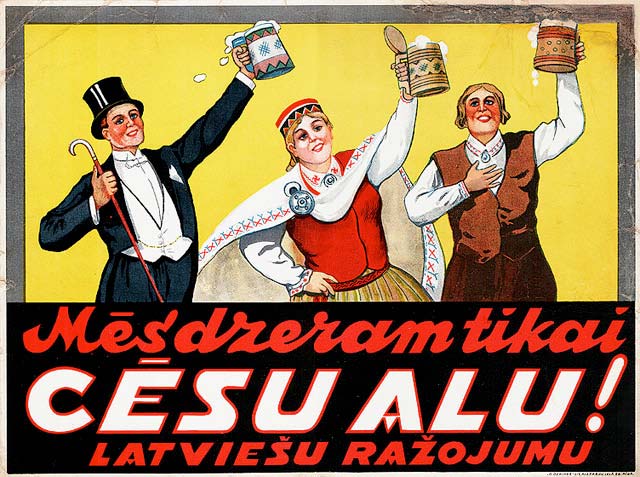
An advertising poster for Cēsu alus, dating from 1935.
If there’s any beverage that can claim to be Latvia’s national drink, it’s beer. Hundreds of dainas and folk songs about beer have been passed down through the centuries. Beer has always been consumed by Latvians. It has accompanied Latvians through life’s joys and sorrows. Sadly, it has also brought much despair as many have taken to beer and alcohol to escape life’s burdens.
Beer is not a uniquely Latvian drink. It is common to many agricultural societies. The origins of beer are murky. Like other alcoholic beverages, it was probably discovered by accident when harvested grains were left outside in the rain and wild yeasts did their magic to produce a mildly intoxicating beverage that has evolved into what we know today as beer.
At the time of conquest by German crusaders in the 13th century, beer was well known to the Latvian tribes. It is mentioned in crusader chronicles. Beer was a weak beverage brewed both for festive occasions and day-to-day consumption. The Latvian name for beer is alus and it shares a common etymology with other European languages—English ale, the Swedish term ol or Finnish olut. Beer or alus should not be confused with mead or miestiņš, an alcoholic beverage made from honey, or medalus, where honey is added to beer. All three were known to ancient Latvians.
The German conquest saw the fusion of Western European brewing traditions, largely developed in monasteries during the Middle Ages, with the more primitive techniques of the Latvian tribes. Brewing was carried on in the monasteries and castles of Livonia. Many of the workers employed by the German nobility and monks were Latvian. Invariably, western techniques made their way into home brewing, which was still allowed unlike other parts of Western Europe. According to Linda Dumpe, author of Alus tradicijas Latvijā (Beer Traditions in Latvia), this allowed many traditional home brewing techniques to survive in Latvia until the modern era. But various herbs that had been used in brewing were now displaced by hops as a preservative and flavouring agent.
Beer was a profitable commercial good for both the German estates and mercantile class in the cities. The Large and Small Guilds in 14th century Rīga quarreled over exclusive rights to brew beer. Of note is the establishment of the Beer Porters Guild in Rīga in 1396. The guild survived into the 18th century but by that time it had been renamed as the Wine Porters Guild. Two porters would carry a beer barrel (an invention that also allowed beer to completely ferment in a closed vessel) hung from a carrying beam from brew houses to taverns and households.
Taverns in Latvia played a key role in the history of beer. Their development is described by Arno Teivens in his book Latvijas lauku krogi un ceļi (Latvia’s Country Taverns and Roads). They were the primary outlet for estates to sell beer. Taverns sprung up by the roadside, often at crossroads or near river ferries, to provide travelers with food, lodging and beer. They evolved into long structures with a large room for commoners and a smaller room for the gentry. Some of these taverns can still be found in Latvia, albeit converted into residential dwellings or commercial stores. As elsewhere, taverns in Latvia were the first public halls (the word pub is derived from public house) where landowners and peasants alike could meet. Taverns were often pressed into service as courtrooms or for administrative sessions of the municipal government. During the Swedish reign over Vidzeme, taverns served as postal relay stations providing fresh horses for couriers. Surprisingly, most innkeepers were Latvians.
Taverns also sowed the seeds of political dissent as travelers from the west to points east in the Russian Empire brought news of the Enlightenment and revolution sweeping Europe. The leaders of the 1802 Peasant Uprising in Kauguri plotted over a tankard of beer in a tavern at Brenguļi. The ideals of the National Awakening were discussed at taverns throughout Latvia. Taverns also served as venues for musicians, choir rehearsals and theatre performances. In the purges that followed the 1905 Revolution and in retribution for attacks on their manors, the German gentry razed many taverns, which had been used as countryside meeting places for revolutionaries.
In the latter part of the 17th century, many country estates shifted production from beer to spirits. The reasoning was simple. Profits were five times greater. By 1860 in Vidzeme for example, there were 198 breweries but 247 distilleries and more than 2,400 country taverns. The spread of spirit consumption coincided with ever-increasing repressions of the peasantry by the German nobles and Czarist Russia. It also saw many Latvians sink into despair and alcoholic haze. The rise of Hernhute congregations or Brālu draudzes in central Vidzeme between 1730 and 1749 was a reaction to these repressions and the spread of alcoholism. The German landowners pressured the Czarist administration to shut down the congregations, partly because revenues at their taverns plummeted.
The 19th century brought the Industrial Revolution to Latvia. Large mechanized breweries sprung up in the cities, particularly Rīga, and were able to brew better beer and sell it for less. They replaced small country estate breweries that had employed only a few workers and brewed on average 4,000 buckets (1 bucket equals 12 litres) a year. They could not afford the capital investments required to upgrade. In the second half of the 19th century, 26 new modern breweries were built but many older ones folded. In the 1860s there were 147 breweries in Kurzeme. By the end of the century the number had dropped to 50. The boom in railway construction and building of regional warehouses allowed beer from cities to the distributed throughout Latvia. Prior to World War I, beer from Rīga was even sold in places as far as Warsaw, Baku and Vladivostok.
Beer styles brewed in the late 19th century included Porter, Honey Beer, Bavarian, Pilsner, Munchener, Table, Export, Light, Dark, Bock and March beers. Porters were sold in separately in Porter salons.
Standard size bottles were introduced in 1842. This was done to make collection of excise taxes easier for the Czarist administration. Bottle sizes were denoted in 1/16, 1/20 and 1/40 bucket units. Bottles were a significant expense for breweries. Nineteen Rīga area breweries in 1906 imposed a deposit on bottles to encourage consumers to return them. The cost of beer at that time ranged from 80 kopecks to 1.10 rubles and the deposit for each 1/20 bottle was 4 kopecks.
The first industrial brewery in Rīga was Kimmel, founded in 1815. Like many factories, its machinery was evacuated to the Russian hinterland during World War I, in this case to the city of Toropets. In 1924 Kimmel was Latvia’s largest brewery and it survived until 2007 after production had been moved to Adaži in 2002. Its structure is still standing in Rīga on Bruņinieku street.
The Waldschlossen Brewery was established in 1865 in the industrial Rīga suburb of Sarkandaugava. In 1906 it hosted the European Brewers Congress, testimony to Rīga’s position as a well-known brewing centre. Waldschlossen Brewery shut down operations during World War I. It was resurrected in 1937 as Aldaris when the Kārlis Ulmanis government forced a number of breweries to amalgamate, breaking up a cartel that had kept beer prices artificially high. Today, Aldaris is Latvia’s largest beermaker. The old 19th century tower brewery where beer moved from top to bottom through various stages of brewing with the help of gravity still stands next to the modern plant.
Other breweries established in Rīga in the 19th century included:
- Iļģuciems, founded in 1863. It survives today as a producer of kvass, a popular non-alcoholic East European drink made of fermented rye bread.
- Kuncendorf (1825).
- Stritzky (1854).
- Josef Hindel (1865), which survived until the 21st century under the banner Vārpa before ceasing operations.
- Livonia (1870).
- Tannhauser (1875), which was one of the breweries folded into Aldaris.
- Classen (1875).
- Lovis (1879-1907).
- The short-lived Bertels (1883-1888) and Jozefi (1887-1892).
Further afield, the Daugavpils brewery, renamed Latgales brewery in modern times, was established in 1860, a year before opening of the Riga–Daugavpils railway. It was brewing up until recently.
Gulbenes Brewery, which stopped producing beer in 2008, was founded as Alt-Schwenenburg Bierbrauerei in 1824.
The Lodiņa brewery was established in Bauska in 1873 and survived until 1958 after the descendants of the German founder had repatriated to Germany in 1939. The brewery was resurrected in 1998 in its original facility. It is an example of the fine 19th century industrial architecture that can still be found in Latvia.
Like many things, beer brewed in Latvia during the Soviet era was nondescript. The breweries lagged by Western standards and the quality of their beer was poor. It would quickly sour. Several of today’s better known breweries were founded in Soviet times on the backs of collective farms: Lāčplēša (1949), Tērvetes (1971) and Bauskas (1981). A number of breweries were able to attract capital and modernize when Latvia regained independence in 1991.
As a footnote, a brew with the name Senču (Ancestor), was produced by most Latvian breweries during Soviet times. Use of the name is similar to use of the term “country style” in North America for products rather than being a true beer style. Today, the Tērvetes, Piebalgas and Bauskas breweries produce their own Senču.
Latvian Scrabble players should take note of a rich brewing vocabulary. Terms include mieži (barley, the primary grain used to brew beer), apiņi (hops, a preservative and bittering agent), raugs (yeast), iesals (malt, grains that have been allowed to germinate converting starches into fermentable sugars), iejava (mash, a mixture of malt and water heated to extract fermentable sugars), misa (wort, the resultant liquid that is then boiled to produce unfermented beer), raudzēšana (fermentation, yeast plus fermentable sugars produce carbon dioxide and alcohol), pēcraudzēšana (conditioning) and ogļuskābe (carbon dioxide). Brewing implements include tīne (a wooden container used to store malt), čerpaks (a large ladle) and zlauksts (a long wooden vessel used to heat wort).
Today, Latvia’s breweries face the same challenges as those elsewhere. At one end of the spectrum there are large breweries, often part of well-capitalized international conglomerates. At the other end are microbreweries with niche products. In between regional breweries are being squeezed out by the two, unable to compete with the big guys on price yet too big to be daring and innovative.
Aldaris is Latvia’s biggest brewer with approximately 40 percent of the market. It is now part of Denmark’s Carlsberg group, which through its Baltic Beverages Holdings subsidiary has breweries in each of the Baltic states and Russia.
In 2004, Denmark’s Royal Unibrew purchased Lāčpleša brewery. Liepāja’s Līvu alus, founded in 2000, was also acquired in 2008. Production was consolidated and Lāčpleša beer production was moved from Lielvārde to the plant in Liepāja.
Cēsu brewery rounds off Latvia’s big three. It is part of the Finnish OLVI Oy group, which also includes sister breweries in Estonia, Lithuania and Belarus. Cēsu Brewery claims it is the oldest in Latvia and traces its roots back to the founding of an estate brewery in 1590.
The Brenguļu, Krāslavas, Valmiermuižas, Lodiņa and Alus tirdzniecības grupa operations can be classified as microbreweries. The Užavas brewery started as a microbrewery and had a near cult following. Since moving in 2001 to a new plant in Ventspils from Užava, it has expanded rapidly. The Lido entertainment complex in Rīga houses Latvia’s only microbrewery.
Bauskas, Tērvetes, Piebalgas and Inčukalna breweries are somewhere in the middle. Tērvetes brewery is part of a large agrofirm southwest of Rīga. It is trying to carve out a niche for itself through Green Spoon (Zaļā karotīte) certification, which is a national program that certifies products produced with at least 75 percent local raw materials. In Tērvetes case, only the hops are imported.
Looking at the beer section of a large supermarket in Rīga, it may appear that there is a huge selection. Unfortunately that is not the case. The majority of beer brewed in Latvia is a pale lager brewed with bottom fermenting rather than top fermenting yeasts as is the case in Britain and Belgium, broadly in the export or pilsner style. Tumšais or dark beers are less hoppy and sweeter but they are really only amber coloured.
Aldaris gets credit for continuing to brew a strong dark Baltic Porter, a beer style that has a rich history going back to the court of Russian Czarina Catherine II and 17th century London. Cēsu brewery also brews a porter on a periodic basis. Brenguļu brewery produces two unfiltered and unpasteurized draft beers that come closest to Britain’s real ales. Until recently one had to head out to Brenguļi near Valmiera to savour the company’s beers. Several outlets in Rīga have now opened where the consumer can purchase draft beer from a number of breweries, including Brenguļi. The beer is poured right from a barrel into plastic bottles for home consumption.
Perhaps the most adventuresome brewery in Latvia is Alus tirdzniecības grupa. Originally founded in 1993 as Sandriko Brewery and based in Spilve on the outskirts of Rīga, the brewery makes Latvia’s only wheat beers. Its signature line consists of ginger-flavoured wheat beers that include a light, reddish and black brew. In 2009 it released a cherry-flavoured wheat beer.
Most Latvian breweries today are trying to compete with each other with similar products. It is difficult for the smaller players to match the big breweries on price point.
For those abroad who can’t make the trip to Latvia and wish to sample a Latvian beer, the best chance is locating one of the brands produced by Aldaris, most likely the mainstream Zelta or Luksus beers, although Porteris and the odd beer from other breweries has may be found. Being part of a large international conglomerate does have its benefits and allows Aldaris to leverage the distribution network of its parent company providing beer drinkers in other countries the opportunity of connecting with a proud brewing tradition dating back centuries.
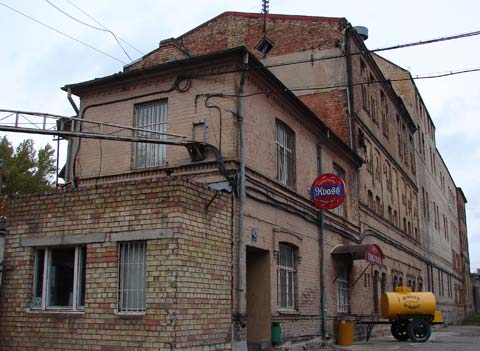
The 19th century Ilģuciems brewery now makes kvass. (Photo by Viesturs Zariņš)

A newspaper advertisement from 1906 promotes the Livonia brewery’s Pilsener beer.