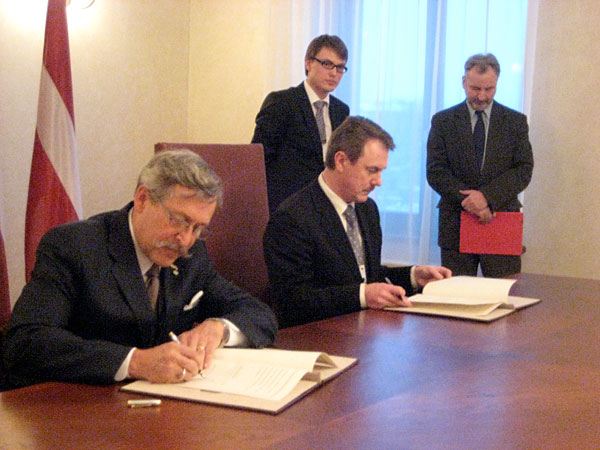
Mārtiņs Sausiņš (left), chairman of the World Federation of Free Latvians, and Foreign Minister Ģirts Valdis Kristovskis sign a cooperation agreement Jan. 6 in Rīga. (Photo by Andris Straumanis)
Although details have yet to be worked out, Latvia’s Foreign Ministry plans to improve its cooperation with diaspora communities under an agreement signed Jan. 6 in Rīga.
The two-page document was signed by Foreign Minister Ģirts Valdis Kristovskis and Mārtiņš Sausiņš, chairman of the World Federation of Free Latvians (Pasaules brīvo latviešu apvienība, or PBLA).
“In truth, it is a big surprise to me that we are just now signing this cooperation agreement,” Kristovkis said in a press conference following the signing ceremony in the Foreign Ministry. “Cooperation between Latvia and the PBLA has been strong and very substantive and valuable for many years.”
The agreement calls on the two sides to foster Latvian language and culture, as well as to strengthen the diaspora’s participation in the homeland’s political life and economy.
The agreement also is in line with the new government’s declaration, Kristovskis said. Among goals of Prime Minister Valdis Dombrovskis’ coalition is strengthening Latvians’ ties with the homeland and supporting their return to Latvia.
The Foreign Ministry will be the main contact point for the diaspora’s collaboration with government institutions, non-governmental organizations and private individuals, according to the agreement. The document, Kristovskis said, will give the diaspora a measure of continuity when dealing with the Latvian government. In recent years responsibility for dealing with the diaspora has been shared at times by the Foreign Ministry, the Justice Ministry, the Education Ministry and the former Secretariat of the Special Assignments Minister for Social Integration Affairs.
Sausiņš agreed, noting that the PBLA “finally feels at home.”
The next step, he said, is completion of a strategic plan between the PBLA and the Foreign Ministry.
Among the questions the two sides are discussing is the issue of allowing dual citizenship. A last-minute bill seeking to amend Latvia’s citizenship law was introduced in October during the last Saeima, but failed to garner support. Kristovskis said a new bill will address shortcomings of that bill and is expected to be introduced soon in the 10th Saeima. The board of directors of the Unity (Vienotība) bloc, of which Kristovskis is a leader, declared in July that Latvia’s citizenship law should be amended to allow dual citizenship for Latvians living abroad, for Latvian citizens who are working long-term abroad, and for descendants of Latvian citizens who were born abroad.
In time, Kristovskis added, the Latvian government might be able to again finance projects to support the diaspora. The integration affairs secretariat provided tens of thousands of lats in aid to Latvian diaspora organizations before it was shut down as part of downsizing of government.
The PBLA’s representative office in Rīga may become busier as people turn to it as a result of the agreement with the Foreign Ministry, Sausiņš said.
Andris Straumanis is a special correspondent for and a co-founder of Latvians Online. From 2000–2012 he was editor of the website.