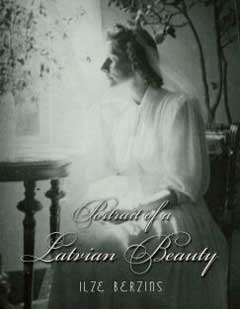
Portrait of a Latvian Beauty, a book of 113 pages and more than 120 photographs, presents a powerful visual odyssey of a Latvian refugee family after it is forced to leave Latvia for Germany and then Canada.
The author, Ilze Berzins, focuses on her mother’s story and provides a vision of the past as perceived by the “Latvian beauty” through many of her life’s wrenching changes.
In general one can trace very similar patterns for thousands of Latvian refugees who fled from the menace of the Red Army and a Stalinist occupation with all of its death threats and repressions. To be sure each family’s story has its own unique characteristics. This particular story is coloured in part by the reminiscenses of a dutiful daughter, intermingled with a touch of hero worship and a certain innocent nostalgia for a lost mythical paradise whose images have been passed down from one generation to the next.
The mother, Ilze Henriette Bērziņš (née Beldavs), was born in the Russian Empire in 1912, and died in Canada in 2008. Ironically, at the age of three, her family fled into Russia, running away from the Germans, but in 1944 she was forced to flee to Germany, running away from the Russians. This aspect of Latvia, as a major crossroad for foreign armies and killing fields, is briefly but well captured by the author in her broad overview of Latvia’s history.
The idyllic life of her mother in pre-war Latvia is described in almost poetic paragraphs. The mother spent winters in the city of Valmiera, a historical jewel on the banks of the Gauja river, but her most fervent emotional attachment was to the summer residence near Stende in Kurzeme, called Bēķi. Indeed the first chapter in the book describes the mother’s first trip by herself to Bēķi, recounting emotions and details which no doubt the author has heard countless times in the family’s kitchen.
The memory of Bēķi suffuses the book and the book well describes the dream-like impact and the virus-like contagion of such a mystic vision:
The sun always shone at Bēķi. Despite her beautiful gardens in Canada, Bēķi always remained for my mother her special enchanted place, shining all her life with untarnished nostalgia. From her rose-tinted storehouse of memory, an idyll emerged and I too became enchanted by Bēķi.
This dream of course could not survive reality and certainly not the heavy burden of Bolshevik kolhoz imprimatur. Indeed throughout all Latvia this period of occupation has left the most ugly scars and broken cement jetsam in the countryside where once natural beauty reigned. The author visited Bēķi after Latvia’s independence and was glad that her mother had not seen the devastation.
Nevertheless this corner of paradise provides the bookend statement of the importance of Bēķi. A superimposed photo of a young girlish mother walking above the tree tops is framed by the dream of Beki as stated in the mother’s “own words”:
I have been promised that, when my turn comes, I will be taken to Bēķi and to our ancestral resting place where my grandparents lie, and my parents, and my beloved husband. There I will again be free to race with the wind through the fields and meadows, wander the burgeoning woods, and then, when exhausted, happily throw myself down in the orchard under the fragrant apple trees and turn my gaze up to the limitless sky.
The book’s clear advantage is its compact nature. It can be offered to friends or younger family members who would otherwise not read a bigger and fuller tome. It offers a visual and punchy answer to anyone asking “how did you (or we) end up in Canada?”
The photographs alone provide a portal into a lost world of ancient Latvia and the Displaced Persons camps of Germany where Latvian culture pulsated as never before or after. No doubt many will be surprised by the elegant clothing worn by Latvians in czarist and independence days. Only Bolshevik anti-bourgeois ideology was able to dent this tendency for Latvians to present themselves in the best garb. One photo in particular intrigued me. As a result of wartime fuel shortages, a vintage family car was outfitted with a gasification carburetor enabling wood to be used for the internal combustion engine. Is this the next big idea that could counter the demands of a $300 oil barrel?
On a personal note I should point out a certain resonance of the experiences of my own family that parallel those of the author’s descriptions. The author’s parents met as agronomy students and married May 31, 1941. My father (born in 1914) also studied agronomy and did his practicum duties at Auce. Indeed, he might have attended the same classes. My parents married in June 1941, immediately after the Soviet army retreated ahead of Nazi Germany’s “Operation Barbarossa.” Turbulent times did not allow for the luxury of drawn-out trial “common law” cohabitation. Our family also boarded a ship from Liepāja, braving the Soviet attack planes and submarines to reach DP camps in Germany. Our trip to Canada was also rough and sea sickness was rampant. I also remember the first view of Canada at Halifax, when our ship docked at the same Pier 21 described by the author as the equivalent of Ellis Island in the United States. I do remember the ugly warehouse building of Pier 21 now a recognized historical memorial. Thereafter the view of Canada from the train window improved immeasurably with the alternating fields and forests and the many waving schoolchildren. Finally I share a common year of birth with the author and can visualize many of the described events from a similar age platform.
While the book has many positive qualities, one can always find room for alternative approaches. For example, the introductory chapter could have been better placed after the next chapter, which outlines the mother’s essential background and ancestry. The second half of the book dealing with Germany and Canada seemed at times uninspired although providing some individual masterful paragraphs. The reader is also left to guess about the last few years of the mother’s life when she became more “difficult.” Given the title it is obvious that the mother would receive the most attention. Nevertheless the father, who is mentioned almost en passant seems deserving of a much larger part in the book. Indeed, his diary and his numerous photos form the basis of much of the book’s content.
One index of the strength of attachment to Latvia by the author’s parents is the retention of the original Latvian names by their children. The author’s brother, who became crown attorney for Canada’s capital region, was frequently seen on Canadian television as Andrejs Berzins rather than “Andrew,” which was a common practice among many intent on blending in. Similarly the author herself has retained her original Latvian version of Ilze.
In conclusion I should mention that Ilze Berzins has written many books. One of these, Happy Girl, dealt with her return and experiences in Latvia. The murder mystery Riga Mortis was a book I could not lay down before having read it from cover to cover.
Details
Portrait of a Latvian Beauty
Ilze Berzins
Ottawa: Albert Street Press, 2009
Notes: The book is available from the author’s website, www.ilzeberzins.com.