Jurjevics sets second novel amid war, corruption in Vietnam

For 14 months from 1967-1968, Juris Jurjevics served as part of American forces in Vietnam. He used that experience as background for his soon-to-be-published second novel, Red Flags.

The book is the story of Erik A. Rider, an Army cop who is sent to the Central Highlands to help stop the flow to the North Vietnamese of cash that is being generated from the opium smuggling. The story begins when, 40 years after the war, Rider is visited by the daughter of his former colonel. Some say Rider was involved in the colonel’s death.

From the back cover publicity:

Rider lands in Cheo Reo, home to hard-pressed soldiers, intelligence operatives, and profiteers of all stripes. The tiny U.S. contingent and their unenthusiastic Vietnamese allies are hopelessly outnumbered by infiltrating enemy infantry. And they’re all surrounded by sixty thousand Montagnard tribespeople who want their mountain homeland back.

The Vietcong are on to Rider’s game and have placed a bounty on his head. As he hunts the opium fields, skirmishes with enemy patrols, and defends the undermanned U.S. base, Rider makes a disturbing discovery: someone close to home has a stake in the opium smuggling ring—and will kill to protect it.

Red Flags is due out Sept. 20 and is being published by the Houghton Mifflin Harcourt Company.

Jurjevics was born in Latvia and came to the United States after World War II along with thousands of other Displaced Persons. After his stint in Vietnam, he began working for publisher Harper & Row. Among other positions in the publishing industry, Jurjevics also co-founded New York-based Soho Press and led it for 20 years.

Jurjevics’ first novel was The Trudeau Vector, published in 2005 (see our review, Death under the northern lights).
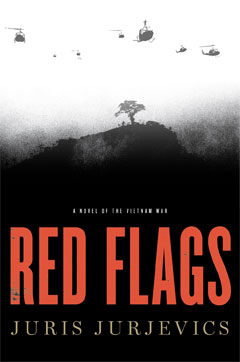
Red Flags

Where to buy

Purchase Red Flags from Amazon.com.

Note: Latvians Online receives a commission on purchases.

Andris Straumanis is a special correspondent for and a co-founder of Latvians Online. From 2000–2012 he was editor of the website.

Absentee ballot applications drop 40%

A total of 539 citizens have applied to vote by mail in the Sept. 17 parliamentary election in Latvia, according to data compiled by the Central Election Commission in Rīga. That is a nearly 40 percent decrease from the 890 persons worldwide who planned to cast absentee ballots in the last Saeima election.

Applications to vote by mail were due Sept. 2 and could be submitted to any of 21 Latvian embassies or consulates around world.

The greatest number of applications—174, or about 32 percent of the total—were received by the Latvian Embassy in Washington, D.C.

The Latvian Embassy in Oslo, Norway, was second with 121. That number typically includes Latvia’s soldiers serving in Afghanistan.

Third was the Latvian Embassy in Bonn, Germany, which received 83 absentee ballot applications.

The embassies in London and Stockholm both received 36 applications. The embassy in Ottawa, Canada, got 30 applications.

The embassies in Azerbaijan, Greece, Israel, Russia and Turkey received no absentee ballot applications, according to the election commission’s data.

Persons who applied for absentee ballots had to complete an application form and send along their current Latvian passport. Absentee ballots were to be mailed to applicants between Sept. 3-7.

Andris Straumanis is a special correspondent for and a co-founder of Latvians Online. From 2000–2012 he was editor of the website.

Vīķe-Freiberga to receive Medal of Freedom in Washington ceremony

Former Latvian President Vaira Vīķe-Freiberga will be one of two recipients of this year’s Truman-Reagan Medal of Freedom, the Victims of Communism Memorial Foundation has announced.

Vīķe-Freiberga is scheduled to receive the honor Sept. 8 during a ceremony in the Latvian Embassy in Washington, D.C. The other recipient, U.S. Rep. Ileana Ros-Lehtinen, a Republican from Florida, will be attending a joint session of Congress and will receive her medal at a later date.

The medal is awarded each year to individuals and institutions that have demonstrated a life-long commitment to freedom and democracy and opposition to communism and all other forms of tyranny, according to a press release from the foundation.

Vīķe-Freiberga served as Latvia’s head of state from 1999-2007 and was the first woman president in post-communist Eastern Europe. Born in Latvia in 1937, she and her family fled to the West during the Second World War. Vīķe-Freiberga is a professor emerita of psychology from the University of Montreal in Canada. With her husband Imants she now runs the Rīga-based VVF Consulting, a firm that specializes in international relations, diplomacy, science, politics and negotiations.

Ros-Lehtinen, chair of the House Foreign Affairs Committee, in 1989 became the first Hispanic woman to serve in Congress. She fled her native Cuba as a child. According to the foundation’s announcement, “During her two decades of Congressional service, she has been a staunch defender of human rights around the world and a sharp critic of Fidel Castro’s dictatorial regime.”

The Victims of Communism Memorial Foundation was established by Congress in 1993 to build a memorial in Washington to commemorate the more than 100 million victims of communism. The memorial was dedicated in 2007. Two years later, the foundation launched the online Global Museum on Communism.